Alice Sabo is about to release the third book in her A Changed World series. We have talked to her about the series and the new cover designed by Alex Storer.
Gleanings is the 3rd book in your Post-Apocalyptic A Changed World series. Can you tell us a bit about the series?
A Changed World has two things working on it—extreme weather in the form of superstorms, and a virus that has decimated the population. The virus comes back every year like a flu and takes more people. Ten years on, the survivors are trying to become self-sufficient in a modern world that is severely underpopulated. And because no one can be sure to survive, knowledge and skill is a precious thing.
What new goals did you set for yourself with Gleanings?
I needed to expand the setting a little. I think some of my own anxiety shows up in a character that doesn’t want people to spread out. There is a certain dynamic that happens when all your characters live in the same building. Also, I needed to wrap up a storyline about a man searching for his brothers. By the end of Gleanings, all the brothers will be at High Meadow.
And in general, I am always learning, trying new skills. Every book under my belt improves my ability to tell a good story.
What is it about the Post-Apocalyptic setting you find fascinating?
Basically, you can make up any world, and it will work as long as you can create a feasible setup. I think there is a certain appeal to stories about picking up the pieces and looking for solutions. When you strip away the conventions of modern society, you can go just about anywhere.
I read a story about an EMP blast, and the people went absolutely crazy afterward. That partly inspired me to write the opposite. Not everyone will go feral, killing for a can of beans.
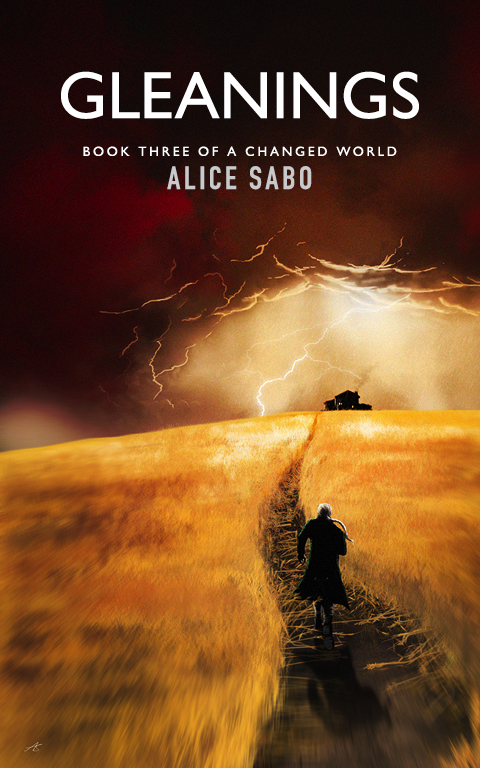
New book and a new cover. Can you tell us a bit about the new book cover?
This book is dealing with expectations and reality. Here is a beautiful field of grain with a tornado on the horizon. Will there be any grain left to harvest tomorrow? That’s an important question for the survivors. You can plant in the spring and plan for the harvest, but there is never a guarantee.
I love the running man. My readers will recognize Wisp’s long white braid. When Alex added the man, I knew it needed to be Wisp.
How do you work with the artist from an idea to the final result? Is it a very interactive process?
Working with Alex is a very interactive process. I am always amazed at how he can take my ramblings and turn them into a beautiful cover. Sometimes I have a very specific image in my head, and we go back and forth until he understands what I’m looking for. Sometimes I send him random images that I download from the internet with notes on them to help illustrate what I’m imagining. With this cover, I was totally at a loss. We emailed back and forth quite a few times before the field emerged. And then he really surprised me with the other elements, but I think they work perfectly.
What do you personally feel is most important in a book cover?
First of all, I think a cover should scream out the genre. If you aren’t famous, readers don’t automatically know your genre. When I’m skimming through books, the cover gives me the first impression. A castle, dragon or starship tells me exactly what to expect. It might be a cliché, but it is also how our brain works. I think it should also give you the tone. There’s a big difference between a starship blasting another out of the sky, and a ship that is flying in for a landing on a green planet. They both might be space opera, but the first one is probably more military leaning while the second is probably about cultures, first contact or colonization. I’m not a fan of space battles, so I would skip that book.
In a world with information bombarding us every day, I think it counts to make things easily identifiable. The cover of the first book in the series has a tornado on it, but I was concerned that people would think this was a weather-disaster story. So Alex added elements to the title that hinted at disease. That helped explain that there were two elements to the story.
You have a Bachelor in Fine Arts. Is that something you feel influences how you view book covers?
Absolutely. I figured it would be easy for me to create my own book covers. The first couple was fun until I compared them to those that were professionally made. Not only is there a steep learning curve for the better software programs, but there is a lack of experience that inevitably shows. Art is all about learning to see in a certain way. Graphic art has a slightly different skill set than a watercolor painter like me. I could probably take some courses and learn the skills, but I’d rather be writing.
Having tried my hand at it makes me truly appreciate a well-executed cover.
What’s next for the series and do you also have more new and exciting projects you’re working on?
Right now I have a lot going on. It’s a very exciting time. I’ve been writing and publishing since 2012, and this year things are finally starting to take off.
The next book of A Changed World will deal with a new group of people that live at a college. There will be some big changes when they meet the folks from High Meadow.
Lethal Seasons, the first book of A Changed World, was accepted into a boxed set, Apocalyptic Fears III, which is available on Amazon.
And a short story of mine has been added to a post-apocalyptic anthology, Apocalyptic Fears 6, also available on Amazon. It is a story that was first inspired by the SARS epidemic in China and then changed along the way.
I’m also working on a space opera series, Transmutation, about an extrasensory-gifted species that has been hiding in plain sight for centuries. Book 1, Façade, came out in April. I have book 2 planned for April 2017.
There is also a fantasy series in the works. I am outlining a prequel novella and at least a 3-book series.
* * * * * * *
Interview by Dag Rambraut – SFFWorld.com © 2016