“Somewhere on the outer rim of the universe, a mass of decaying world-ships known as the Legion is traveling in the seams between the stars. For generations, a war for control of the Legion has been waged, with no clear resolution. As worlds continue to die, a desperate plan is put into motion.”
We have talked to Kameron Hurley about her new stand alone space opera novel, The Stars are Legion.
First of all can you tell us a bit about this new world you’ve created in The Stars are Legion?
The Stars are Legion is part space opera, part thriller, about two warring families battling it out for control over a legion of organic starships. I wanted to create a truly autonomous, living system of ships that could live and even reproduce in the vacuum of space on the way to… wherever they were going. I imagined them like this giant organic liferafts that would hurl onto the surface of some planet and then the creatures and bacteria and people in them would use the world as a stepping stone to basically terraforming the planet – and themselves to suit the world over vast time scales. The vastness of space, and the time scales involved, are one reason why we see so much hand-waving with wormholes and “hyperdrives” and such, because it’s difficult to imagine how we could realistically move through space and come out the other side intact. So I created worlds with their own ecosystems, where the people who started the journey are quite likely to be very different from the people who end up on the other side a thousand years later.
Right from the start you’re gripping the reader with the mystery surrounding Zan’s memory loss and then you’re brining us on a journey… What was important for you when you created your main characters Zan and Jayd?
Certainly I needed two very compelling first-person narrators. I also had to be able to have a character who held her secrets pretty close to the vest, in the case of Jayd. As much as possible, I wanted the reader to figure out Zan’s backstory at the same time Zan did, which is what inspired the first person present tense.
I must say that the uniqueness of what you have created with The Stars are Legion is quite staggering. Is it important for you to always bring something unique into your storybuilding?
It is. I read and write speculative fiction because I want to go someplace really different. If all you’re doing is putting people with the same thoughts and feelings and challenges as we have now onto a starship that’s just like a 1970’s starship, that’s just not as appealing to me as that… sense of wonder. I want to be constantly in awe of the possibilities of the universe. I’m always striving to remix old tropes and ideas into something really new.
Why did you want to do this as an all-female universe?
Why not? I had never seen it done before. Turns out the idea blended pretty seamlessly with the worldbuilding in the story, so it felt natural to the writing of it.
How did you come up with the organic tech? It’s not for the squeamish is it?
It’s not. My editor did ask me if I wanted to tone down the gore in one particular scene (the infamous chapter 14) and I was like, “Nope!” The truth is that our meat-bag bodies are pretty squicky and sloshy and gross. I’m intrinsically tied to my body, as is everyone, but having a chronic illness and constantly dealing with issues related to fertility made me realize just how gooey we all are, and that comes out on the page. One of the things that’s tough to get away from when you launch us into space is our meat suits. A lot of people solve this by putting us into augmented bodies, or uploading our consciousness to some main frame. But hardware is also prone to eventual degradation and malfunction. I wanted to take our greatest weakness – our bodies – and turn them into our greatest advantage in getting to the stars. We already know that there are some living organisms that can withstand the vacuum of space. It’s no crazier to think we could change our own bodies in some way than it is to say we could create a hyperdrive.
You’ve written both fantas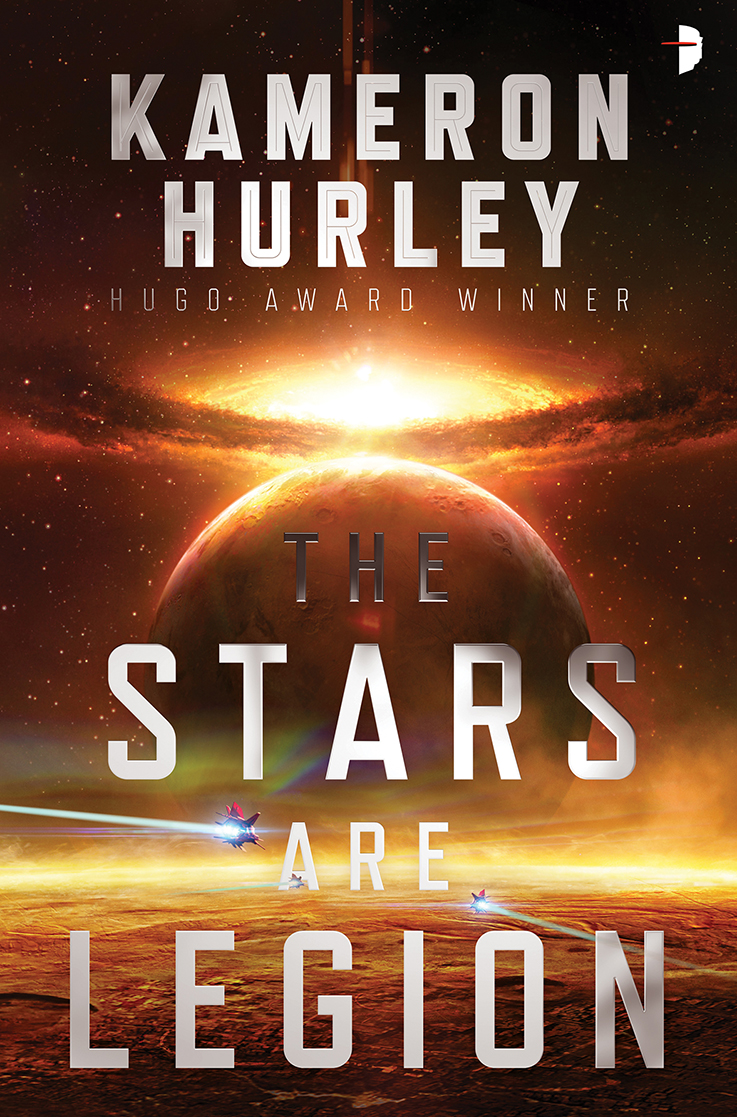 y and science fiction in the past. Is it refreshing to start something entirely new like this?
I’d argue this fits are more into science fiction than my God’s War trilogy, for sure! The most refreshing part is writing a stand-alone book. This is the first fiction book I’ve written that’s meant to stand on its own. I really enjoyed just doing a one-and-done.
Did The Stars are Legion turn out as you originally imagined when you got the idea?
Ha! Not at all. I originally came up with this idea back in 2010 or 2011, right after I finished writing God’s War. It was originally going to be a much weirder book (if you can imagine). Much more family politicking, less adventure-oriented. But I found myself throwing the reader into the soup in much the same way I had with God’s War, and it was just overwhelming for some people because the world is so gross and different. I really had to figure out how to ease people into it. My editor calls the first 50 pages of any really dense spec fic book “The Gauntlet,” and I’m well-known for my gauntlets, which I knew was costing me potential readers. I wanted to keep my weirdness, but make my work a little more approachable. So, I switched from third person past to first person present, shifted to two narrators instead of 3-4 POV characters, and reworked the whole plot from a family saga to this adventure where Zan is literally crawling through layers of the world trying to figure out who she is and remaking herself along the way. There’s a reason the “amnesiac in space” trope exists, and I think I used it really successfully here, or at least I have according to all the readers who say they’re cruising through the book. People are reading this really fast, which pleases me. I tried to write a page-turner, and it looks like I did pretty well with that.
What’s next, are there any new and exciting projects you are working on at the moment?
There are! I’m typing madly on The Broken Heavens, which is the third and final book in my Worldbreaker Saga. It’s been agony trying to get this one out, and it’s due to my publisher in April. It’s a race to see if that will happen. I also have another stand-alone science fiction book for Saga Press to write after this is done. It will be a time-traveling military science fiction novel, another stand alone book, so I’m really looking forward to that.
___________________________________________________________________________________________________
About Kameron Hurley:
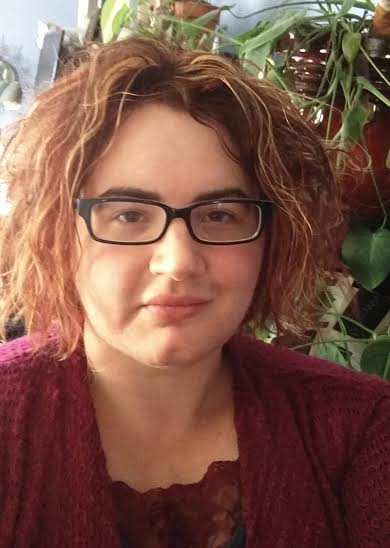
Kameron Hurley is an award-winning author, advertising copywriter, and online scribe. Hurley grew up in Washington State, and has lived in Fairbanks, Alaska; Durban, South Africa; and Chicago. She has degrees in historical studies from the University of Alaska and the University of Kwa-Zulu Natal, specializing in the history of South African resistance movements. Hurley is the author of God’s War, Infidel, and Rapture, a science-fantasy noir series which earned her the Sydney J. Bounds Award for Best Newcomer and the Kitschy Award for Best Debut Novel. She has been a finalist for the Nebula Award and the Locus Award. Her work has also been included on the Tiptree Award Honor List. Hurley’s short fiction has appeared in magazines such as Lightspeed, EscapePod, and Strange Horizons, and anthologies such as The Lowest Heaven and Year’s Best SF. Her fiction has been translated into Romanian, Swedish, and Russian. She is also a graduate of Clarion West.
* * * * * * *
Interview by Dag Rambraut – SFFWorld.com © 2017