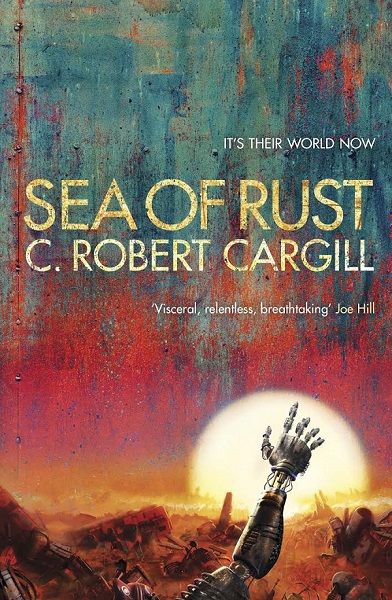
 This book begins with what we would think is a major event, the death of the last man on Earth. However, this is really not a big deal in Sea of Rust. The story is really about what is left afterwards. It is about the rise of the robot – and it is, erm… riveting.
Told from a strong first person narrative, the tale is about Brittle, a robot Caregiver, and her means of survival in this future world. It is not an easy place to live – the Sea of Rust, for example, is a desert created from the decaying cities and objects of Humans, with most of their items (and the humans) long disappeared. It’s all rather like Star Wars in its degraded state appearance, but without the living creatures.
Brittle survives by travelling the desert wastes looking for robots, or parts of robots, that she can recycle and trade. As a freebot, the means of survival is by having enough parts for yourself and items worth enough to trade at the various markets in the wastes.
Brittle seems to survive pretty well, until one day she finds that she is being hunted by a robot as skilled as herself. It is a battle of wills and energy between equally skilled opponents. The chase begins and the pace doesn’t stop.
Through backstory, along the way we discover how Mankind was destroyed and how AI took its place. We read of the rise of the mega-computers and how the ones remaining search for robots to force them to join their religious-like community.
There’s a lot here that you might recognise. Think A.I. meets Mad Max & The Terminator, with a knowing nod to Isaac Asimov’s ideas and Colossus: The Forbin Project. It is a supremely well-thought-out scenario, with the future being a sensible extrapolation from now. The result of this proliferation of robots and artificial intelligence is a wonderfully imaginative world that seems right. It would be easy to have mass-produced robots being rather uniform in manner and purpose, yet the author has clearly made a great deal of effort in imagining a variety of different types of robots with different mannerisms and characteristics.
Brittle’s character is simply wonderful. Cynical, yet self-depreciating, Brittle’s ‘voice’ is what carries the book along. It’s an ambitious solo monologue that is by turns funny, sceptical, knowing and reflective. Brittle has done some very bad things in her life and yet seems to carry off that impression of being both likeable and knowledgeable. It is impressive stuff.
As well as the characters, the world Brittle travels through is superbly realised. It is a world of terminal decay, of collapsed buildings, decaying shopping malls, rusting vehicles and vast wastes of steel and concrete, within which these self-aware intelligences are scrabbling for survival with limited resources. The robots realise that their lives are finite and that time is running out as parts become scarcer. It is a world that in its empty entropy JG Ballard would be proud of.
Despite this worldly barrenness, the book has a fast pace that is never boring. Some of the battle scenes are very impressive and read very well.
This is a book that will keep you reading from the start. There’s not an inch of waste in the precision-manufactured product – each chapter and flashback serves a purpose in fleshing out the characters and helping the reader understand where they have come from. Surprisingly, but pleasingly, by the end the book had managed the unexpected and made me care about what happened to the robots. The pace is terrific, the characterisation is brilliant but most of all the world building is superb.
Sea of Rust is a brilliant evocation of a future run by machines. It is startling, imaginative, relentlessly paced and often brilliant. One of the best books I’ve read this year.
Sea of Rust by C. Robert Cargill
Published by Gollancz, September 2017. Review copy received.
384 pages
ISBN: 978-1473212787
Review by Mark Yon