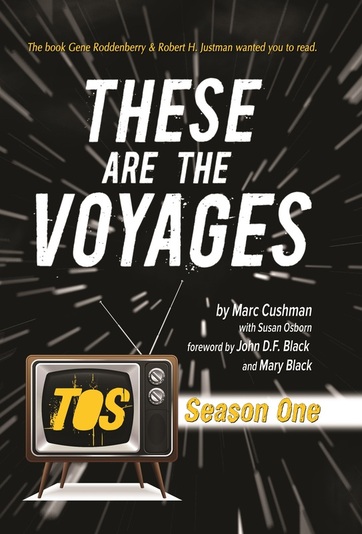
 “These are the Voyages, TOS, Season One” by Marc Cushman is being released in August. A detailed documentation of the creation, production, and post-production of both the pilots and the additional twenty-eight Season One episodes. We have had the pleasure to talk to Marc about the book and other things.
Q: Why did you decide to do a book on Star Trek?
In the mid 1980s I was reading a book on Orson Welles and the making of Citizen Kane. It was perhaps the third or fourth book on that movie (there have been dozens more since). It occurred to me that more people around the world had seen any single episode of the original Star Trek than had seen or, for that matter, even heard of Citizen Kane. So shouldn’t each episode of TOS have at least one book written about it? Jump forward in time nearly 30 years and this still holds true. TOS is everywhere. These episodes are historic. The writing and making of “The Classic 79” deserves to be documented in detail.
Q: You have written for Star Trek NG in the past, can you tell us about that experience?
I met Gene Roddenberry in 1982 when I was assigned by a company I worked for to interview him for a planned documentary on the Star Trek phenomenon. That started a relationship that brought me the opportunity to pitch to Gene at Next Generation between Season One and Two. I told him four stories, one which asked the question: “What happens when a Vulcan goes through senility?” That was the story Gene wanted to go with. He had me write a treatment, which was called “Sarek of Vulcan.” He couldn’t put me on assignment to do a script because a writers strike started right around that time, so I wrote a first draft script on spec and sent it to him at his house. It was all quite unofficial, as it had to be in a situation such as that. He called and said that he could see I had great passion for the first series. Perhaps too much. My script leaned more toward the pacing and mood of TOS. Gene also changed his mind about doing an episode that would bring a character from the original series into the new series this early in its development. He felt it would be better suited for, say, Season Three. So I wrote a new treatment of the story with Jake Jacobs (brother-in-law, friend and frequent collaborator) substituting in a different character for Sarek. We were paid some money and this, along with the first version, went into a filing cabinet somewhere. Gene’s health took a turn for the worse during the second season and by the third, Mike Piller and Rick Berman were running the show. They resurrected the story, with Sarek back in, and Peter Beagle ended up writing a new script based on the original. And that became “Sarek.”
I liked NG, but did not really pursue writing assignments because, as Gene had said, my heart was in TOS. But they – the makers of NG, and then ST: Voyager – pursued me. I’d be invited to go in every season and pitch ideas, springboard, really. Elements of these made it into some episodes. But it was that first time I most remember – with Gene. He was the only producer I ever pitched to who would ask what the theme of the story was. It was important to him that every episode of Star Trek had something important to say.
Q: How did your background in writing TV scripts influence you in writing “These are the Voyages, TOS, Season One.”?
I understand story which, to put simply, is about a character with an urgent problem to solve, a need to make something happen or not happen. When writing about classic TV series, such as the one I wrote on I Spy, I find the inherent drama and conflicts in the making of a TV series — all the blood, sweat and tears that goes into each episode, especially with a series as ambitious as Star Trek and I Spy were in the 1960s. As a screen writer, I’ve been trained to keep it active. Everything is happening now. My goal is to put you in Roddenberry’s office, and on the soundstage as the episodes are filmed, and in front of the TV sets in the 1960s watching these episodes for the first time.
Q: What do you think it is that makes Star Trek so popular?
Roddenberry’s determination that every episode have a message. Rod Serling did the same thing with The Twilight Zone. You thought about those shows after you watched them. The premise of the series alone is the best of any TV show made – it can take you anywhere and the potential is unlimited. And, finally, something that can only be described as magical – that thing that brought the likes of John Lennon, Paul McCartney, George Harrison and Ringo Starr together. It’s the same magic that brought William Shatner, Leonard Nimoy and DeForest Kelley together with writers like Harlan Ellsion, Richard Matheson, George Clayton Johnson, Theordore Sturgeon, John D.F. Black, D.C. Fontana and Gene Roddenberry, and with Matt Jefferies, who designed the Enterprise, inside and out, and William Theiss, who designed the wardrobes, and Alexander Courage and Gerald Freid, and the other great composers, who wrote the soundtrack. It was all the right people in one place at one time creating something magical. We can analyze it all we want, but some things defy explanation. My job, with these books, is to allow the fans to witness the making of this series and recognize the remarkable talent behind it.
Q: I gather you met with a number of participants, which were most helpful and interesting?I
Roddenberry, of course, back in 1982 and again in 1989. And Robert Justman, his right hand man at Star Trek. Dorothy Fontana has been extremely helpful. And John D.F. Black and his wife Mary, who worked for him while at Star Trek. I interviewed everyone I could and to a depth that perhaps they were never interviewed before. A remarkable group of people.
Q: Can you give us a sneak peek into the surprises readers should expect in your book?
The ratings were much better than we have been led to believe. I licensed all the Nielsen reports for every episode and people will be surprised. Folklore is not always correct. In fact, rarely correct. Roddenberry was not well liked at the network. Or at the studio, for that matter. And Star Trek was ahead of its time. It was not easy for these businessmen to comprehend or appreciate. There really seemed to be an agenda to get rid of it. I was also surprised to find out who did most of the writing on the series episodes, and it was almost never the person credited on the screen. We all get Star Trek now, we’ve grown up with it. But in 1966, TV writers couldn’t quite grasp this series, and science fiction writers couldn’t grasp TV. Roddenberry and his staff rewrote nearly every script. They would work until two in the morning, routinely. Also, Star Trek rarely stayed on schedule or within its budget. This was one of the most expensive TV series on the air, but budgets back in that day couldn’t afford a show like this. The compromises that were made are staggering. And fourteen hour days were the norm. To quote Mr. Spock, it was “fascinating” to find out what went into the making of every episode, and what went wrong and caused the few failures they had. These people cared beyond belief, but sometimes situations, and outside interference, sabotaged the writing and/or making of certain episodes. The facts were all there in the show files — which are immense, in the neighborhood of 60 large boxes, and which Roddenebrry and Justman encouraged me to spend months sifting through. And the facts are now in these books — 10 to 20 pages on each episode.
Q; This the first book in a trilogy, why three books?
It had to be that big. Each of these episodes is historic. The fans rightfully want to know what it took to make them; why certain decisions were made; what factors influenced what was made and what wasn’t. People will find out for the first time just how many stories and scripts were developed but never filmed. And why. And that many of these were written by famous science fiction authors. The books are big because the story was big. In fact, bigger.