

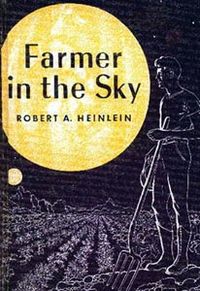
 Farmer in the Sky by Robert A. Heinlein
Originally published by Scribner (1953) after magazine version in Boy’s Life (August-November 1950)
Virginia Edition published December 2008. Text with minor corrections based on the Scribner’s edition.
ISBN: 978 1 897350 188
168 pages
Review by Mark Yon
Here’s the latest reread of Heinlein’s works, as Mark goes through the Virginia Edition series.
By this stage (1950-53) we’re well into Heinlein’s publications designed for the teenage boy reader. Usually nicknamed ‘the juveniles’, Farmer in the Sky epitomises the strengths and weaknesses of this period of Heinlein’s writing.
There’s a lot here the reader will recognise – young protagonist, this time moved with his parent & family to the hostile moon of Jupiter, Ganymede. Compared with his previous tale Red Planet (young protagonist, moved with his parents to the hostile frontier planet of Mars) there are definite similarities.
Our hero this time is a typical Heinlein boy-hero. William (Bill) Lermer, with his recently re-married father, George, step-mother Molly and step-sister Peggy, have decided to emigrate on the torch-ship Mayflower for a new life on Ganymede, which is being terra-formed into a farming colony that, in the future, will supply an overcrowded and beleaguered Earth.
New life, fresh start, unexplored opportunities: the similarities between this and the Pilgrim Fathers travelling to the New World (both on the Mayflower) is rather laid on with a trowel. (In terms of the time spent travelling, “That makes Ganymede closer than London was to Plymouth Rock”, says Bill at one point.) Like Red Planet, which told of life on the frontier planet of Mars, here we travel further into even less explored territory near Jupiter.
Much of the early part of the book is about the spaceship itself: its design, layout and organisation, all given with great dollops of exposition and questions answered through lectures. This gives the 1950’s fledgling space cadet reading the book an idea of what the spaceship could be like, atomic motors and all. It is also about the many dangers of the journey – g-force, weightlessness – all modern updates to the hardships of the original journey to America. Bill deals with a meteorite strike on the spaceship and attends classes and troop meetings to alleviate the boredom of travel. Much of the tale at this point deals with the practicalities of such a trip, to give the reader a feel for what would be difficult conditions of travel. Bill, being a Scout, clearly deals with whatever hardships the situations throw at him, and spends some of his time setting up Scout Troops on board ship to relieve boredom, learn skills and develop discipline.
There’s some nice links to some of the earlier novels and stories. The Space Patrol (see Space Cadet) is mentioned, as too the song The Green Hills of Earth and its blind composer Rhysling. Colonies on Mars and Venus, briefly mentioned, relate to Heinlein’s other tales. Heinlein was clearly starting to make his stories of the future interrelate. He even introduces the idea that there has been in the past a space-faring race that has left their mark in space.
So, what does Heinlein bring to the table that is new this time around?
The first shock is that the first part is written from the point of view of Bill. After the previous books were traditional second-person perspective, this is a bolder stylistic move, and one that creates a more personal standpoint. The second shock is that from the start the book does not read positively. This is a surprise, as the juveniles were stories written predominantly for boys and meant to highlight the virtues of the Scouts, and yet from the beginning this is not the positive characteristics you expect from a Scout. On the first page Bill has to deal with a trainee Scout who he calls a twerp from the outset. There is an argument between Bill and his widowed father George over George’s decision to embark on the Mayflower. The world around them is clearly not good, with food rationing in place and rations often cut, George going without meals to ensure that their nutrition intake is sufficient.
Bill is clearly still grieving over his mother’s death. Heinlein is angry.
Things don’t get better immediately once the characters have left Earth. When George, Bill and the other travellers get to Ganymede there are a number of nasty surprises waiting for them. Firstly, the colonists have more people than the world-system can reasonably cope with, which leads to rather Spartan treatment for many of the new colonists. Secondly, the farm set-up at Ganymede that was promised before their embarkation is, in reality, much less developed and overstretched than they had believed it to be. This echoes Heinlein’s dissatisfaction on Mars in Red Planet, where big corporations threatened and even killed pioneers in order to advance colonial expansion into the Solar System. The System of the 1950’s is a harsh and unforgiving place!
It must be said that time has not been totally kind to some aspects of the tale, however. On occasions Bill and George settle down in their leisure time for a nice game of cribbage, a card game most people today won’t know about, never mind play. Similarly, Bill prepares a lovely steak meal in two and a half minutes, and it is written as something as a major development, whereas these days we would just think ‘microwave’. Having said that, the reader should really expect some dated-ness, in a tale over 60 years old. Generally it is not as bad as you could expect, and does not slow down the reader’s enjoyment too much, although at times I did wonder what difference a mobile phone and a GPS would have made. Whilst much of the novel’s science has been superseded by more recent discoveries (Jupiter’s rings, Mars and Venus habitable, Ganymede covered with ice), it must be said that, as an adventure tale, it is still a good read.
Indeed, this novel shows a Heinlein honing his craft. Whilst he can be seen to be working to a template, and clearly knowing the audience he is writing for, what we are also seeing is Heinlein pushing the boundaries of 1950’s SF within the mould. Dealing with basic values such as honour, respect, and perseverance, here Heinlein also manages to sneak in the odd curveball in terms of society and culture. This is not a tale that has ‘happy ever after’ written all over it, but a tribute to Scouts making the most when dealing with a bad hand and coping with difficulties.
What is perhaps most interesting is that Heinlein doesn’t sugar-coat the difficulties and hardships encountered by the characters, but instead uses these difficult situations to highlight the versatility, ingenuity and gritty determination of these pioneers, all laudable qualities for any reader to emulate. As a reader we can appreciate the difficulties and respect the way that Bill and his colleagues deal with any difficulty thrown at them. There is a degree of realism that is not hidden here, and the book is stronger for it.
The novel was awarded the Retro Hugo in 2001. I can see why: the spirit of frontier-ism is strong in this tale, and it is something that readers will find agreeable.
Written at a time when human exploration was not only likely but seemingly inevitable, Farmer in the Skyshows a writer starting to stretch his authorial skills, and writing an exciting story. The journey would be difficult, but in Heinlein’s tale (and in the minds of many of its readers, no doubt) it would be worth it. The future is ‘out there’, not ‘in here’ and this is something that was suitably zeitgeist in 1950.
For those wanting to read how the future should be, from a 1950’s perspective, this is a good read.Farmer in the Sky has many of Heinlein’s strengths and not too many of his later weaknesses.
Mark Yon, April 2013.




“as too the song The Hills of Green Earth ”
Er …. The Green Hills of Earth.
Oops. Corrected. Thanks, Michael!