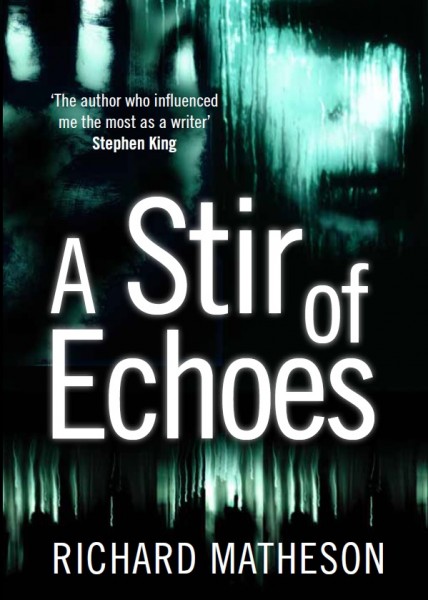
A Stir of Echoes by Richard Matheson
Published by TOR UK, September 2013 (Review copy received)
Originally published in the US, 1958.
ISBN: 978-1447242390
220 pages
Review by Mark Yon
Why isn’t Richard Matheson better known and more read in the UK? If any of his books are known, it is more because of the movies of his novels, rather than the books themselves. Of these, I am Legend (which I reviewed HERE just before it was released as a Will Smith movie), or for those a bit longer in the tooth, The Incredible Shrinking Man are probably the best known two, though there are others.
Like those, this book has also been made into a movie, released in 1999 and starring Kevin Bacon (as A Stir of Echoes). But the actual book hasn’t been around here in the UK for a long while – I make it nearly fifteen years. So ‘Bravo!’ to Tor for re-releasing it.
As might be befitting an older novel, the story’s fairly straightforward. Tom Wallace is a typical middle-class suburbanite from the 1950’s, working in Publications at the North American Aircraft factory in Inglewood, California, renting a nice house with his pregnant wife Anne and young child Richard.
Whilst at a neighbour’s dinner party, Tom is persuaded to be hypnotised as part of a joke. All seems well, until afterwards Tom begins to imagine a presence in his house, later believed to be ex-resident Anne Driscoll, waking him up at night. Initially it is shrugged off as overwork. However over the next few days Tom also starts to get impressions other people’s thoughts: things that he shouldn’t know, dark, nasty, evil thoughts that suggest that whatever we see on the suburban surface is not what people are thinking. When his wife is hit on the head by a tin of tomatoes she knocks over at home, Tom feels it at work.
As time goes on, the effects become more pronounced, and the consequences of Tom’s newfound power are shocking. Repeated nightmares mean that both Tom’s work and home life suffer, especially when Tom’s condition worsens so that he starts to know things before they happen. Friends, neighbours and Anne begin to suspect he’s having some sort of breakdown. Is it a real phenomenon? Or a descent into madness?
Sounds like a Stephen King novel, right? Or a Twilight Zone episode? If you think so, then you’re not that far off the mark. Stephen King has always claimed that Richard was a major influence on his own reading and writing in his formative years (and quoted on the front cover of this new edition – “The author who influenced me the most as a writer). Richard also wrote some of the iconic TW episodes in the original series (Nightmare at 20 000 Feet being one of my personal favourites.) And the signs are there.
Though the book has clearly dated in some aspects (Tom’s brother-in-law drives a 1951 Mercury Coupe as if it is something modern to be admired) what still works is the straightforward, lean prose and the seemingly natural conversational tone of the story, told in the first person by Tom. The dialogue reads surprisingly naturalistically, although there is the odd dated reference that could be missed by contemporary readers. Those touches of cosy Americana that we read in King’s novels are also found here, although a little unreal fifty-odd years on. (I kept thinking ‘Atomic Age’ whilst reading throughout.)
Most importantly, the sense of dislocation, of Tom and the people around him trying to deal with his rapidly changing condition is very well done. It seems logical in that the way that Tom reacts is how any of us would react. I must admit though that the actual means of dislocating from the mundane aspects of reality here is a little hokey too, though rather Bradbury-esque, in that it is based on hypnotism – a magician’s trick, in the same way that many of Bradbury’s tales were based around the circus. This is where the book shows its age a little, as well as reflecting its environment at the time of writing when ESP was very much jour du rigueur. These days I guess it would be caused by mobile phones, the Internet or some such device.
But, to be honest, the means of its origin isn’t too important. What really works is the upheaval of normality, the consequent sense of unease and impending menace that threatens to overturn this cute vision of perfection, this 1950’s model of idealism. And perhaps rather shockingly for a book from the 1950’s Richard doesn’t hide the adult sexual tensions and frustrations of normal life that Tom picks up on, those things that mostly go by unseen. (David Lynch’s movie Blue Velvet followed a similar idea, albeit rather more extreme visually.)
The ending is pleasingly ambiguous.
Sadly, Richard died in June 2013, aged 87. He was due to be a Guest of Honour at this year’s World Fantasy Convention, to be held in October in Brighton, England. This book shows why. It’s short and yet will remain with you after you’ve read it.
This book is worth reading, from a major influence on some of our writers today. If you’re a fan of Stephen King, I can’t see why you wouldn’t like this book. Allowing for its age, it’s still a rattling good read. I read it pretty much in one sitting.
I hope TOR (or anyone else!) continue to republish more of this much-underrated writer in UK in the future.
Mark Yon, August 2013