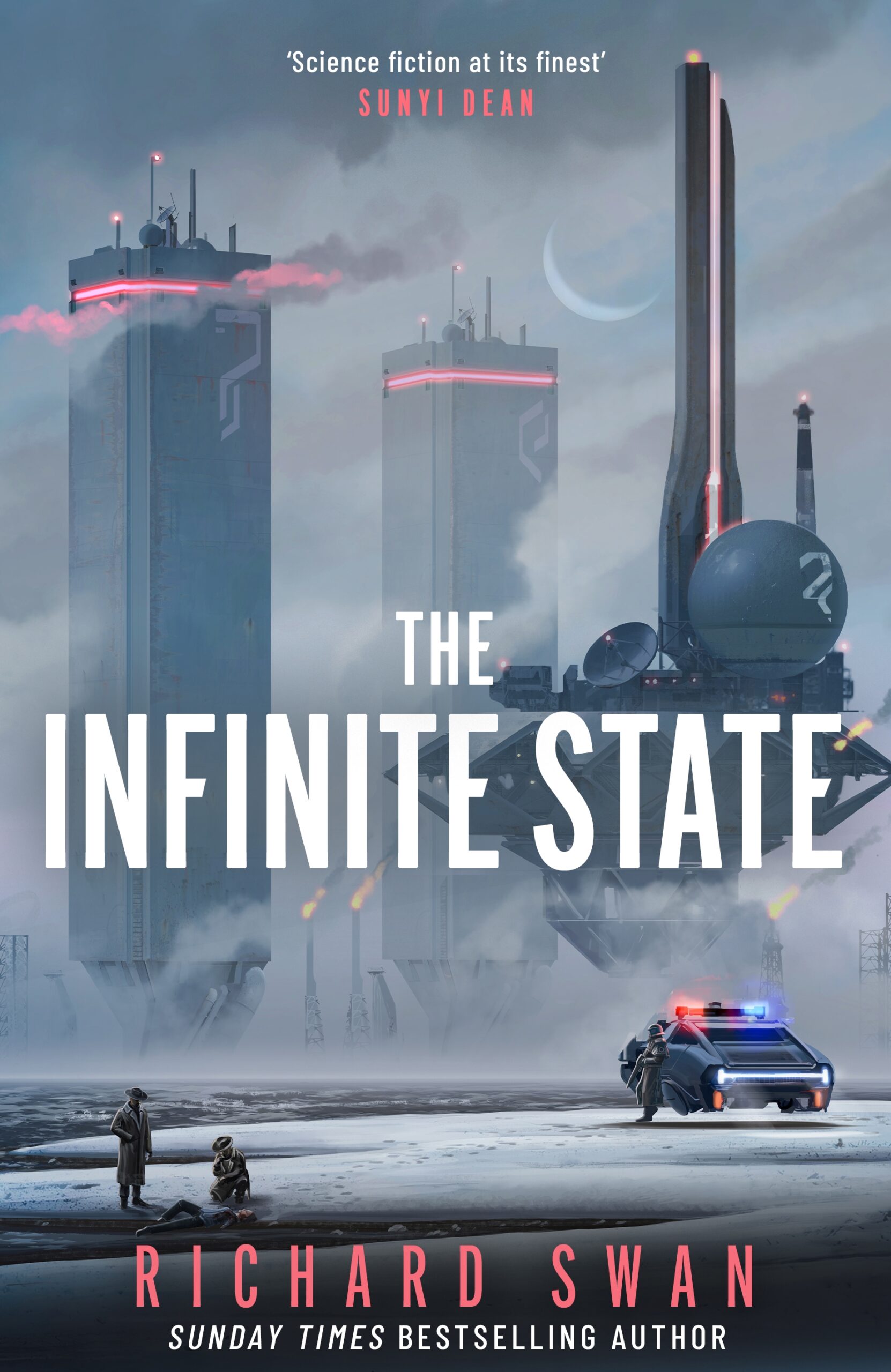
 In these current times of seemingly endless global turmoil, I have found myself being reminded that science fiction often looks at the events of today through a fictional lens. The upsurge of interest in dystopian fiction seems to occur in cycles and to me currently appears to be back on an upswing.
Such tales, whether Fantasy, Horror or Science Fiction, seem to do two things: one, it allows us a degree of escape from the horrors of reality, and two, it offers us a variety of alternatives. The more I read SF, the more I realise that it is less about ‘the future’ and more about our present as seen in an alternate situation.*
Why am I mentioning this here?
Well, Richard Swan, an author previously mainly known for his Empire of the Wolf and The Great Silence fantasy series, has taken on such ideas in a dystopian SF novel.
This is a book of two halves, in three acts.
Much of the first part of the book is set in the city of Kada Gamar, the centre of the Decurion Empire. We are introduced to our three main characters. Katherine Fuller was the loyal wife to a prominent Party member. When he disappears, she is left with a vast sum of money. She decides to use it to buy her own planet and set up a better, fairer society.
Also in Kada Gamar is Cyprian Veselin, who is that Harrison Ford/Blade Runner-type character that seems like he has just wandered in from the Blade Runner movie. Taciturn, overweight, perpetually drunk and grumpy, he is a disgraced Investigator whose wife died and his children were taken away from him to be re-educated. He is now existing by working for the Inspektorate in solving murders – a common event in this dark Stalinistic environment.
Thirdly, we have Julian Yashego, a non-native Imperial citizen from Trillia, who is this season’s hottest hypersled driver and who is forced to make a deal with the State – an offer he can’t refuse, if you like – to become their latest propaganda tool. After all, the State never loses, and will do everything it can to preserve that situation.
Much of this first part of the book shows our characters trying to cope with living in an authoritarian state. It is not easy – women are encouraged to bear as many children as they can for the state, everyone is watched and opposition dealt with viciously, there is an ongoing war away from home – it all sounds like a cross between Big Brother in 1984 and the Roman Empire. There is a sense of power and brutal authority throughout.
“If you want a picture of the future, imagine a boot stamping on a human face – forever.”
(George Orwell – 1984)
Of course, such power and authority needs its regulators and enforcers to maintain control, and so to implement this we have Political Enforcement, the executive arm of the Ministry for Information, led by Jaroslav Droor. (As I was reading I was thinking of Joseph Goebbels as a real example.) They are the people who knock on your door late at night, who make people disappear in order to preserve the image of the Empire. It is effectively and chillingly depicted by Richard here:
“She thought of the large residential ghettos around Kada Gamar, rife with mould and death and disease and crime, subject to frequent Inspektorate raids, epidemics, and riots. She thought of the endless number of young men sent to perish on distant, foreign worlds for the sole sake of Imperial prestige, frightened and alone, far from their mothers and homes.”
The tension is created in the first half to see whether Katerine can get away with her plan. She enlists a number of people to help, including Ruben Morozov, the Councillor General for the Permanent War Council, and a librarian, Lukah Walzingham. Cyprian is given the role of Head of Security for the new planet, named Gabriel.
The second half of the book is set on the planet Gabriel itself. Katherine, Lukah and Cyprian are already there and construction of the first city is ongoing. At this point the book took on the feel of those old-school SF novel, where a number of challenges are created but then the characters resolve them – or try to. Juggling all these elements in the plot actually made me think a little of those old computer games like Civilisation or Sim City as things develop, although the construction here is uniquely science-fictional.
Much of the growing tension here revolves around whether Katherine’s plan for her democracy will be discovered – the longer it exists and the more construction work goes on, the more chance there is that the Empire will turn up and destroy it.
Around all of this there are conversations about the morals and ethics of such a state – a discussion of liberty, authoritarianism, identity, about questioning the system and the status quo, all of which are as relevant today as they have been in the past. Katherine, as the naive newcomer, is the foil against which these ideas are tested. As a reader, such analysis makes you think about the world of the present.
In the third act of the novel we find these disparate elements come together with some brilliant new elements – the creation of a cloned simian army for defence on Gabriel is something which is both very cool and an essential part of the plot.
In summary, I think that Richard’s The Infinite State will be a real crowd-pleaser. It has dark elements, admittedly, but in the end there is hope, and along the way there are thrills, characters you grow to like or dislike, and a couple of twists along the way.
Richard has played to his strengths here – enigmatic and ambiguous characters, great battle scenes and brilliant world (or is that ‘worlds’?) building. I found it great fun to see lots of science-fictional tropes – Blade Runner, Phantom Menace and others – moulded them into something of Richard’s own. It also allows us to examine – and question – what we think of as essential in life, and how to possibly attain them.
I can’t wait for the next novel.
© 2026 Mark Yon
Hardback | Gollancz
THE INFINITE STATE by Richard Swan
August 2026 | 416 pages
ISBN: 978 1399 627 733
*I was once told – or perhaps I read it – that the more things are ‘bad’ in real life, the more horror fiction seems to sell. (I am thinking Grady Hendrix, in his excellent Paperbacks from Hell book.) The same idea would also apply to Fantasy and SF too, I think.