

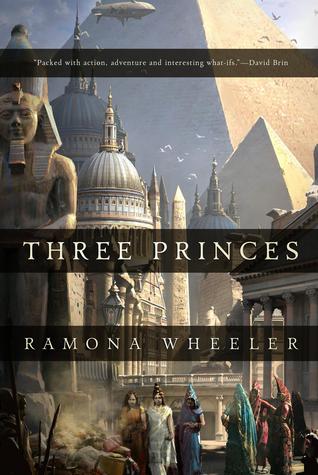
 Three Princes by Ramona Wheeler
Published by Tor Books, February 2014
352 pages
ISBN: 978-0765335975
Review by Mark Yon
I must say that I do like a good alternate history. They seem to encapsulate the epitome of the what-if extrapolation, following through on ideas to often original ends.
And as alternate histories go, this one’s great. Here the idea is that (unlike our world) Caesar and Cleopatra survived, creating a Empire-dynasty that has continued through to the year 1877 of Our Lord Julius Caesar. In the age of the Egyptian Empire, Memphis, Egypt is recognised by many as the capital city of the world, the latest Cleopatra, Queen Sashetah Irene, is the Queen of the World, married to Pharaoh Djoser-George. Europe is rather more side-lined in this world than in ours. There are terrorist plots aplenty, determined to create their own World Order and bring down the Egyptian regime. These are often originated from Victoria and Albert and their agent, the terrorist Count Otto von Bismarck.
Our tale is told mainly by following Lord Scott Oken, fourth son of the Spate Arch of Mercia in the Britannic Isles and one of the great descendants of the Caesar line. Often working as an ambassador for the Egyptians, Scott is also a secret agent for the Egyptian Queen. His ability as a memoryman, a person who can record things by memory and retain them, means that he is often called upon to note key events.
His mentor, Professor-Prince Mikel Mabruke, and Oken are given the task of uncovering an international conspiracy, seemingly being organised by Bismarck.
Their tale goes from Memphis to Europe to the New World. It is here that we meet the third prince of the title, Prince Viracocha of the Incan Tawantinsuyu. In South America the Incas have a rival empire to the Egyptians and one that is on the verge of a technological revolution – they are about to send a spaceship, Jules Verne style, to the Moon. Mabruke and Oken are given the task of determining whether this space rocket is viable and, if so, establishing links between Egypt and the Incas.
As you might gather from such a summary, Three Princes is engagingly cinematic. This is a book that takes you on a journey, as the cover to this book elegantly shows. The mixture of different empires gives this story a feeling of variety and diversity. The world building is just wonderful, giving a feeling of both old and new in a pleasingly baroque setting. There is a sense of age and history which seeps from the page as we travel around Egypt and Europe with Oken, but which is then combined with newer elements of the Roman and Victorian/British Empire, opera with steampunk. By contrast, the Incan Empire is both scarily barbaric, with blood sacrifices and the like, combined with technical marvels – Quetzal airships (which travel across the Atlantic seemingly by pedal power!), moon-ships and so on.
The characterisation is quite interesting too. Though the lead characters are male, in Egypt it appears to be that the Queen does much of the diplomatic organisation – it is Queen Sashetah Irene who our two leads work for, after all – with Pharaoh Djoser-George being otherwise engaged. In the Incan world, the role of the ‘man in power’ is much more clearly delineated yet still complex. Oken comes across as some sort of handsome young James Bond type figure, bedding his way across Egypt, Europe and South America. Mabruke is rather more like an Indiana Jones-type professor but older: perhaps Henry W. Jones Sr. rather than Indiana.
Although what we glimpse of the Incan society is brief and fairly primitive, Prince Viracocha’s attempt to modernise and establish communication with the Egyptian Empire are generally seen as a good thing and Viracocha himself as a likeable and well-loved potential ruler.
The role of women in the novel is also intriguing in that for most of the time they seem to be side-lined, as you might expect in a novel based in part on old-world values. However, what Ramona does is show that often it is the women who are the power behind the throne, so to speak, and although none of the characters are as prominent as the men, they are important and clearly going to change things in the future.
My only quibbles with the novel are that some things are left hanging a little at the end and others are rather too neatly tied up. Parts of the plot happen a little too conveniently for my liking, and what appear to be major components of the plot at the beginning are, in the end, less important than you might think.
However it must be said that, in the end, I really enjoyed this one. Three Princes is a meld of steampunk, Lawrence of Arabia, pulp detective novels, Victorian England and jungle exploration. The plot is fast-paced, the ideas throughout logical and unusual, the characters are understandable and engaging. Most of all, the book is great fun. Throughout I was thinking “What a great idea” as our characters move from place to place on a rich travelogue. Three Princes is an exciting romp, filled with great ideas, and developed to a reasonably satisfying conclusion.
I hope that the author continues to mine this rich vein of possibilities.
Mark Yon, January/February 2014




Sounds like one to move up in my to-be-read pile. Thanks for the review!
I saw this on the shelf at Barnes & Noble only 2 hours ago. I was interested, but wanted to see what people here thought first. After such a good review, I’ll have to go back and get it. Thanks Mark!
Thanks, RM (and Nila!) There are some reviews out there that have not been as kind as mine, to be fair, but I enjoyed it. I can see it developing as a series. Hope your faith in my review has not been misplaced: enjoy the book!