Starman Jones by Robert A Heinlein
Originally published by Scribner (1953).
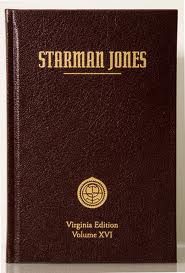
Virginia Edition published December 2008. Text with minor corrections based on the Scribner’s edition.
ISBN: 978 1 897350 218
200 pages
Review by Mark Yon
Here’s the latest reread of Heinlein’s works, as Mark goes through the Virginia Edition series.
After the rather disappointing read of Space Family Stone (1952) (review HERE) by 1953 we’re back on form with this addition to the list of the so-called Heinlein juveniles – books published that were written by Heinlein, predominantly for teenage Boy Scouts.
Much of this one fits the usual template shown in Red Planet, Space Cadet and Between Planets. However the title tells the reader that the biggest change here is that Heinlein goes interstellar, travelling outside the Solar System for the first time in his novels. This must have been quite exciting for the Heinlein reader of the 1950’s!
After pushing his repertoire with a dialogue heavy, multi-charactered tale in Space Family Stone, in Starman Jones we’re back onto one main character and his bildungsroman journey into manhood. Max Jones fits in nicely with the template we’ve seen so far, of one young man making personal progress, despite all the odds against him. The focus is on one character as he deals with his mother remarrying a bully of a man, his leaving home to try and join a Spacing Guild, his eventual journey into space and his travels out into interstellar space as a spaceship crew member.
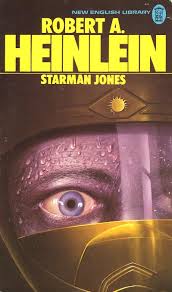
Written in a more traditional third-person perspective, Starman Jones follows the now fairly expected pattern that we have seen in the books from Red Planet to Between Planets. Interestingly, the Introduction to this edition from Robert James and Bill Patterson points out that the inspiration for the tale came from a true naval event from the nineteenth century. Told to Heinlein by a fellow writer, it’s clear that Heinlein found the idea attractive. It is noted that Heinlein’s short story, Misfit, written fourteen years earlier than Starman Jones, follows a similar framework.
Max has that element of now-expected Heinlein characterisation in his juvenile novels. Starman Jones again promotes the idea that through determination and natural ability, you (or at least the protagonist) can attain your dreams. With a gift for mathematical concepts and an eidetic memory, Max is seen as a young prodigy, who, eager to learn, never fails to make the most of his talent. Through hard work, coincidence and a smidgen of luck, Max begins the tale in a bad place but ultimately makes good before returning to his place of origin a much wiser, and some would say better, person.
This would seem initially to be a rather simple tale. So far, so typically juvenile Heinlein. However, although at first glance the book follows the usual template, there are some subtle differences here. James and Patterson point out that Heinlein, in his long-running attempts to circumvent what he saw as his publisher’s censorship, does turn things around a little from the usual tale. “His character would be a runaway, but happy about it. He could be an orphan – the kind of orphan Huck Finn was – with no blood relations. When Max Jones ran away, he would have no reason to return.”
.Some of the scenes, such as where Max is propositioned in a rather sleazy bar by a working girl, completely missed me by forty years or so ago, but are quite surprising considering the difficulties Heinlein had had with censorship previously.
In addition, for a character whose key importance seems to be to show how to make your way in life, Max is a bit of a bad boy*. Thought it causes him personal turmoil, it must be noticed that Max manages to make progress only by gaining forged documents and cheating his way into the elite Space Guilds as a cook/farmer upon the spaceship Asgard. Despite our first impressions, this is not the traditional Heinlein Boy Scout model, although it does show ingenuity.
And the tale is not all plain sailing for Max, either. He has to deal with making life-or-death decisions, romance, alien creatures and the death of more than one crew member as part of his burgeoning responsibilities and maturation into adulthood.
As might be expected with a tale over 60 years old, there are elements that don’t sit well with a more modern, more cynical reading audience. Heinlein generally does well to present women as something other than domestic servants, although there is a lapse from into ‘men work, women look after the house’ at one point. This is something much more prevalent in other tales of the time, and whilst Heinlein’s Elspeth is not your typical screaming female of the 1950’s, she does occasionally revert to type. The speed in which Max accepts help from adult strangers shows perhaps a more trusting time, although admittedly there are occasions when that trust is betrayed. Miss Alice Dalgleish, Heinlein’s editor for the juveniles did point out that some events happened a little too quickly in the first part of the novel, although this was not changed. (For the record, this is actually something I agree with the editor about.)
The biggest bugbear for some readers will be one I have mentioned before, in Space Cadet: the need for complicated human mathematical calculations and cross-referencing required before jumping through wormholes, which most of the crew in the book seem to do. In fact, it could be argued to be a contributory factor in the death of one crewmember. These days I am convinced that computers would do more, in the same way that a driver trusts a car without knowing all the precise mechanical details of how it drives. Nevertheless generally the book holds up fairly well, and there’s enough here to keep you ignoring the implausibilities whilst turning the pages.
All the novels to date have involved an alien of some description, and Starman Jones is no exception. Our main alien this time is Mr. Chips, a spider-puppy, a creature with apparently limited intelligence and speech vocabulary, but still quite endearing, and with quite a role to play as the book develops, in a similar way to the Martian Willis in Red Planet and the Venusian Sir Isaac Newton in Between Planets. We also have some aliens that are not as cute as ‘Chipsie’.
The ending of The Rolling Stones/Space Family Stone was problematic for me, in that it just seemed to end. Starman Jones has a much more satisfying one, when Max returns to his point of origin. By the end there is a pleasing feeling that the narrative journey has been worth it. And that the future is not on Earth, but in space – something perhaps every budding Boy Scout in the 1950’s could identify with.
After the disappointment for me of Space Family Stone, a return to the key aspects of the traditional Heinlein juvenile template, but with some important changes, for me makes Starman Jones a success. I found myself staying up to finish this one. A tight plot, with a clear outcome and some great ideas along the way, as Heinlein takes the frontier out to the stars, for me this is about as good as Heinlein’s juveniles get.
*Something that Patterson has pointed out in the Baen Books edition, I’ve found out since writing this review.
Mark Yon, December 2013