
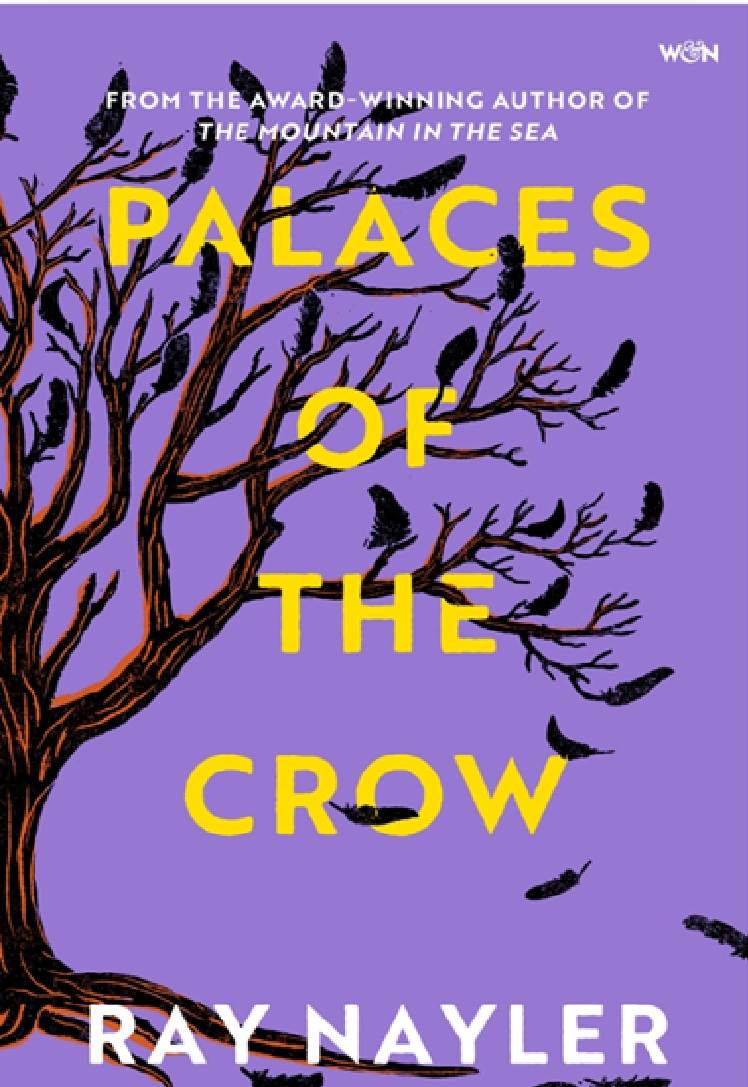
 So: it’s become a thing for me that Ray Nayler, with I believe only two novels, a novella and a couple of short stories to date, has become a must-read author. Both novels, The Mountain in the Sea and Where the Axe is Buried, have both been in my best of the year lists when they were published; the novella The Tusks of Extinction was acclaimed and won the Hugo Award for Short Story in 2025, a nominee for the Nebula Award of 2024 and a finalist for a Locus award. To my mind, Ray is rather like Ted Chiang for me, where the author’s output is relatively small, but the quality is usually high.
Ray’s stories have tackled interspecies communication, octopuses, mammoths, over-fishing in the Asian seas, technology, AI, political authoritarian dictatorships of the future and the effects of soul-crushing censorship, reflecting issues in our own world as well as that in a fictional one.
With all of that in mind, I can say that I wasn’t expecting this.
Palaces of the Crow begins in Eastern Europe in June 1941, We are told the plot through four main characters. First, we meet Neriya, a young Jewish girl who dreams of becoming a scientist who has observed and befriended a number of crows outside her home, especially one she has named ‘Buster’, after the film star Buster Keeton. We then meet Czesław, an underage Polish deserter fleeing the Red Army by hiding in the woods in Latvia. Thirdly, Kezia is a Roma horse trader whose family is on the run from Soviet collectivisation but who are killed, leaving Kezia to survive alone in the woods; and eventually a nameless, abandoned boy usually named ‘The Boy’, who cannot speak, possibly due to trauma.
Driven deep into the Lithuanian woods, they form an unbreakable bond with one another and with a flock of crows whose uncanny intelligence hints at a secret older and stranger than they could ever have imagined.
At a basic level, Palaces of the Crow is a story about war and the effects of such events on the common people – not just the soldiers, the combatants, the men (for it is usually men) in charge who make life-changing decisions, but the general public, the men, women and children left at home on whom these horrific events are impinged upon. Many of the shocking atrocities mentioned here are based on real-life events, based on Ray’s extensive research. Writing in speculative fiction allows us to look at such ideas with a degree of distance. Here Ray shows us that the past should also be examined, studied and learned from.
Unfortunately, looking at global events currently, as I type this, there are depressing similarities between the events of 1941 and now, none of which show humans in a particularly good light. Then, like now, there is division, mistrust, racial and religious bigotry, antisemitism, xenophobia – human traits that are seemingly constant. War is hell. And yet we seem determined to not learn from the past, to repeat actions already proven to be unnecessary and futile.
In Palaces of the Crow, by contrast, there is morality, there is intelligence and even majesty – but this is shown most by the crows, not the humans, which makes the savage and brutal actions of the humans in the novel all the more heartbreaking.
“The crows take care of their sick, their elderly, their wounded… they teach, they learn, they live and die in a world that is parallel and akin to our world but is not the world we live in.”
Like Adrian Tchaikovsky’s Children of Time (2015), not to mention Ray’s own The Mountain in the Sea, as I read I found myself siding with animals rather than humans, even though we are always warned not to make such anthropomorphic connections, aren’t we? (Ray himself also points this out in his Acknowledgements.) Our brains try to do this to make sense of what we know, and sometimes 2 + 2 = 5 as a result. Whilst Ray never becomes Disney-like and sentimental, it is clear that there is much that people could learn from these often ubiquitous and yet fairly unknown birds. I found that as The Mountain in the Sea made me go down the rabbit-hole for details of octopi after reading, so Palaces of the Crow did for crows.
The ending is not predictable, nor necessarily obvious as an ending, for whilst there is closure, there is a degree of ambiguity. Its open-endedness may not be what some readers want or expect. Nevertheless, I believe that it is appropriate – I did sit and think about it for a while after I closed the book.
So, what did I consider? Well, three novels in, and I’m starting to notice a trend, a pattern. Whilst Ray’s books are often set in the near future, as well as now in the past, they bring up ideas and concepts that seem eternal. Like the scientist Neriya, Palaces of the Crow also examines these ideas, putting them under a microscope, studying them, testing them and then running with them to see what they can do. In its environment of war and injustice, Palaces of the Crow tells of the importance of communication and relationships, both between humans – Neriya, Czeslaw, Kezia and The Boy – but also between humans and other species.
Ray’s books show us that this is a challenge, that a lack of communication causes problems. And yet, such challenges can be overcome by people and animals, communities working together to solve problems and minimise misconception.
In addition, the value and importance of intelligence is emphasised, but also how such intelligence is badly used or ignored (usually by humans!)
Summing up then, despite its different setting, Palaces of the Crow is yet another affecting and effective novel from Ray. It is rather emotional, perhaps his most affecting story to date. Like before, with Ray’s previous books, Palaces of the Crow made me sad, it made me angry, and yet made me think. All of this together means that Palaces of the Crow is another book by Ray that hits the ball out of the park for me. Still a must-read author.
© 2026 Mark Yon
Hardback | Orion Publishing (W & N)
PALACES OF THE CROW by Ray Nayler
May 2026 | 384 pages
ISBN: 978 139 9637



Just read it. I absolutely agree with all of the above (in the review). I really choked up at the end because it is a shocker.
Thank you for your kind words, Tom. What can I say but “Great minds think alike!” *grin* But it is a great book – pleased you enjoyed it.