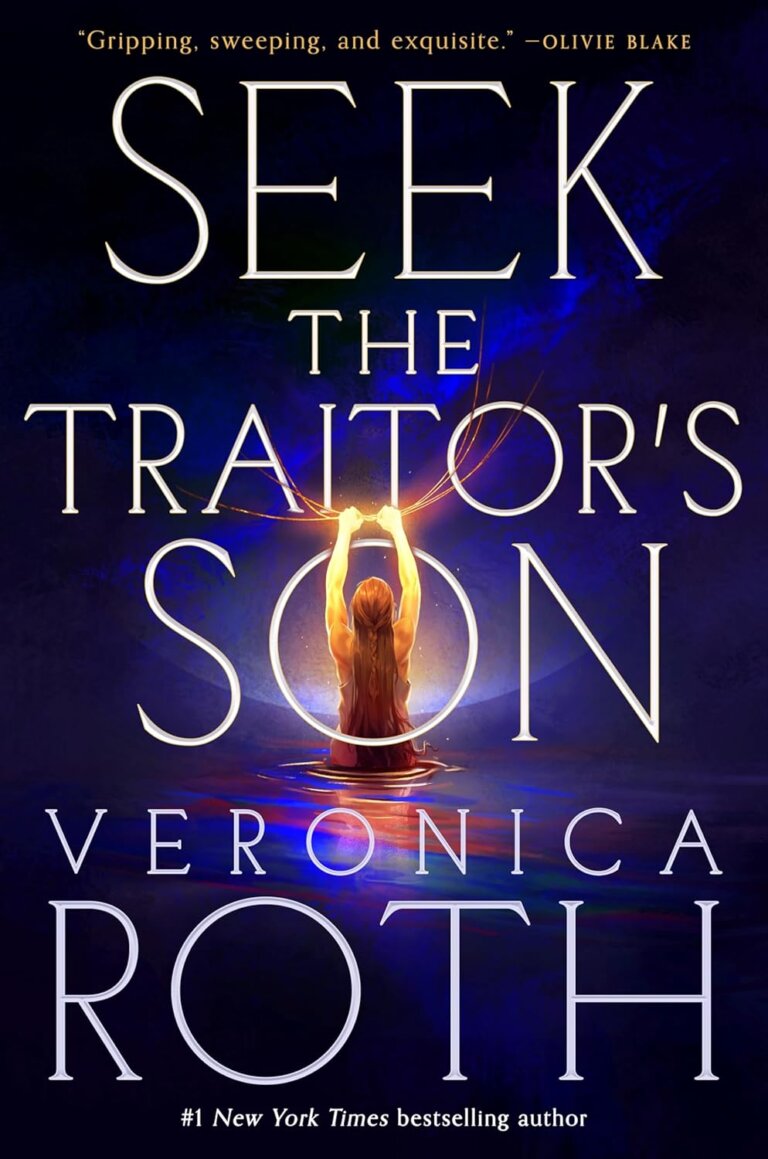
 Veronica Roth first came to my attention, as she did many others, I’m sure, with her Divergent series of novels (2011 – 2014), a dystopian science fiction series that seemed to be what readers of The Hunger Games (2008 – 10) wanted.
More than a decade later, those Divergent readers have become adult, and so has Veronica’s writing. Seek the Traitor’s Son is being promoted as a science fiction book for adults, presumably for those now-older readers.
From the publisher: Elegy Ahn did not ask for destiny to find her. She’s a soldier defending her small country against a powerful enemy: the Talusar. Rava Vidar is a Talusar general with a reputation for cruelty and triumph in equal measure. And when Elegy and Rava first meet, it’s to hear a prophecy that could apply to either of them.
It declares that either could carry their people to victory. But they won’t know who will triumph – not until it’s too late to change anything. And at the centre of both of their fates is a man. A man who, Elegy is told, will bring her death. A man she’ll fall in love with.
In one day, Elegy’s old life is over. With the fate of nations hanging in the balance, she and Rava are destined to collide. And when they do, only one will be left standing. Elegy intends to make sure it’s her.
The science fictional elements of the plot were interesting. I was intrigued that the COVID pandemic seems to have inspired or at least influenced a key part in the plot, in that the Talusar are voluntarily given a disease known as the Fever, which kills you. The upside of this is that if it resurrects you (not everyone survives) brings you back better than ever – in many cases to the point of religious fervour.
The social and political divide this creates is an important part of the plot. Society has fractured into two opposing groups – the Fevered Talusar, who dominate most of the Earth, and the Cedre, who to avoid ‘contamination’ now live on Cedre Station, a satellite space station above the Earth. Once upon a time, there was major conflict between the two. Now, a hundred years later, there is currently an uneasy truce between the two, although the past skirmishes are not forgotten.
Although there are the trappings of a science fiction novel, it is less about the science fictional elements and more about the characters and their various relationships, and Veronica does much to develop them beyond what you might expect – but not too much.
The story is mainly focused upon Elegy and her sister Larke, who are Cedae. Elegy is known as the Hope of Caedre, ‘the spare’ to Larke. who is the designated child that will become the Cedrae’s leader after her mother, the Sword of Cadre.
On the opposing (‘infected’ side) we have Rava Tidar, a Talusar general whose reputation for cruelty is as well-known as her skill on the battlefield.
This is complicated enough. The situation becomes further complicated when both the Cedrae and the Talusar are given details of a prophecy, which involves both Elegy and Rava. It seems that either of them will be an important influence on both societies in the future of future events. Much of the book is about how each of these characters come to terms with the prophecy, all of which have life-changing consequences.
And as a result of such mysticism, we tip over from science fiction to science fantasy. There are spaceships – the Cedrae have the Sundial currently mothballed in space which was about to attempt first contact with aliens who made contact just before the Fever struck – and there are aircraft and vehicles with names like Sparrow and Hummingbird that sound like they’re straight out of Dune, but generally it is about as SF as light-sabres. Really, there’s not too much depth in terms of the science fictional themes here – it’s more Doctor Who than Ted Chiang, for example.
Most of all, Veronica has written here a romantic SF novel. It’s not as full-blown as many of the SF romances are out there currently, nor as – graphic, let’s say – as some, but the slow-burn romance of enemies to lovers is still there, in a science fictional setting. What I appreciated is that the slow burn romance did not dominate the setting, or the plot until towards the end.
Whilst the book is being publicised as an adult book, it is really not that different to what I know of Veronica’s YA work: we still have much of what I would expect in a YA novel. The main characters are in their twenties and still young, trying to find their meaning in changing circumstances. This youthfulness is reflected in much of the main character’s bantering dialogue, which creates the odd jarring moment – would people in this future still call others ‘pervs’, for example? – but the dialogue is generally appropriate for a contemporary readership without being too new-fangled.
In summary, Seek the Traitor’s Son is a solidly entertaining read that focuses more on characterisation than concepts. The result is that Seek the Traitor’s Son is an easily accessible read, admittedly light on the science and technical gubbins whilst focusing on a situation which allows the characters to predominate. Fans of her earlier books will find much of what they liked there here in this book, with the occasional nod towards being more adult – a swearword added here and there, slightly older characters – but not too old.
The cliffhanger ending will be the test of whether readers wish to continue or not.
© 2026 Mark Yon
Hardback | TOR UK (Pan Macmillan)
SEEK THE TRAITOR’S SON by Veronica Roth
May 2026 | 432 pages
ISBN: 978 103 7401 176