
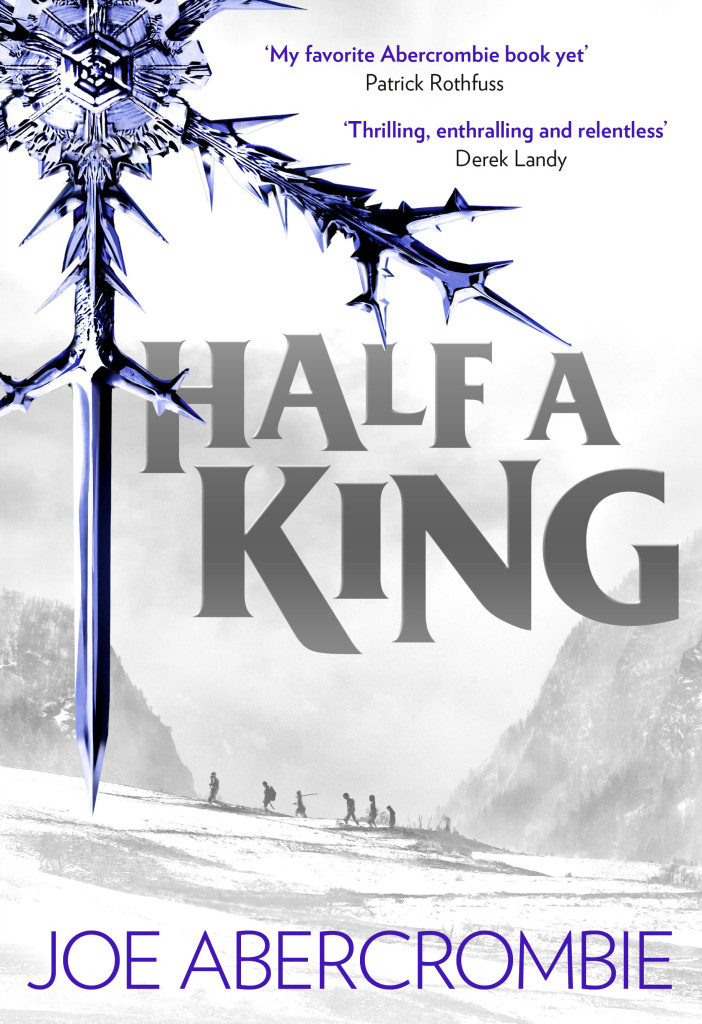
Half a King by Joe Abercrombie
Published by Harper Collins, July 2014
ISBN: 978-0007550203
384 pages
Review by Mark Yon
In this new series, away from The First Law and the lands of the North and the South, we see Joe tackling a much more traditional group of Fantasy tropes.
Last time I reviewed Joe (for Red Country), I said at the end that, as much as I enjoyed it, I felt it was time for something different. And here we have it: a Viking-esque, young adult tale that is less gory, less sweary and yet all the more enjoyable for it. It has an Abercrombie tone, it must be said, although I’m still trying to work out what exactly I mean by that, but the writing is as tight and as dexterous as ever.
The forty chapters, generally no more than half a dozen pages each, give the novel an episodic format, but not too fragmented. The characters and their values are identifiable, and, for the most part, likeable.
Our hero, Prince Yarvi, is an outsider, initially put into a position unwanted and yet necessary by circumstances outside his control. Against opposition, he must prove his worth and show that he is capable of dealing with the many problems brought to him. ‘A king must lead’, it is pointed out early in the book.
The twist in the story is that he must do this all the while with a physical disability – he is ‘Half a King’ because he has only one fully formed and functional hand. Consequently seen by many, including his father, as a weakling, (and to my mind rather like Miles Vorkosigan before him), Yarvi has personal demons and practical issues to deal with as well as his unwanted new commitments. As his warrior credentials are weak, Yarvi must find other ways to win his battles.
Mind you, this doesn’t stop him having to follow a quest. Betrayed by the people around him, Yarvi finds himself a slave (in a rather Ben Hur type moment) yet determined to revenge the death of his father and brother. Along the way, this leads to danger and eventually retribution.
So: what we have here is a tale that has common Abercrombie themes (mainly revenge) but written in a Young Adult format (albeit one which adults should enjoy also.)
What impressed me most was that the characterisation here is good, drip-fed as it is throughout, to create an impression of a Viking-style tribal group or a proto-medieval kingdom answerable to the High King. Yarvi’s father is a rather distant and perhaps unpleasant King-figure, whilst his mother is a Queen, stately and yet also caring towards her sons. Although a world of Kings and Queens, it also has a form of government too, through the Ministers, something which ironically Yarvi had hoped to become. His mentor, Mother Gundring, is a typical ‘witch-woman’ adviser of such tales, good-hearted and yet reprimanding, a female Yoda to our hero. It is a world of change, as noted by the fact that the High King has been building a temple to his One God for years. On the seas we have sea-captains accustomed to ruling things their way. Out in the Wilds, the Shends skin captives and eat their own dead.
There are also tantalising glimpses of an ancient world, thousands of years old, dominated by the work of elves. Jointless ruined buildings, with black ‘elf-glass’ and yet melted on top (by the Breaking of God, no less) suggest that things have happened here in the past, and that our characters have but a minor place in this world by comparison. I think there’s more to be told here, and I look forward to finding out more about it.
There are subtle changes to the usual Abercrombie template here. In a normal Abercrombie tale a reliance on other characters usually leads to betrayal or at the very least a severe beating. Here, in Half A King although things do not start well, it is such loyalties that become important at the end. That’s not to say that there isn’t betrayal, and death, but I did feel that the usual emphasis has changed a little here in that there is less unremitting bleakness here, and in the end, despite all the horrors seen to that point, it is loyalty and friendship that wins through.
That’s not to say that this is an easy, softly morally-led tale. Joe does well to point out that there is death, horror and fear along the way. The fighting scenes are as well done as ever, the inner turmoil created by such actions as clearly shown as ever. Whilst such a point could be given in a rather simplistic way, I’m pleased that Joe examines these as rather grey areas through the novel, and in the end our characters do not always go for the choices that society dictates you should make, which (should it exist) is an Abercrombian trope, I feel.
Interestingly, I found that whilst the violence and death we normally expect from Joe is there (people killed in gory ways, villages massacred, children murdered), it is sometimes left a little bit more than usual to the reader’s own imagination. This actually worked better for me, my own imagination filling in the gaps.
More to the fore in this book are the issues of duty, family and friendship. It is interesting that in a place of disloyalty and betrayal Yarvi finds that, away from the courts, it is the loyalty of his friends that he must trust. His fellow slaves, Jaud and Rulf, become firm allies and people to rely upon in a world full of difficulties. He even makes friends with characters that were enemies at first, is such a way that seems unforced. In the end, despite all the trials and betrayals that have been made along the way, it is Yarvi’s loss of family and friends that is felt the most keenly.
I’m also pleased to read the typical Abercrombie humour still present, though perhaps not as explicitly adult as previous novels have been. (Though, personally, I could have survived without the liberal use of the word ‘arse’ throughout.)
The ending has a great reveal, that I’m not going to spoil by telling you now. Suffice it to say that it is surprising and fitting.
In summary, I enjoyed this enormously. The book grabbed me from the off and Joe’s illustrative yet tight prose meant I was then keen to keep the pages turning. It’s a quick read, yet one that will leave you wanting the next book soon. Don’t be put off by the young adult tag that seems to be appearing in places, and to which some readers seem to be worried by (including members at the SFFWorld forums). This is as skilful and as enjoyable a read as any Abercrombie I’ve read to date, and often much subtler. Sometimes less is more. It is different for Joe, but not that different, and to my mind that’s not a bad thing.
Just don’t give younger readers The First Law series as an immediate follow-up!
Mark Yon, May 2014





Whether the reader is young or old, I agree this is a great introduction to Mr. Abercrombie’s work.