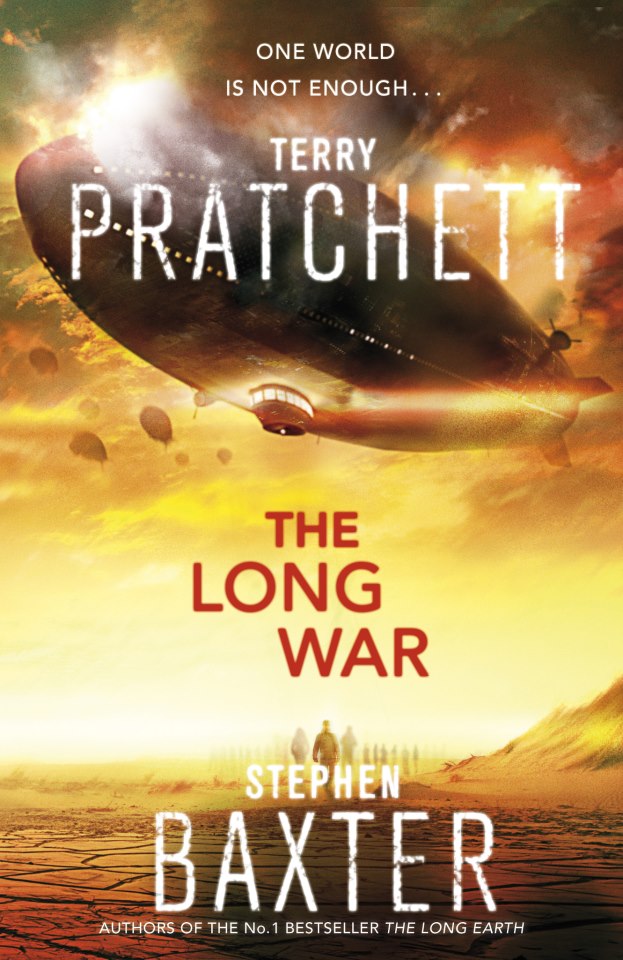
 The Long War by Terry Pratchett and Stephen Baxter
(Book 2 of The Long Earth series)
Published by Transworld/Bantam, April 2014
437 pages
ISBN: 978-0552164092
Review by Mark Yon
Here I return to The Long Earth series by Messr’s Pratchett and Baxter. The Long War is the second book in this series, which moves forward from the first twenty five years or so to the next generation of Steppers – those who travel between millions of parallel Earths. If The Long Earth set out the worlds to be discovered, The Long War looks at what happens next – when colonies become settled, new species are met, technology develops and trade becomes established and tensions increase.
After the setting off of nuclear weapons on the original Earth (referred to as Datum Earth) by the non-stepping Humanity First sub-group (summarised at one point as ‘a dumb plot by resentful home-alones’), things initially settle down to some degree of stability. The fledgling network between the Stepped worlds consolidates and becomes more robust.
A new network hub has been established. Called Valhalla, it is the link between Datum Earth, the Low Earths and the Meggers – the Long Earths over a million away from Datum. Supported by Combers – hunter gatherers who travel across the stepwise Earths – the settlement is rapidly becoming a place where those who want a new life without the hardship of farming can reside. Supplied by twains, the airships that can travel across the worlds, the place is flourishing.
Such developments are not well-received by Datum Earth. Losing its population and gaining little in return, the people there have begun to try and impose some degree of authority over the sidestepped worlds, whether out on the Long Earths or on the Datum World itself. As one character puts it, ‘The Datum’s become a world full of paranoids, run by paranoids.’ The pioneers are portrayed as slackers. With such a viewpoint it is perhaps no wonder that the newly-developed Stepped cultures grow increasingly less happy with their relationship to the older Datum Earth. Taxes and rules brought in by the Datum American Aegis government, to exist across all Americas, Stepped or otherwise, are a growing cause of friction to those who become increasingly disassociated with the home-world. The use of the sentient and rather gentle humanoid ‘trolls’ as experiments or as servants becomes an issue too.
As the colonisation continues, we also meet others from the wider world outside Datum America – Captain Maggie Kaufman, Captain of the dirigible, the USS Benjamin Franklin. Kaufman is sent on a mission to raise awareness of the power of the USA across the Long Earth, in a form of meet and greet. Lobsang introduces us to another ally, Nelson Azikiwe, who as the book progresses is clearly going to play an as yet undetermined part in safeguarding Lobsang’s future. Roberta Golding is a gifted, if rather remote, student given a scholarship as a gesture of good will between the American Datum government and the Chinese government to twenty million earths from the Datum. On these travels we go to new worlds and meet new alien creatures evolved in different ways from the Datum, some of which are fascinating.
And, of course, outside this we have the ubiquitous Black Corporation and its leader Douglas Black, spreading its influence and technology across the Long Earth. There is clearly a wider strategy at work here and tantalising hints of bigger things are dropped in throughout, but are not fully realised here.
A number of separate events, seemingly unconnected, become multiple causes for crisis across the Long Earth. War is brewing, a war that could spread across the Long Earth. And then the trolls begin to disappear from the Earths. Lobsang, the AI first met in Book One, asks Joshua and Sally Linsay, his super-stepper travellers from the first novel, to help sort out the problems. But it is clear that things are changing.
Though we meet characters from the first novel, the scope of the plot here widens to the next generation of characters. Much of the initial part of The Long War is centred around Joshua Valiente, and his wife, Helen, who we first met as teenager Helen Green in The Long Earth, and his young son, Dan. As part of the next generation, Helen is left to carry on daily life whilst Joshua tries to help Lobsang work out some of the changes happening across the Long Earths.
If the first book was trailblazing, then this second book is more akin to the colonisation of America and its Civil War. Things are starting to move plot-wise. Here we are firmly echoing the evolution of our United States’ history, but spread over millions of Earths. To add to this, we have the concepts of the Long Earths themselves. There were moments in the first book that were pure travelogue, and much of this continues in Book Two. Fans of Baxter’s SF will appreciate the sense of wonder that these create. It’s a bold, breath-taking idea, if not always sympathetic to the dramatic changes such a birth creates.
I enjoyed this one more than the first book. It reads like an alternate History novel, Harry Turtledove style, but with added breadth (across multiple worlds) and perhaps even depth. The use of airships as the main means of travelling en-masse across the worlds is continued from the first novel and gives the book, at times, a steampunk/frontier-type feel.
The characterisation is as the first. The emphasis is on a variety of different people, who we get to know more about but never really get to analyse in great detail. This can mean that there are times when the book initially teeters on the edge of turning into Little House on the Prairie (something which, to their credit, the writers gleefully acknowledge at one point in the novel) and there are moments that wouldn’t be remiss from Star Trek (again, something which, to their credit, the writers acknowledge at one point in the novel), but the events towards the end of the novel transcend into something rather Olaf Stapledon-ish in their broad scale and range, something which Arthur C. Clarke would admire.
Once again the strengths of each of the two writers are combined in such a way that it is difficult to separate them. I could hazard a guess that the planetary romance is Baxter’s and the humour is Pratchett’s, but to be honest, I could be wrong and in the end it doesn’t really matter.
The actual ending is similar to that of The Long Earth, although the actual outcome is different and actually rather more positive than I thought it would be based on what has happened previously. It can perhaps be said that one of the central themes of this novel is that humans can learn from their previous mistakes and although there are still things to improve on, there is a hope that suggests the human race can do better.
In summary, The Long War is as good as I had hoped for. You may need to read the first novel before understanding some of the events and characters herein, yet in the end, this is another great page-turner.
There are hints here as to where the third book, due June 2014 and named The Long Mars, will go. I can’t wait to see how this entertaining series will unfold.
Mark Yon, April 2014