The Art of Fred Gambino: Dark Shepherd
Published by Titan Books, July 2014
160 pages
ISBN: 978 178 116 8431
Review by Mark Yon
Here’s another of those great Art books Titan are currently publishing. This time, (after John Harris’ HERE and Chris Foss HERE) it’s Fred Gambino.
Personally I’ve come across Fred’s work through his book covers: Elizabeth Moon, Allan Cole and Chris Bunch’s STEN books, for example. However, this book shows how the work of the modern artist is changing, as we move into a world of video games, film and interactive media. The style of Fred’s work is ideal for this, as it is usually a combination of digital art and traditional methods, with more recent work being predominantly electronic. Fred’s latest project, Dark Shepherd, is a multi-media project which is creator-owned.
So, what of the book itself? As you might expect from what I’ve already said, it is dazzling.
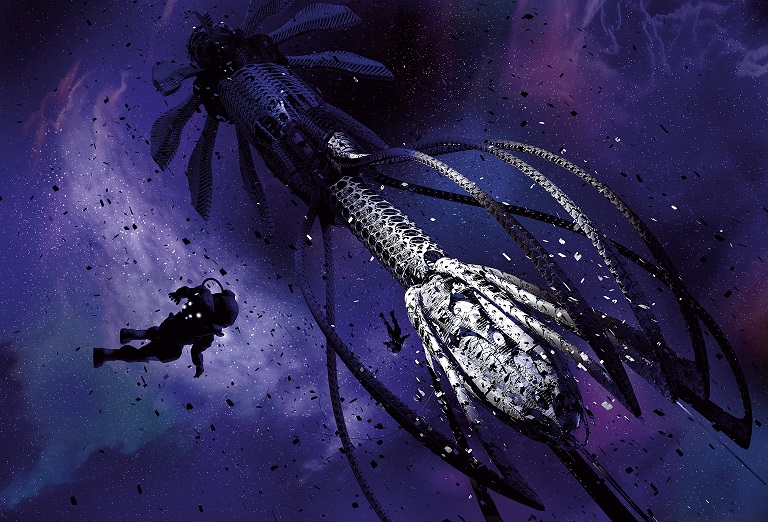
There is a Foreword from John A. Davis, which explains the importance of visual concept art, and how he and Fred worked together on the film, The Ant Bully. An Introduction by Fred himself tells of his transition in the last fifteen years from solitary freelance illustrator to being one of a team, busy in film and game studios, and how that has led to the creation of Dark Shepherd.
 The main part of the book (just under 50 pages) is a section with the Dark Shepherd screenplay, intermixed with the images Fred has created to go with the script. This works fine as an illustrated screenplay. The images are as I expected, a combination of Babylon 5 with the epic-ness of 2001, or perhaps Rendezvous with Rama.
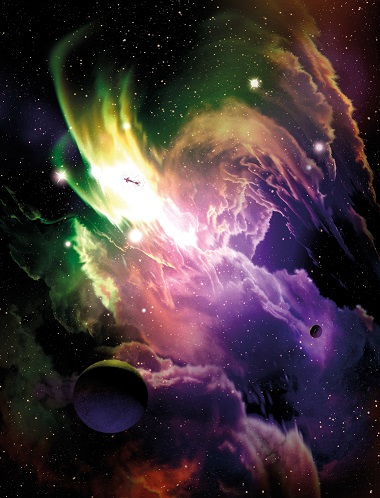 There are some great vehicles (a la Aliens, perhaps) and some amazing planet-sized environments. The next section is one of concept ‘sketches’, although what this means for Fred is the creation, through Photoshop, of images. Many of these are around a real model, Bealey Mitchell. Comments by Fred explain how the images are built up and created. The Mechs in the story are great-looking, and reminded me a little of both Battlestar Galactica’s Cylons and the Sentinels from X Men: Days of Future Past.
After that we get a version of Dark Shepherd as a graphic novel.
The Dark Shepherd work shows how a project could go from conceptual art to screen, and is a fascinating process in itself. However, the book is not just about Dark Shepherd, intriguing though that is. The latter part of the book, 90 pages or so, shows a range of work from the last fifteen years to show that Fred has been rather busy with other projects as well! We have a selection of swords, models, dragons, 3D work and photography, not to mention the liberal use of the ubiquitous Photoshop. Much of Fred’s work has been Military SF, so we have covers from books, such as the STEN books and Elizabeth Moon’s Vatta’s War series.
The Battletech and Mechwarrior section shows people with lots of big robots and machines which Fred produced under those franchises.
An idea I had never come across before was the ‘Speedpaint’ section, where Fred, to keep up enthusiasm and engage interest whilst working in video games, would paint a picture every morning. The idea was that this would then inspire other people in their work. These are sketchy but great fun, and I thought had a little of the John Harris feel about them, but are quite varied.
A section on Advertising and Commissions show Fred’s commercial side. There is a great variety of Fred’s work shown here. Mammoths and tree-characters show other sides to Fred’s work. There are also Fred’s contributions to Star Wars Visions, (although none of the iconic characters are featured there)album covers from the band Operahouse and their album Escape from the Sun, and the video game BioShock. Project X and Escape from Planet Earth show Fred’s work from films and computer games, including designs that didn’t make the final movie versions. Firebreather was a 3D animation project that Fred produced landscape drawings for.
For Starbeast, Fred produced visual development images to help sell a proposed film version of Heinlein’s novel. Having recently reread the original novel, I must say that it is disappointing that this version has not made it to the cinema screen. Lummox here is part elephant/rhino and part Photoshop, but does quite look the part based on what I read in the novel.
In terms of book work, a section on Robo Dragons shows the artwork made for a novelty activity book, which have a rather steampunk feel. The book Alienology has some great War of the Worlds and Area 51 type flying saucers, used for inspiration. The book also had an interactive website, for which Fred created an animation around a space station. Pictures of this are shown here.
In summary, as a showcase of Fred’s work, Dark Shepherd is a visual treat. It also shows how the art of illustration is changing and what artists do these days to both extend their repertoire and maintain a living. As we move in illustration from books to computer games and films, Dark Shepherd shows both a business transition and an artist happy to take on new challenges.
Mark Yon, July 2014