
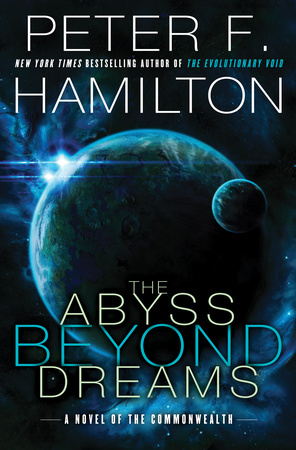
The Abyss Beyond Dreams (Chronicle of the Fallers #1) is Peter F Hamilton’s return to his Commonwealth Universe, a setting that, prior to this novel, stands at six volumes. Not that they’re all a continuous series, but rather a stand-alone (Misspent Youth), a duology known as the Commonwealth Saga (Pandora’s Star and Judas Unchained), and his Void Trilogy (The Dreaming Void, The Temporal Void, and The Evolutionary Void). To date Hamilton has written in excess of 5,000 hardback pages in this universe – his most-used. While a return to this setting is most welcome, the nature of this new duology raises questions. Fitting in snuggly between the Commonwealth Saga and the Void Trilogy, The Abyss Beyond Dreams addresses a revelation from The Evolutionary Void, that Querencia was not the only human planet settled within the Void. Perhaps a throw-away line at the time, this premise is addressed in the Chronicle of the Fallers, and is Hamilton’s return to form following what many considered a bloated stand-alone in Great North Road.

The nature of The Abyss Beyond Dreams means that there are inevitable spoilers for the Void Trilogy, many of which are discussed below. Read on for the publisher’s synopsis:
When images of a lost civilization are ‘dreamed’ by a self-proclaimed prophet of the age, Nigel Sheldon, inventor of wormhole technology and creator of the Commonwealth society, is asked to investigate. Especially as the dreams seem to be coming from the Void – a mysterious area of living space monitored and controlled because of its hugely destructive capabilities. With it being the greatest threat to the known universe, Nigel is committed to finding out what really lies within the Void and if there’s any truth to the visions they’ve received. Does human life really exist inside its boundary?
But when Nigel crash lands inside the Void, on a planet he didn’t even know existed, he finds so much more than he expected. Bienvenido: a world populated by the ancestors of survivors from Commonwealth colony ships that disappeared centuries ago. Since then they’ve been fighting an increasingly desperate battle against the Fallers, a space-born predator artificially evolved to conquer worlds. Their sole purpose is to commit genocide against every species they encounter. With their powerful telepathic lure – that tempts any who stray across their path to a slow and painful death – they are by far the greatest threat to humanity’s continued existence on this planet.
But Nigel soon realizes that the Fallers also hold the key to something he’d never hoped to find – the destruction of the Void itself. If only he can survive long enough to work out how to use it . . .
As The Abyss Beyond Dreams begins we are on board one of the Brandt colony ships that were taken into the Void, with members of the crew trying to discover what has happened. With time short, and Skylords approaching, the decision to split the seven-ship fleet is made. Some of these go on to Querencia – and the events of the Void Trilogy – while we follow the others on to what will become known as Bienvenido. It is here that a mysterious orbital ‘forest’ is observed, and the discovery of the Fallers, an ancient menace stuck in the Void, and one that will plague Bienvenido for generations to come.
When Inigo dreams of life within the Void the Raiel are keen to learn more, and enlist Nigel Sheldon for the task. With knowledge of the Void’s abilities, and with the help of the Raiel, Nigel enters the Void in an effort to end its destruction from within. But his plans go awry when, after hoping to land on Querencia, he instead ends up on Bienvenido, and seemingly without hope. That is until he learns more of the Fallers, and a way that they could lead to his goal: destruction of the Void.
Split into six books, The Abyss Beyond Dreams does take a while to really get going. The first couple of books – Twenty-Seven Hours and Forty-Two Minutes, and Dreams From The Void – set the scene and provide information rather than actually telling the story. It’s an interesting format to choose, but one that does ultimately work in its favour. However, the first book, while interesting and important to the story, doesn’t do the rest of the novel justice. It’s procedural, and slightly long, but interesting nonetheless. The second book, however, is where things really start to get going. It’s the only part of the novel that is not set within the Void, and is essentially where Hamilton gives us the information we need to become fully engrossed in the story. And from there on out it’s all about Bienvenido and the Fallers.
As is the case within the Void, advanced technology just doesn’t work. Bienvenido is at a comparable technological level to the late 19th century, having the use of trains as the quickest method of travel. The towns and cities also have a similar feeling, with industry taking a focal point, but with the added bonus of the telepathic and telekinetic properties of the Void. It all adds up to a very impressive society, and one that is surprisingly different to that of Querencia given everything that they have in common. For those that are familiar with Hamilton’s Void Trilogy, this is perhaps one of the most impressive feats in The Abyss Beyond Dreams, being able to portray something so different when it could have been way too similar.
The Fallers are exactly that: eggs that fall from the sky, and ones that can absorb and mimic their prey with very little to give them away. It’s this threat that Bienvenido has suffered since humans landed on the planet, and one that is central to the story, and to the main protagonist, Slvasta. Having lost his hand to a Faller egg, Slvasta moves forward with one main goal: the eradication of the Fallers whenever they touch down on Bienvenido. It is this fanaticism that brings him to the unwanted attentions of his superiors in the military, and ultimately leads him to the capitol where his fights for change.
I must admit that I initially felt a little déjà vu with this story thread. Not only is the story reminiscent of Edeard’s ascension on Querencia, but it seems to have more in common than I would be happy with. However, Hamilton once again shows his storytelling prowess by subverting the expectations that are gained while progressing through the other books within The Abyss Beyond Dreams: Revolution For Beginners, Cell Structure, Those Who Fall, and Those Who Rise. Not only does he create yet another vividly realised world and society, but he populates them with characters that are more than they initially seem. Of course, once Nigel shows up on Bienvenido and crosses paths with Slvasta the story picks up pace yet again, and deliver so much more than is expected.
It’s safe to say that The Abyss Beyond Dreams is an ambitious novel, not only in scope, but also as a pre-sequel. To tackle an issue that the reader already knows has been resolved is initially confusing. After all, the Void Trilogy essentially renders Nigel’s quest redundant – it’s set many centuries after the events here, and the Void is still standing. Given this it’s hard to put into words just how shocked I was come its finale, and how desperate I am to read the conclusion to the Chronicle of the Fallers (The Night Without Stars, expected late 2015).
So what, exactly, can one expect to find within the pages of The Abyss Beyond Dreams to justify its existence? Quite simply, this is a novel whose world-building and story have been masterfully interwoven with previous Commonwealth novels, as well as one that stands alone in delivering a complex and immersive narrative, and shows a master at the top of his game. It’s intelligent and gripping, action-packed and emotional, but most of all it’s a shining example of what science fiction has to offer.
I can’t recommend this novel highly enough.
Publisher: http://www.panmacmillan.com
Author: http://peterfhamilton.co.uk
October 2014, 750 Pages
Hardcover, ISBN: 9780230769465
Review copy received from the publisher
© 2014 Mark Chitty



Nice review, Mark. My mouth is figuratively watering in expectation of reading this very soon.
I guess, it being a Hamilton book, there will be amazing world building but too many characters and too many plot lines.
It’s a pity. With the right editor he would be the best there is.
Great review Mark – good to see the book is living up to its expectations. Met PJH at the signing in Bath on Thursday when he was in an intersting and introspective mood this time! I reread Great North Road this year – and yes it is long maybe bloated – but in the end I still felt most should be in the book. This could of course be because I knew what happens and so could enjoy the detail as I read it and not get frustrated for plot developments. But then that is what makes a PFH book special.
Interestingly we discussed at Bath the subject of how many characters one can have in a book!
I really do enjoy Hamilton’s work, but, alas, the Void trilogy was one set of books that I could not get into. I have yet to finish the last book in the series, and I doubt I will.
Though, will I be able to read this series and still enjoy it?
Mike
If it helps, Mike, I think you can. This is a prequel of sorts, and although there are links to other books, they’re not overtly explicit. Abyss is a pretty good entry point to Peter’s books. Now whether you like what you read, I guess is up to you… !
Thanks Hobbit.
The Void trilogy just didn’t work for me.. I dunno why.. Some books are just hit and miss. But, I do like Hamilton. And, generally, I like your recommendations. 🙂 I’ve been around for awhile. (Keyoke – Lurker)..
Mike (Keyoke)