

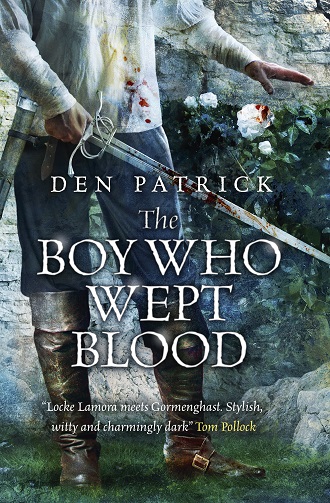
 In Book Two of The Erebus Sequence we return to the world of Landfall and the castle of Demesne. Nine years after the events of The Boy With A Porcelain Blade we are a wiser reader, now knowing that the King’s reign was a time of horror and almost mystical wonders. Lucien, the ‘Boy’ (or Orfano) of the first book has retired in solitude to San Marino. After the terrors of her father’s reign, his sister Anea, The Silent Queen, seems determined to bring in a new era of enlightenment, with rights, education and emancipation for the lower classes – something the aristocratic ruling hierarchy are horrified by.
The Boy Who Wept Blood however is mainly focused on the actions of one person – Anea and Lucien’s half-brother, Dino, the boy with chitinous tines on his forearms and who, as the title of the novel would suggest, bleeds when drawn to tears. Acting as bodyguard to his half-sister, this world of Demesne is both dangerous and exciting. There are regular attempts on Anea and Dino’s life by the frightened populace – both the various Houses now jockeying for political position and the equally unsettled general population. To add to this upheaval there is the rise of a new religion amongst the people – The Cult of Santa Maria – which has led to travelling disciples and civil unrest among the masses.
As the plot develops, Dino finds himself involved in court intrigue and subterfuge. Acting as both bodyguard and assassin, Dino’s life becomes increasingly complex trying to satisfy the many demands made upon him. He finds himself having to make ever more difficult choices, often with things he disagrees with.
And at the same time, Anea’s research into her father’s ancient technology suggests that there are older and darker forces at work.
The Boy Who Wept Blood still has that wonderful sense of world-building we encountered in the first book. Demesne is an amalgamation of some kind of baroque, Renaissance-like Gormenghast, combining the weirdness of Mervyn Peake with the science-fantasy of Jack Vance’s Dying Earth, not to mention a touch of Scott Lynch’s Locke Lamora, with its strange places and unusual Italian-esque names. These can take a little while to get used to, but create that sense of ‘somewhere different’ wonderfully.
But what wins mostly is the sympathy that Den creates for his characters. Dino in particular is a pleasingly well-developed character, and much of the book is about him dealing with the subterfuge and danger of daily life. Dino finds himself acting as bodyguard, court commentator and spy, dealing with betrayal and murder whilst simultaneously coming to terms with his own sexuality. In comparison with Lucien, Dino is a more approachable and social character, although he does not find being placed centre-stage easy.
It is a time of change in Demesne, and The Boy Who Wept Blood reflects this. The overall tone of the book is rather akin to imagining the 18th century French Revolution in Renaissance Italy, which sounds odd. But it works.
The supporting cast help fill out the environment nicely. Dino’s friend Massimo is a loyal ally, in a world where friends are rare. Each House has its own identity and its share of unusual characters. In particular, the Duke and Duchess of Fontein House and Duchess Salvaza Prospero (formerly of Fontein House) are advocates of inertia, seeing Dino and Anea as threats to the establishment and Dino discovers that rapidly to his cost. The plot twists and turns created by their combined interactions, some of which are logical, others you will not expect, are what make this novel exciting.
If The Boy with the Porcelain Blade introduced us to the world of Landfall, The Boy Who Wept Blood adds detail, texture and colour. This is a bigger and more ambitious book than Porcelain Blade and one with enough development to keep fans of the first book very happy. I would recommend that you read The Boy with the Porcelain Blade first, but you should be able to pick this one up without too much trouble.
In summary, The Boy Who Wept Blood is a book that you can revel in. I was most impressed by the book’s gothic-ness, its secure world-building and deft characterisation – The Boy Who Wept Blood is an exciting page turner that didn’t disappoint.
The Boy Who Wept Blood by Den Patrick
Published by Gollancz, February 2015 (Review copy received)
ISBN: 978 0 575 13433 1
405 pages
Mark Yon, January 2015.




Oh, boy. I’d like to read this one. Let’s see when I can find the time.