

Military Science Fiction and Space Opera are practically kissing cousins in the Science Fiction branch of the Speculative Fiction tree. A good deal of Military SF takes place in the dark, vastness of space giving credence to this relationship. These two ‘cousins’ intersect in Impulse, Dave Bara’s debut novel, and the first installment of The Lightship Chronicles.
The story is set far enough into the future that “Old Earth” is not the focal planet for humanity in the story, rather, Quantar is at the center of events. Like many Military Science Fiction novels, Impulse is told in the first person, in the case from the viewpoint of Peter Cochrane, a Lieutenant in the Quantar Royal Navy, who is assigned to investigate a disaster in space which claimed the lives of fellow military personnel, including his girlfriend. The Impulse; however, a Unified Space Navy ship is under foreign command and ends up on a moon/planet about which little is currently known. Peter initially received this news from his father (Grand Admiral of the Quantar Navy, and part of the ruling family of Quantar), though the assignment comes from his superior, Supreme Commander of the Unified Space Navy.
The orders Peter is given are not 100% standard operating procedure as he is going into the mission under one set of orders and he’s told to “disobey your superior if that means being loyal to the Navy.” In addition to the military personnel, each ship has as a member of its crew a Earth Historian, the humans from Old Earth who control the technology non-Earth planets can use. When the initial mission is chaotically torn asunder, Peter is joined by a second Historian, one who was something of a mentor to him in the past.
Much of the narrative is laying groundwork for the novel, setting up the conflict Peter must face, introducing Peter and his supporting characters, and giving a hint of the future history of the human race out in the stars. There’s a deep history to this universe, with a long-vanished civilization leaving relics behind for humanity to discover. These Relics each have a code of sorts associated with them that if we are advanced enough, we can decipher it. While this is a fairly tried and true trope of the genre, I was reminded of Mark Van Name’s Jon and Lobo novels. Other elements reminded me of David Weber/John Ringo’s Empire of Man novels. The bulk of the knowledge of these Relics is protected by the Historians, advanced humans from Earth who don’t often take too active a role in humanity’s development and exploration. These characters reminded me a great deal of the Observers from the TV show Fringe.
There are some elements in the novel that, while they didn’t ring true as others, didn’t ultimately lessen my enjoyment. The one story element in particular was the ‘romance’ between Peter and Dobrina. Shortly after these characters meet, the feel of the story would suggest these two characters might become romantically entangled, but initially there doesn’t seem to be much romantic chemistry between the two. As the two characters became more familiar with each other and as the story progressed, it felt less forced.
As a whole, the main society of Quantar depicted in the novel, of which Peter is a part, has a fairly balanced in terms of gender roles. Initially, we see only men in the military, but as Peter moves through his story, women are in roles/positions of power. What came across effectively was the nonchalance with which Peter accepted his female superior. In other words, her position was the norm rather than the exception.
In the other society depicted in the novel (Levant), Bara shows a less progressive and modern gender balance. The patriarchy comes across as a bit archaic, as noted by Peter as well as the citizens of that society. That said, Levant society provides a good contrast for the main society (Quantar) and how human society has diverged over the course of many hundreds of years.
What Dave Bara did deliver in Impulse was a fun and engaging story. The protagonist comes across as relatable and believable, confident enough in himself, but not overly confident. The closest comparison I can make is Jack Campbell’s Lost Fleet novels (though I haven’t read all of them) aside from those authors/books I’ve mentioned above. I like the universe humanity populates and want to learn more about the history, where the story is going, and more from Peter. In short, Impulse is a winner for me.
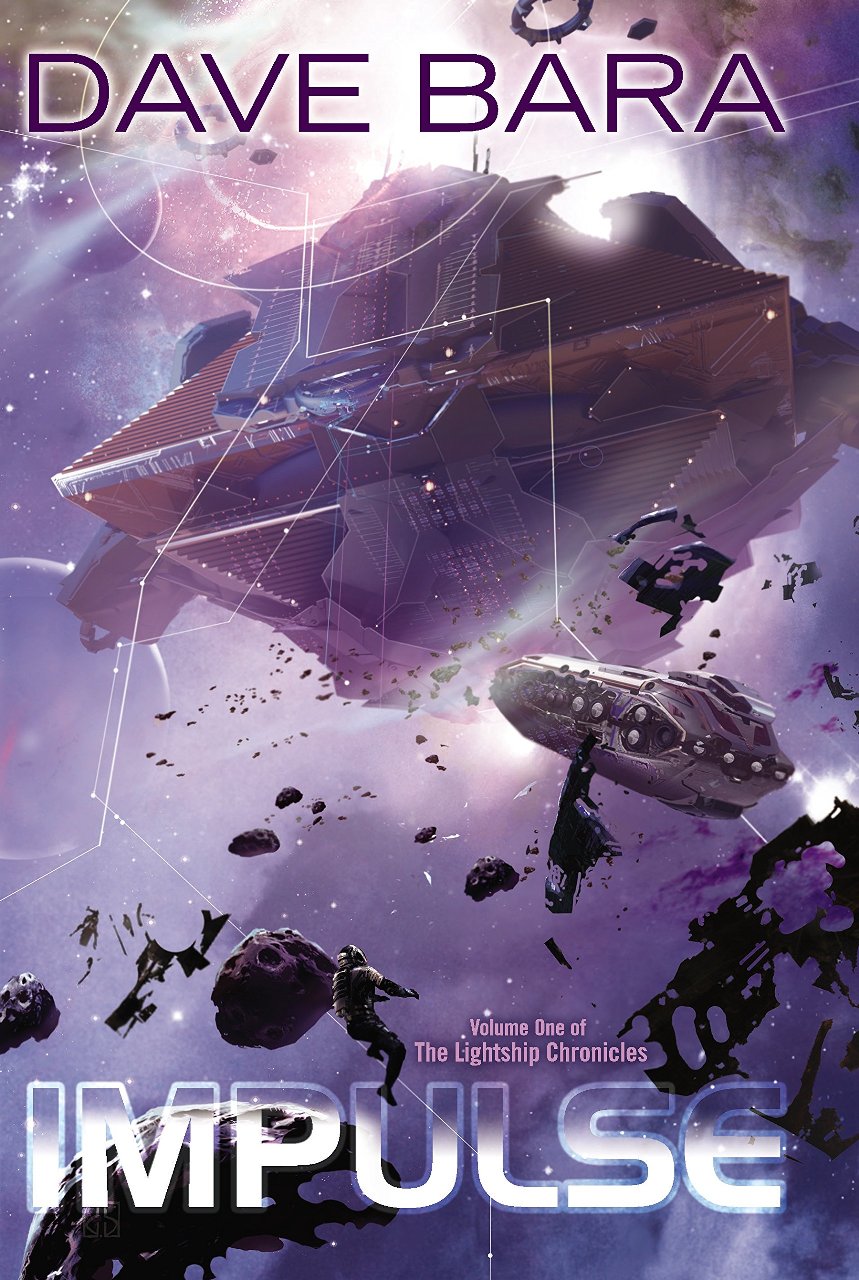
I have to call attention to the great US (DAW Books) cover art by Stephan Martiniere (one of the very best cover artists in the genre), who is at the top of his game with the image here. There’s a great use of color and light depicting a chaotic space scene.
Highly Recommended
© 2015 Rob H. Bedford
Hardcover, February 3, 2015, 400 Pages
ISBN 978-0-756-40996-8
http://davebara.com/
Review copy courtesy of the publisher, DAW




It sounds awesome. I am adding it to my list… Once I get my own book launched, I hope to have some time to do some reading for pleasure, and this sounds perfect.
It is a perty cover. Nice review – I’ll probably have to pick this one up when it publishes here (with a slightly less perty cover).
This is already on the to-read stack, and this review just makes me want to read it even more. Thanks Rob!
Yes, Martiniere is one of the best, and this is a great cover. Your description of the novel has me putting it on my “to buy” list. 🙂
Love the cover! I am reading a great Military Thriller called The Far Side of Silence, not futuristic except for the medical side. It’s really great. Bara’s book is going to be next for me, looks good.