

The Mechanical by Ian Tregillis is the first book in the author’s new trilogy The Alchemy Wars. It is a book that belies easy genre classification, spanning fantasy, alternative history, and steampunk subgenres. The author’s fifth novel overall, following on the heels of the well-received Milkweed Triptych and the stand-alone Something More Than Night, it is being published by Orbit in early March as one of the most eagerly anticipated science fiction and fantasy book releases of 2015. I am pleased to report that the book, in my opinion, will not fail to satisfy expectations.
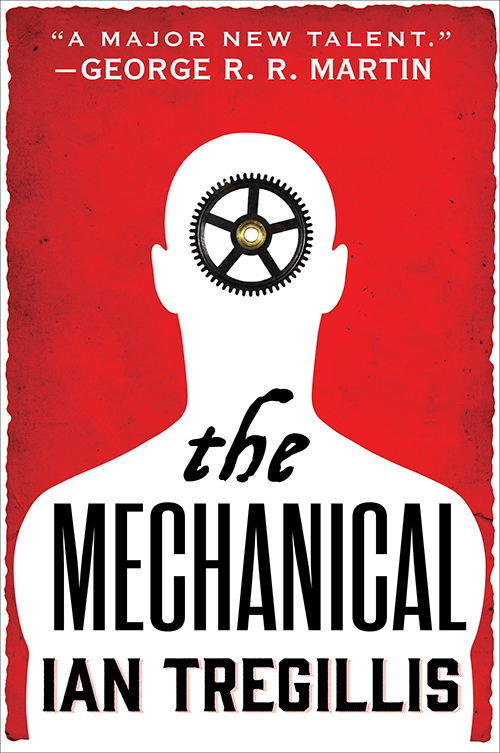
The Mechanical posits that the course of European history was changed in the 17th Century by Dutch scientist and horologist Christiaan Huygens. In Tregillis’ alternative history, Huygens’ alchemical pursuits led him to the invention of mechanical beings known as Clakkers, who were immediately forced into magical servitude by their Dutch masters. The Clakkers provided the Netherlands, ruled by the Brasswork Throne, with the means to become the dominant nation in the world. The plot of the book picks up in 1926, where the only remaining resistance to Dutch supremacy is New France. Since being forced into exile from the continent of Europe during the reign of Louis XV, New France has established Marseilles-in-the-West as a centre of government in the New World. Using chemical weapons to battle the Dutch alchemical machines, New France has warred with the Netherlands to the point of a delicately maintained stalemate.
The book alternates between the limited third person points of view of three characters. Things kick off in the The Hague where readers are introduced to Jax, a Clakker in the service of the Schoonrads, a prominent Dutch banking family. In the opening scenes Jax witnesses the execution of four Papist spies and a Rogue Clakker. A rogue, it is explained, is a Clakker that has somehow asserted its own Free Will and mysteriously escaped the magical bonds of servitude that compel it to serve its masters. Jax is thrown into existential turmoil after witnessing these executions, and hearing Adam’s final words, “Clockmakers lie”. He returns to his master’s manor to assist with preparations to relocate the household across the sea in the New World. Here, the Schoonrads will assume control of the Central Bank of New Amsterdam, which is near-collapse following an embezzlement scandal. During these preparations Jax overhears his master discussing a conspiracy that could tip the balance of power between the Netherlands and France in favour of the Dutch.
Readers are next introduced to Pastor Luuk Visser who is ministering at the Nieuew Kerk in The Hague. Visser is secretly a Catholic priest and apparently the soul remaining member of the Papist spy ring after four of its members were executed in the events of the preceding chapters. A spiritually distraught Visser is preparing to commit the sin of suicide, fearing that the Stemwinders, the hulking four-legged mechanical monsters that serve as the brute force of the Dutch secret police, are about the take him into custody and torture him. Visser’s suicide attempt is thwarted by the appearance of Jax, running an errand for his masters. When Visser learns that Jax will soon be travelling to the New World he takes to opportunity to task the Clakker with covertly delivering an item obtained by the Papist spy ring to French sympathisers in New Amsterdam in the hope that it will somehow find its way to the Talleyrand, the French Spymaster. This item, a mysterious microscope that once belonged to Dutch philosopher Spinoza, could reveal to the French the secrets behind Dutch alchemical technologies.
It is the Talleyrand, Berenice Charlotte de Mornay-Périgord, vicomtesse de Laval, who rounds out the trio of point of view characters in the book. From Marseilles-in-the-West, deep in the heart of French territory in the New World, Berenice learns that her spy ring in The Hague has been decimated, a blow to her covert operations against the Brasswork throne. However, Berenice is already pursuing a new scheme to regain her advantage against her Dutch enemies. In the last siege of the town prior to the ceasefire, a military class Clakker was abandoned by the Dutch, frozen to the battlements by an epoxy adhesive weapon. Berenice negotiates the political intrigues of the French court to secure permission to extract the dangerous mechanical being from the wall and bring it into the town precinct in order to study it as France’s first fully functioning Clakker specimen. In doing so, Berenice hopes to find away to break the yoke of servitude that binds the Clakkers to their Dutch masters.
With The Mechanical Tregillis displays the craftsmanship and precision of a master clockmaker. His world building is intricate and textured with specific detail. There is a convincing and consistent logic to the political, economic and social consequences wrought by the invention of Clakkers in the book’s alternative history setting. Furthermore, Tregillis skilfully portrays characters that are as compelling and sympathetic as they are flawed and conflicted. It is interesting that Jax is the most relatable and human character in the book. While it is easy to sympathise with Jax’s desire for freedom, he is frequently motivated by self-preservation and, through lack of foresight, he acts selfishly and reactively in ways that lead others to harm. This is also true, perhaps even more so, for Berenice. The French spymaster has many admirable character traits; she is cunning, charismatic and practical. However, she is also ruthless, arrogant and stubborn in a way that has disastrous consequences. Lastly, Visser, unravelling under the weight of Catholic guilt, deludes himself into believing that he is acting for moral reasons, whereas in reality he is driven by cowardice. I admired how these moving gears eventually came together to tell a precisely calibrated story about free will and the nature of the human soul.
I have some minor negative criticisms that apply to the final part of the book, and could be dismissed as subjective matters of taste. Firstly, while all three main characters share an even amount of page space for most of the novel, the character of Visser is absent for much of the last part of the book; an absence that results in the some of the more interesting elements of the story lacking in these final pages. Secondly, there is an infiltration scene towards the climax of the narrative that I felt relied unconvincingly on luck and coincidence to succeed. Furthermore, I found some of the climatic action set pieces, while admittedly infused with an exhilarating energy and impressively choreographed, to be somewhat confusingly described. Finally, it may bother some readers to know that, while the book tells a self-contained story arc, the conclusion is not necessarily completely satisfying, I assume relying on later volumes of the projected trilogy to achieve a more definitive resolution for the majority of the plot threads.
A clockwork fantasy seems, to me, to be the ideal subgenre to tell a story about the relationship between the free will and the soul. The book asks what makes us different to Clakkers? Do we truly have a free will once our key is wound, our springs tensed, and our gears, cogs and pistons set in motion by our maker? What is it about the concept of a human soul that makes us different to clockwork machines, and gives us self-determination and agency? I would recommend The Mechanical to any reader with an interest in well-written and engaging fantasy story set in an elegantly constructed alternate history, pushing against genre boundaries, and exploring sophisticated moral and philosophical issues.
The Mechanical (Book One of The Alchemy Wars) by Ian Tregillis
Published by Orbit, March 2015
480 pages
ISBN: 978-0356502328
Review copy received from the publisher
Review by Luke Brown, February 2015




Great review. I just finished read and loved it! A great big mixing pot of ideas, thought provoking, unflinching and spot on characters.
Lynn 😀