

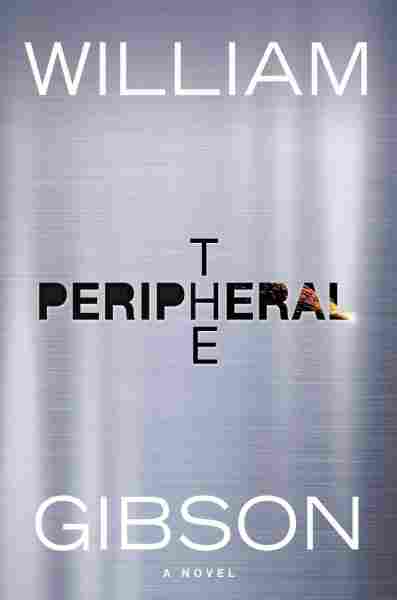
 The Peripheral, William Gibson’s latest book, is the noir prophet of cyberpunk’s version of a time travel novel. However, it is a distinctly Gibsonian concept of time travel presented in this book, used as way to explore how the past and the present, the present and the future, are in constant conversation. An H.G. Wells epigraph at the beginning of the novel warns “of the sickness and confusion that comes with time travelling.” The sickness and confusion that is Gibson’s concern does not just impact at the individual level, but at the level of whole societies.
The density of the novel’s first one-hundred pages will come as no surprise to those familiar with the author’s oeuvre. The book is told in staccato chapters, interchanging between two limited third-person perspectives inhabiting two different timeframes. The writing congeals around strings of neologisms and techno-jargon, and Gibson spurns exposition of any kind. Though the novel adheres closely to plot devices familiar to the mystery-thriller genre, narrative takes a backseat in the novel to texture and atmosphere, with writing that evokes a fully developed social reality. And, with The Peripheral, Gibson is not content with evoking just one such future society – he, instead, offers readers a vision of multiple futures.
The novel begins in the near-future in a small town in rural America where Flynne Fisher works at a 3D printing shop and lives with her mother and her brother Burton, who served in the US military’s Haptic Recon unit. Burton heads to another town to counter-protest a religious extremist group known as Luke 4:5 (“Basically they were just assholes, though, and took it as the measure of God’s satisfaction with them that everybody else thought they were assholes” (p.8)). Flynne agrees to sub for Burton in his job piloting a security quadrocopter in a video game, working for a Colombian company called Milagros Coldiron. On her second night in the game world – a cityscape that looks eerily like a deserted version of a strange future London – Flynne witnesses a man murder a woman with a swarm of nanobots.
Flynne’s chapters are interspersed with a narrative set over seventy years later, in the early 22nd century, where Wilf Netherton is a publicist in London living after an apocalyptic event known as the Jackpot. He works with Daedra West, an American performance artist, on establishing relations with a group of mutated humans, called Patchers, on an island of garbage in the Pacific Ocean. When this goes horribly wrong, Wilf is fired and ends up crashing at his friend Lev Zubov’s house. Lev, a member of a powerful and wealthy Russian crime family, is a continua enthusiast; a hobbyist who plays on a mysterious Chinese quantum computer server that is somehow able to exchange data with past timelines. This act of contact with the past creates a new timeline, known as a stub, which is a branch off of the original timeline (and, therefore, any interaction with a stub cannot affect this future timeline). Lev interacts with his stub using Milagros Coldiron as a front organisation. Wilf and Lev learn that Daedra’s sister, Aelita, has gone missing and that the person they hired from the stub to work security might have witnessed what happened.
From the outset, Flynne is an engaging protagonist. She is intelligent, resourceful and resilient. She is surrounded by a band of misfit veterans and other charming down-and-outers. Her characterisation injects a novel set in estranging technological environments with a much needed dose of humanity. Wilf, on the other hand, is harder to get on with. He is an alcoholic, a misanthrope, a pessimist. He wallows in self-pity for much of the book. His character lacks agency and he has little influence on the trajectory of his own story arc. However, a certain lack of agency in this book might be considered inevitable when one considers the themes of influence and power that Gibson is playing with.
The title of the novel comes from the name given to mechanical or android bodies that can be controlled remotely and sensorially inhabited. This is possible even through the Chinese quantum computer server. By taking control of a peripheral, Flynne is able to time travel 70 years into the future (though to a future that is not her own). This literal travelling through time serves as a metaphor for the way Gibson sees the present and the future as in conversation. At one point in the book, a character reflects:
“Eras are conveniences, particularly for those who never experienced them. We carve history from totalities beyond our grasp. Bolt labels on the result. Handles. Then speak of the handles as though they were things in themselves. (p.282)”
History is not a series of distinct points in the past, detached from the present. For Gibson, history flows into the present through a complex set of power dynamics.
Of course, Gibson novels have traditionally been concerned with power dynamics, particularly the relationship between governments, corporations and individuals (usually criminal). That concern is still very much present in The Peripheral:
“‘The use of explosives is unusual, and we prefer to keep it so. Too much like asymmetric warfare.’
‘Terrorism,’ said the rental.
‘We prefer not to use that term,’ said Lowbeer, studying her candle flame with something that looked to Netherton to be regret, ‘if only because terror should remain the sole prerogative of the state.’” (p.144)
Using its technological supremacy over Flynne and Burton’s stub, Milagros Coldiron is able to wield tremendous economic influence, dramatically altering the trajectory of that timeline, perhaps even diverting the Jackpot altogether. Gibson logically follows this interplay of knowledge and power throughout the entire book, to the point where the influence exerted by some entities over events during the novel’s resolution could be viewed as deus ex machina. Again, perhaps this should be viewed as an inevtiable characteristic, rather than a flaw, of a book with the ambitions of The Peripheral.
The Peripheral is to be celebrated as a return to futuristic science fiction for a writer who revolutionized the genre thirty years ago. For me, if the book sometimes allowed its narrative momentum to stall or reached too comfortably for a convenient resolution, it still more than succeeded in its immersive world building and a play of ideas about time, knowledge and power. Gibson retains his mantle of being one of the most ambitious and thought-provoking writers of science fiction working today and remains at the forefront of my must-read list with every new release.
The Peripheral by William Gibson
Published by Penguin, October 2014
486 pages
ISBN: 978-0-670-92156-0
Review by Luke Brown, February 2015





Glad to see Gibson return to his roots. Neuromancer was one of the books I really enjoyed when I first got into Science Fiction.