“With Earth abandoned, humanity resides on Station, an industrialised asteroid run by the sentient corporations of the Pantheon. Under their leadership a war has been raging against the Totality – ex-Pantheon AIs gone rogue.
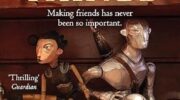
With the war over, Jack Forster and his sidekick Hugo Fist, a virtual ventriloquist’s dummy tied to Jack’s mind and created to destroy the Totality, have returned home.
Labelled a traitor for surrendering to the Totality, all Jack wants is to clear his name but when he discovers two old friends have died under suspicious circumstances he also wants answers. Soon he and Fist are embroiled in a conspiracy that threatens not only their future but all of humanity’s. But with Fist’s software licence about to expire, taking Jack’s life with it, can they bring down the real traitors before their time runs out?”
Based on the publisher’s description above, I must admit that when I got to Crashing Heaven I was rather expecting a violent, yet entertaining type of Space Opera.
Well, Crashing Heaven is not that book – in fact, it is one of the most unusual books I’ve read this year. It is instead what I can only describe as a strange mix of science fiction, detective noir and cyberpunk, with a strong element of Ballard’s dystopian bleakness and William Gibson’s Neuromancer cyberspace upgraded to the 21st century (or, rather, the 28th.)
Some of this you may like – other parts perhaps less so. If you are like me, the character of Hugo Fist is what makes this book work or not work for you. I think that your like or dislike of the novel will mainly depend on your acceptance of the lead characters in the novel.
As was mentioned in the publicity above, Hugo is an AI character that is connected internally to Jack Forster, so closely that when their contract runs out Jack has agreed that he will die and Hugo will take full control of his body. At the moment, Hugo can possess Jack’s body and make him do things he may not want to do, though as we quickly find this is against the law and if caught could lead to Hugo’s demise.
I must admit the thought of a wooden puppet animatronic appearing to allow Hugo to walk around was a trifle off-putting – I kept thinking of the Saw movies and the movie Magic, not to mention Dead of Night and The Twilight Zone for example – but the idea that such a persona was created in order to emphasise the idea of ‘puppet’ and ‘puppeteer’ and make Hugo less frightening for children works reasonably well.
However what makes this all the more unusual is that our first impressions of Hugo suggest that he is seriously messed up – a mean, vindictive, nasty, and manipulative character who is quite different to the rather cool and unemotional AI you may be used to in other novels. His often-maniacal persona made me think of an AI as Mr. Punch, or Batman’s Joker – as unpredictable and moody as you might expect from your usual psychopath.
Part of this may be that on his return to Station, Hugo is restricted in what he is allowed to do, and this no doubt frustrates ‘him’ enormously. As the novel progresses we start to see that such a persona may be a front and that there is more to Hugo than we initially think.
By comparison (but of necessity, I think) Jack Forster is a bit of a non-entity, in counterbalance to Fist’s maniacal behaviour. As we go along we do find out about his past – Andrea, his lost illicit lover, his dead sister and estranged father, for example – but other than that, the Jack we see here is (perhaps deliberately) bland – a sad, depressed figure, rejected by his world and an outsider on a world he has been separated from for years. To rack up the tension, it doesn’t help that he’s on a countdown to a time when his contract runs out, he dies, has his memory wiped and Hugo takes over his body.
Around these two characters, Al Robertson builds an environment filled with interesting ideas. The world that Jack and Hugo live on is ‘Station’, an asteroid-space station habitat that orbits an Earth made uninhabitable by the Soft War. Station is not the shiny future living-space envisioned in Elysium or 2001 – it has been around for hundreds of years and consequently is an amalgam of metastasized residences, shops and business parks. It’s all rather grimy and decrepit, which allows Jack and Hugo to run around in a dark shadowy world that is appropriately grim. This made me think of Blade Runner’s Los Angeles but in space.
Al’s world is appropriately dark for a book determined to be so cyber-noir. What is left of the human race is assisted by The Pantheon, a group of AI’s that fought against the Totality and won, and have celebrity-style god-like status. Most of the human inhabitants here live with ‘weaveware’, a virtual environment that is overlaid on top of the physical one that takes the masses away from the stark reality of this bleak human existence. Tired old buildings have become junkie centres for a drug known as ‘sweat’, their users rapidly degenerating into zombie-like beings obsessed with repetitive work-operations.
Jack’s view on life is rather apropos to the majority on Station – this experiences from the War have left him feeling that AI (and especially The Pantheon) should not be trusted, that the life they offer is a mere sop for the masses. This is not a happy future, even when it may look like it.
There are aliens – Totality bipeds known as ‘squishies’ – who are allowed relatively free access on Station and seem very keen to help Jack in his ‘last days’ but who are regarded with suspicion by most humans. Jack’s friendship with one named Ifor seems genuine but is not particularly liked by Hugo as their generosity may have a deeper motive.
This idea that things are not what they appear at first runs through much of the book. As the book develops, we have a building sense that Jack and Hugo are reluctantly involved in events that go beyond their own concerns – murder, torture, drugs hauls, conspiracies and competing power plays which they are often near but not part of, mean that they soon become part of a much bigger picture. Ultimately they realise that their futures are being played with for the biggest stakes of all, and the future of Station, if not the human race, may depend on what they do.
For such big events, most of the book is tightly plotted on one or two characters and places, until the end when, in cyberspace, things become quite frenetic and don’t quite hold together for me. Though there is resolution, up to a point, it is clear that there are big things still to happen, setting things up for the second book in this duology.
I mentioned on the SFFWorld Forums that I was trying to get my head around writing this review. Having given some time to think about it, I’m still veering between ‘bonkers’ and ‘brilliant’. Personally I’m still not sure whether Crashing Heaven is a case of an author trying hard (perhaps too hard) to be different, or that it is something genuinely original. On one hand I could see some readers seeing it as nothing more than a revamped rehash of older SF ideas, but alternatively it could be a novel that is seen to be trying hard to be something different, riffing off traditional tropes.
Generally though it must be said that Crashing Heaven is good fun and should be applauded for trying to be different. Even if it is not wholly successful for me, I think that many may be less critical of it, to the point where Crashing Heaven could be the start of something that is going to be very big.
Crashing Heaven by Al Robertson
Published by Gollancz, June 2015 (Review copy received)
368 pages
ISBN: 978 1 473 20339 6
Mark Yon, April/May 2015.