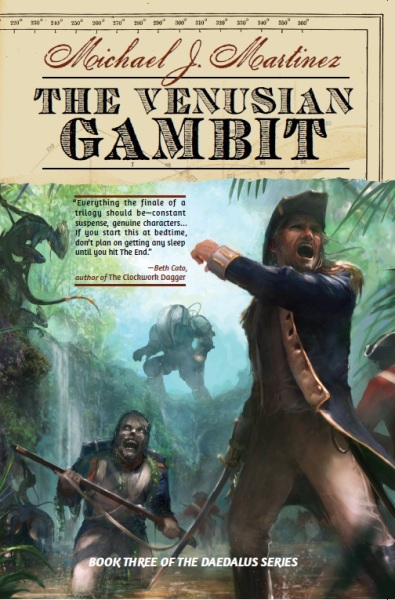
The last chapter of the dimension-spanning Daedalus series brings the nineteenth and twenty-second centuries together for an explosive finale in the jungles of Venus. We have talked to Michael J. Martinez about his Daedalus series.
For those not familiar with the Daedalus series, can you tell us a bit about it?
The short answer is: Napoleonic Era naval adventure…in space. And crossed with 22nd century hard science fiction. And aliens. Actually…this isn’t that short. Longer answer: The trilogy is about two dimensions, one of which is very much rooted in our reality, set a hundred-plus years in the future, and the other of which is set in the late 18th and early 19th century, in which sailing ships ply the Solar System using alchemy. Those two worlds collide due to the machinations of an ancient Martian warlord. There’s alchemy and swashbuckling, zombies and aliens and pretty much everything I’ve ever liked. And I got paid to write it, which is even better.
The Venusian Gambit marks the last chapter of the Daedalus series. How do you feel about the end result? If you had the chance, is there anything you’d want to go back and change?
I know a lot of writers look back and nitpick, and I admit, there’s bits of writing here and there I’d love to clean up a bit. But overall, I’m really quite thrilled with how everything went. I feel like I told the story I wanted to tell, and the books have been really well received and gotten great reviews. People like them. As a storyteller, that’s pretty much all you can ask for.
 Can you give us some insight into your main characters? How do you feel they have evolved throughout the series?
I think both my protagonists were pretty closed-minded in the beginning of The Daedalus Incident. Shaila Jain was disgruntled and depressed and feeling useless, while Thomas Weatherby was young and unsure and grasping for order as his view of the world began to unravel. Really, these books chronicle the story of these two growing up, in a way, and learning that they can shape their own futures and destinies, rather than taking things as they are. In the end, Shaila gains confidence in herself, which allows her to connect with and trust others. And Weatherby comes to accept the nuance and grey areas that life often throws at us, and still manages to keep his honor intact and his goals realized. Actually, I’m kinda proud of ’em, when I think about it!
I think what you write can only be described as a true mix of many genres, steampunk, alternative history, science fiction among others. What is it with this blending of genres you find fascinating?
I think blending genres allows us to look at them with fresh eyes. There’s a great scene in The Daedalus Incident where young Lt. Weatherby encounters Shaila for the first time — a female, British-Indian astronaut. The culture clash there was immense fun to write, let alone the struggle for each side to wrap their heads around the other’s technologies and alchemy and such. I think mixing genres can create something that’s greater than the sum of its parts, and brings a new perspective to both. Plus, it’s just plain fun, like crashing your toy X-Wing fighter into your Batcave playset.
Have you ever struggled between what you would like to happen to a character and what you considered more sensible to occur? Can you tell us when and what did you do at last?
I very much tend to err on sensibility, which unfortunately can lead to boring fiction. I think 75% of all fiction would end up being short and uneventful if people sensibly just sat down and hashed it out. Fiction isn’t just about conflict — it’s about conflict that often can’t be resolved through reasonable methods. In the first drafts of my first novel, it had a Star Trek: The Next Generation feel, particularly in the future setting. Mars has earthquakes? Why, let’s get a team right on that, we’ll contact Mission Control and play this by the book. Boring. For me it was going back to the core issue — Mars has earthquakes. That’s not happened in millions of years. Not everyone is going to be super-rational in the middle of that; they’re going to be pretty on-edge and crazed. So for me, it was recognizing that the stakes really were huge, and that not everyone is going to handle it well. And therein was a great source of conflict which helped further the story.
How did you start writing? Was there a particular book or moment in your life that spurned you on?
I’ve been a writer all my adult life, primarily as a journalist and, more recently, in marketing/communications. I’ve written for The Associated Press, for web sites and newspapers and magazines, you name it. So writing has always been my thing. I like telling stories. In tandem with that, I’ve always had a love of SF&F and geek culture, from RPGs to movies to books. The real moment came when I left journalism and had been in my current job for a few years. While challenging and fulfilling, my current gig is simply not as demanding as the 24/7 news cycle. So I had some time and bandwidth on my hands, and the idea of sailing ships in space had been in my head for a while. I simply decided it was time to give it a go. It’s worked out far better than I could’ve reasonably hoped for.
What sort of challenges, as a writer, might you have faced before your first book was published? Any insights you would be able to share for those aspiring writers seeking advice?
When I tell aspiring writers about my path to publication, they tend to look at me askance, because frankly, I was really lucky. I queried six agents, and got one. We did have the book out on submission for roughly nine months before it found a home, but we ultimately had a couple offers. I followed the process and, well, it worked. I know that’s not what everyone experiences. I will say that my debut was very rough when I sent it to my agent; thankfully, she was willing to work with me to get it into shape because she loved the concept and, as she put it later, I was willing to be taught. So my advice: Any time you think your manuscript is ready to be submitted to agents (or publishers), go and revise it one more time. Or maybe twice! And be willing to be taught.
What is the hardest thing about writing?
Honestly, I don’t find writing hard. Coming up through journalism was great training for writing quickly and without regret. Plow through, then revise. Then plow through again. I’ve quickly adopted a process that works for me, but I know that it’s not that easy for others. Really, the hardest thing is making sure I strike the right balance between writing and the rest of my life. I have a family and a career outside fiction, and those have to take priority, in that order.
For your own reading, do you prefer ebooks or traditional paper/hard back books?
It’s all about the print. I’m used to dog-earing pages and marking up reference material and all that. And I like how bookshelves look.
What kind of books do you read, any favourite authors?
I’ve been introduced to so many excellent authors — in person, and through their works — over the past couple years. And to my great shame, I’ve only read a fraction of the books I’ve wanted to dig into. Writing historical fantasy tends to be pretty research intensive for me, so the past several years have involved lots of histories of the Napoleonic era, piracy, shipbuilding, alchemy, etc. More recently, it’s been all about the Cold War and espionage, but that’s another story….
What do you do when you’re not writing, any hobbies?
My wife is a travel writer on the side; you can find her blog here. So I get to go to very cool places every so often, and I’ll add that my day job company is based in Los Angeles, which is a lovely place to visit as well. It’s not like we’re on the road every month, but we do manage to get in a couple really nice vacations each year — and they’re usually tax-deductible, which is great. Oh, and I brew my own beer at home. This makes me popular with the neighbors.
What’s next, what are you working on now?
With the Daedalus trilogy done, I’ve definitely been exploring a bit. I have a short story in the upcoming Cthulhu Fhtagn! anthology from Word Press, coming out in August. And I have another short piece coming this summer as well that I’ll be announcing soon. Other than that, I’ve been plugging away on a new series in the alternate history/historical fantasy vein, but very different from Daedalus. It’s a little darker, less four-color adventure, and you can infer a few things from my recent reading habits above if that helps. I’m hoping the pieces will fall into place to be able to talk about it soon, because it’s really kind of cool and, I think, has some of my best writing so far. Stay tuned, as they say.
* * * * * * *
Interview by Dag Rambraut – SFFWorld.com © 2015