

I thought long and hard about whether I should make a comparison between Australian author Rjurik Davidson’s debut novel, Unwrapped Sky, and the Bas-Lag novels of China Mièville. It seems a reductive approach to reviewing this book, which is certainly the product of a fertile and ambitious imagination of all of its own. However, undeniably the many pleasures of Unwrapped Sky are reminiscent of those earlier Bas-Lag books. The lavishly constructed city setting patched together from a variety of technological and mythological elements; the wilful subversion of the tropes of epic fantasy; and the book’s conversation with the politics of revolution; all this makes the comparison hard to resist.
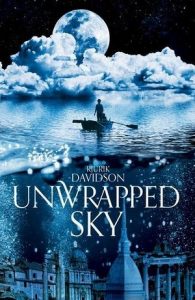
New Weird seems to be last season’s fashion in the world of speculative fiction (perhaps supplanted by Grimdark as the in vogue thing (and I suspect an interesting essay could be written on the relationship between the two “movements”)). However, Unwrapped Sky is a debut novel that spent almost a decade in gestation, with roots in a time period when the term was perhaps more relevant to the conversation in the field. The novel is set in the same fantastical milieu as several of Davidson’s earlier short stories (collected in The Library of Forgotten Things put out by PS Publishing in 2010). The first of these stories dates back to 2005, and that piece, titled ‘The Passing of the Minotaurs’, forms a large part of the opening chapters of this 2014 novel.
Those who have had the pleasure of reading the preceding short stories will be familiar the city of Caeli-Amur, where the entire plot of this novel takes place. Like New Crobuzon, this setting is intentionally anachronistic, with classical references butting up against elements from the post-industrial revolution era.
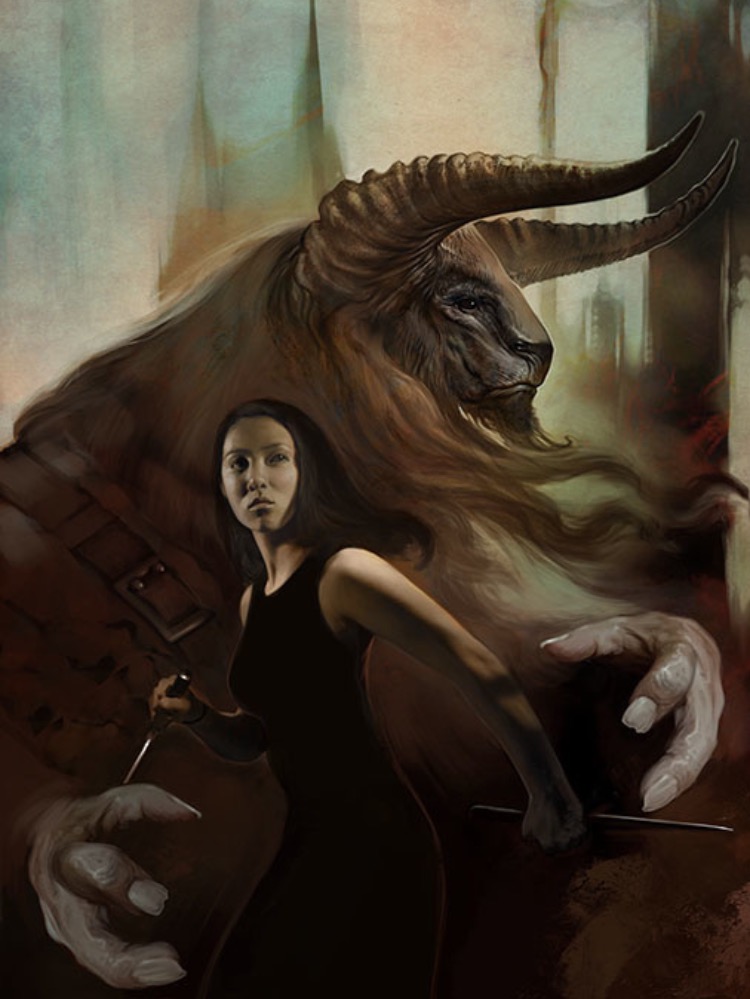
The city is described as nestled on a coastline against white cliffs in a way that immediately brings to mind the cities of ancient Greece. This reference point is further re-enforced by the inclusion of creatures from Greek mythology, such as minotaurs and sirens, though Davidson also throws in creatures born purely from his own imagination, like the fish-men known as Xsanthians. The descriptions of many of the public buildings in Caeli-Amur also evoke the Colosseum and well-known features of ancient Rome.
These elements coexist with factories and production plants that have been transposed from the late Nineteenth or early Twentieth Century. Much of the city’s steam powered technology seems to be from this later period. Though, there is a noticeable absence of gunpowder (presumably there is no analogue for China in this world), meaning that fighting is mainly carried out with blades, bludgeons and bolt-throwers.
Just as the setting is a juxtaposition of old and more modern reference points, Davidson’s prose is often an exercise in contrast. Consider, for example, the dreamlike opening paragraph of the book:
“For the first time in tens years the minotaurs came to the city of Caeli-Amur from the winding roads that led though the foothills to the north. There were three hundred or more of them. From the city they appeared as tiny figure – refugees perhaps. But as they approached, the size of their massive bodies, the magnificence of their horned bull heads, the shape of their serrated short-swords, became apparent. The minotaurs had come for the Festival of the Bull. When the week was over, they would descend from the white cliffs on which the city perched and board ships that carry them out over the Sunken City and home to their island of Aya.” (page 15)
Such surreal and fantastical imagery is often quickly defiled by descriptions of horror and violence. It’s not long into the book that one of the minotaurs described so gracefully (almost sacredly) above is seduced back to the apartment of a human woman for sex, only to be slaughtered and sliced up for some degenerate commercial use. The subversion of magical creatures from legend by integrating them into a grim and dirty world is another another comparison point with Mièville. The graphic descriptions of violence imbue the narrative with a relentless tension. Underneath the sweet smell of the book’s dreamlike passages, there is always the waft of decay and ruin.
Decay and ruin also literally reside beneath the streets and buildings of Caeli-Amur, as the city has been built over the top of a past underground civilisation – a technologically advanced utopia powered by thaumaturgy. Again like Mièville’s own integration of magic in the Bas-Lag setting, Davidson’s conception of thaumaturgy is as a system of magic that operates in accordance with rules that are presented with a scientific degree of rigour, conjured using mathematical principles and interacting with quantum particles.
In Davidson’s world, once the various disciplines of thaumaturgy – Illusion, Alchemy, Transformation, etc. – were unified, however, a battle between the gods Aedilies and Aya in the distant past led to an event known as the Cataclysm. The Catalcysm destroyed the original city of Caeli-Amur, and sunk its sister city of Caeli-Enas beneath the waters off the nearby coast, leaving the original inhabitants of Caeli-Amur, the Elo-Talern, to lurk in the underground ruins of the city, existing like Lovecraftian eldritch horrors.
After the Cataclysm the various disciplines of thaumaturgy were splintered so that they could no longer be practiced under a unified theory. The use of any thaumaturgy is now dangerous and results in a leakage from the source of this power, known as the Other Side, which physically mutates the user:
“That was the price of power: nothing spent, nothing received, though sometimes, for no reason, the sickness was worse than at others. He knew this was only the beginning. He had seen the House’s skilled workers – engineers, tramworkers, mechanics – with strange growths on their faces and bodies, who died young or ran mad in the streets. For those who stood unprotected, unable to control the powers, it was worst.” (page 66)
Unwrapped Sky is a book about power – those who seek it, those who use it, and those who struggle against it. The warping effect of thaumaturgy (again, recalling a fascination with body horror shared with Mièville) is symbolic of the corruptive nature of these various levels of interactions with power in the book.
Unwrapped Sky follows three major characters – a philosopher-assassin Kata, a seditionist and thaumaturgist Maximilian, and House Technis bureaucrat Boris Autec – and as the book progresses each of them is forced to compromise in ways that are literally dehumanising, in the pursuit of their own goals and agendas. At one point an ‘alien’ character in the novel observes:
“‘It may not seem like it, but I value your humanity. The way you are so torn, trying always to do the right thing!‘” (page 112)
There are ‘good’ characters and ‘evil’ characters in Unwrapped Sky, people we can root for and people we can hiss at, but often the line between the two is blurred. Davidson writes characters that are both understandable and flawed.
These three major characters in the book come into conflict in a plot involving a seditionist group’s attempt to overthrow the exploitative regime of the three major trading Houses that rule Caeli-Amur. Davidson’s original short stories in this milieu focused on the bureaucracy of the three major trading Houses controlling commerce in the city of Caeli-Amur, as well as the philosopher-assassins that serve the Houses in their ongoing conflict. With the introduction of a group of seditionists to the mix, Davidson, like Mièville before him in books such as The Iron Council, crafts a narrative designed as a critique of revolution and an interrogation of the possibilities of self-determination within such pervasive power structures.
Unwrapped Sky’s epigraph is from Soviet Russian revolutionary Vladimir Mayakovsky’s poem “Past One O’clock” and the book itself takes it’s title from an inversion of a phrase used in this poem, “Night wraps the sky in tribute from the stars”. Mayakovsky, originally as Bolshevik sympathiser, later grew disillusioned as the Revolution’s ideals were smashed “against the daily grind”, eventually taking his own life at the age of 36. This disillusionment with the notion of revolution is mirrored in the story arc of more than one character during the course of Unwrapped Sky.
There is a schism within the seditionists themselves, with various factions struggling to assert dominance, each with different methodologies for contesting the rule of the Houses. This deliberately evokes the divisions between groups such as the Jacobins and the Girodnists of the French Revolution, or the Bolsheviks and the Mencheviks of the Russian Revolution. Unwrapped Sky presents revolutions inspired by worthy ideals as becoming sordid and violent things, corrupted by self-interest and compromise. Unwrapped Sky is ultimately about three people who are struggling to act with self determination within the confines of oppressive power structures within an authoritarian society.
If this all sounds like characters often perform the role of ciphers for the ideas Davidson wants to explore, rather than fully developed characters with agency, then that would be an accurate criticism. At many times during the novel, characters will make declaratory speeches that read like extract from a philosophical text, rather than natural dialogue. This often has an estranging affect on the reader, making it difficult to feel fully involved in the tribulations of the characters or immersed in the plot.
“The workers wandered to and fro like cogs in a machine – each with his little role to play in a greater logic. Just like her, she thought.” (page 89)
Ironically, this short extract seems symbolic of a particular issue I had with the novel. While Davidson’s characters have agency and influence there own arcs within the story, the major character’s themselves seem have little influence on the broader plot movements.
Putting these reservations aside, I found Unwrapped Sky to be very worthy of my time and it is encouraging for me to see a fellow Australian produce work of a quality that compares favourably to other contemporary fantasy novels. I would recommend Unwrapped Sky to Grimdark epic fantasy readers looking for something with some different flavours, or those readers who have been pining for a new Bas-Lag novel. Unwrapped Sky will be followed by a sequel called The Stars Askew later this year, which I will definitely be picking up with great interest.
Unwrapped Sky by Rjurik Davidson
Published by Pan Macmillan, April 2014
430 pages
ISBN: 9781447252375
Review by Luke Brown, May 2015




Thanks, Luke – am intrigued by this one.