Hello, Pamela: many thanks for giving us some time here. Welcome to SFFWorld.
I’m writing these questions as Open Road Media are releasing some of your older work in the USA as e-books.
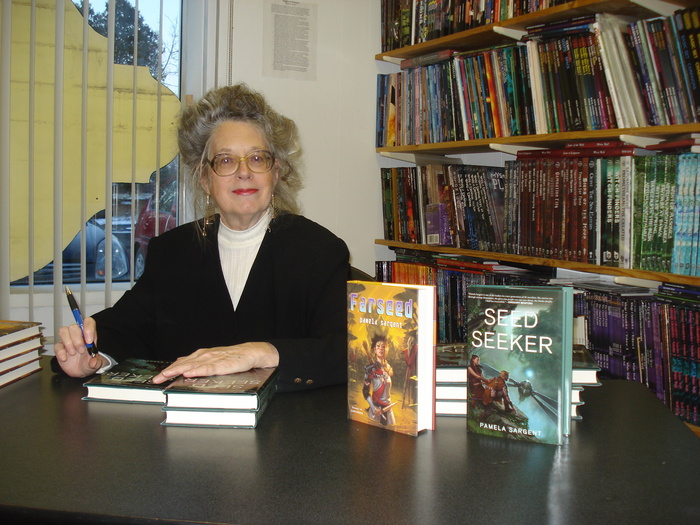 Of the current list (Alien Child, Behind the Eyes of Dreamers, Eye of Flame, The Golden Space, The Mountain Cage), have you got any particular personal favourites in that list?
Each of these can be a favorite of mine at different times for different reasons. Alien Child was a challenge because I had to deal with a very small cast of characters, including a couple of aliens. Usually my books are populated with large casts of characters and unlike many SF writers, I haven’t written that much about alien or nonhuman characters.
Behind the Eyes of Dreamers is a long, ambitious novella – maybe too ambitious at that stage in my writing life, as it was partly based on Joseph Conrad’s An Outcast of the Islands – it pretty much disappeared right after its original publication. They say parents are often most attached to their most ignored children, so that probably applies here.
The title story in Eye of Flame was my attempt to write a novella that is both a historical fantasy – it’s set in Mongolia during the time of Genghis Khan, who appears in this tale as a child – but which also has a completely naturalistic explanation for all of the story’s seemingly supernatural events. The central character, Khokakhchin, is a minor character in my historical novel Ruler of the Sky.
The Golden Space is centered on the classic theme of immortality. I began writing it when I was still in my twenties and might have treated the subject differently now.
The Mountain Cage is a collection first published in 2002 that includes my Nebula Award-winning story, “Danny Goes to Mars,” along with another alternate history story I think of as its companion piece, “Hillary Orbits Venus.” The protagonist of “Danny Goes to Mars” is former U.S. Vice President Dan Quayle, while “Hillary Orbits Venus” has as its main character Hillary Rodham Clinton, who at the time I was writing this story was preparing to run for the U.S. Senate from my home state of New York. For this edition of The Mountain Cage, I’ve included all my original afterwords to the stories; I’d thought of revising and updating some of them but then decided to leave them alone, just to let readers see what I was thinking in 2002 as opposed to the conclusions I’ve drawn since then. The collection also includes another alternate history story, “The Sleeping Serpent,” in which the Mongols, after conquering all of Europe, settle Manhattan Island and make an alliance with the Mohawks, and “Too Many Memories,” a short-short published in Nature. The title story, “The Mountain Cage,” is a fantasy about a cat in Nazi Germany and his encounter with Hitler’s dog Blondi.
Alien Child was originally published in 1988 and I guess you could say it fits what today is labeled as Young Adult. Do you feel it fits that label and do you think it could have a new market with the rise in YA books?
Alien Child’s original publisher, Harper & Row, brought out Alien Child as a young adult novel, but back then science-fictional YA books didn’t do nearly as well as fantasy for younger readers. The assumption seemed to be that maybe science-fictional ideas were too sophisticated for most kids and those who were interested in SF were already reading books written for adults. Well, we all live in a science-fictional world now and I suspect that younger people are more adapted to and at home in that world than some of us older folks. I very much hope Alien Child finds some new readers – of all ages – in its new edition.
How comfortable are you generally with seeing the re-appearance of older work? Is it something you’re happy to do, reaching a potentially new, wider audience, or are they something from your past but something you’ve moved on from?
I’m delighted to see older work coming out and able to reach more readers. Yes, these are novels and stories I wrote years ago, meaning that I was sometimes wincing while proofreading the texts and muttering to myself, “I wouldn’t have written that line that way now” or “What the hell made me think I’d really nailed this story?” Then again, if I didn’t feel that way it would mean that I’d made no progress as a writer. I did the best I could at the time and since I have no taste for collaborating with my younger self, I settled for correcting obvious typos and errors and left it at that. I’d rather move on to new work instead of rewriting older work, but that doesn’t mean I’m unhappy to see the earlier work out there again.
In The Golden Space which you wrote more than 30 years ago you look into the theme of immortality, a theme some would argue is getting more and more realistic. Can you tell us a bit about the book and what it is with this theme you find fascinating?
Well, isn’t the fear of death and the hope that one might live on at the root of most of what we do as human beings? Even so, I took a somewhat dim view of immortality when I first thought of writing The Golden Space. As I mentioned before, I was still young and convinced at that age that outliving people I cared about would be hell; I’d been through it too many times already. People who had thought more deeply about the subject of extended life pointed out that this was an extremely uncreative way to look at the subject; what if most or all of those people could live on with you? That possibility opens up a number of questions, among them what kind of society you might have if it’s made up of human beings who could live, theoretically, forever. Would they become more fearful of taking any risks, given that accidents might still kill them? What kinds of spiritual beliefs would they have, if any? What would the role of children be in such a culture, surrounded by people who had been around for centuries? I don’t consider The Golden Space to be a terribly optimistic book, but it’s not completely pessimistic, either, and in the end the characters who are the most likely to make the most of their extended lives are those who have been altered biologically. In any case, I wasn’t actually writing about “immortals” in the sense of beings who could not die or were invulnerable, but about people with indefinite life spans. They’ve got some of the same problems we have and some additional ones of their own.
Right now we have only a very imperfect glimpse at what a culture of very long-lived human beings would be like. Yes, we have more people living to really old ages – I’m old enough to remember people telling me as a child that so-and-so had lived a “good long life” after dying at the age of sixty-six or so, and now it’s not unusual in developed countries to have people living well into their nineties – but there’s still the problem of diseases of old age, physical decline, the huge expense of caring for the old, and the way older people can so easily become invisible to or neglected by younger ones. A lot of us aren’t going to be able to afford getting too aged and I’m guessing that if there are any real breakthroughs in life extension, the rich will be the ones most likely to benefit. Somehow I can’t see them making sure the rest of us peons also have access to long lives in youthful bodies. I would hope that a society of people with indefinite lives would be much more open and creative than what we have now, and would get past our limitations, but who knows?
You also have a new novel being released this year, Season of the Cats. What can we expect?
This novel is something of a departure for me. It’s set in the present and would probably be classified as an urban fantasy if you’re looking for a genre tag, and Wildside Press is bringing it out in hardcover. Maybe instead of trying to describe it myself, I should just immodestly quote Kit Reed, who said about Season of the Cats: “A gifted social critic, Pamela Sargent draws the lives of a dysfunctional suburban couple as seen in a fresh, sometimes funny, often macabre light. Which is the bigger threat to the marriage, the evil spectre they call Household or the countless furry citizens of Catalonia, their imaginary Magic Kingdom who show up in real life? The race threatens to be a photo finish; finding out what happens, and how, is half the fun.” Or James Morrow, who said: “Pamela Sargent has given us a delectable confection, wrought from an irresistible recipe: a dash of Fritz Leiber, a touch of Neil Gaiman, a dollop of Roald Dahl—plus a full measure of her characteristic adroit plotting and compelling prose. At once whimsical and sardonic, Season of the Cats will enchant all fans of offbeat fantasy.” And Pat Cadigan called it “…a sneaky book. You think you’re reading it; it’s actually stalking you. This is a story that may seem familiar at first but that’s only how it pulls you in. Trust me, you’re about to be unsettled in ways you never imagined.” I was really pleased to get such enthusiastic early comments.
Thinking back, how did you start writing? Was there a particular book or moment in your life that spurred you on?
I don’t know if there was a time in my life that I wasn’t writing, or at least telling stories. I don’t recall learning how to read because, thanks to parents who read to me and my siblings, I knew how to read before starting school. I was the kid at summer camp who told creepy ghost stories to my cabin and tent mates at night. I made a stab at writing a collection of slice-of-life short stories when I was around twelve, so it’s been an ongoing pursuit. My earliest career ambition was to become an actor, but even there I also wanted to write my own plays and even produced a couple of them on stage at school with a few dramatically inclined friends.
After all this time, have you managed to distill an idea on what is it about the SF genre that you like? (Or even don’t like!)
What I like about the genre is what drew me to it in the first place, namely that I could write about the world as it might be or could be as opposed to how it is.
At a time when the science fiction genre was very male-dominated you’ve always written science fiction that presents female characters as strong and intelligent. How has this been important to you and how do you see that female characters portrayed in science fiction have changed over the years?
I have enjoyed seeing how much female characters have changed in SF and how many more women are writing SF. At the same time, I’ve become increasingly exasperated by articles discussing women storming the gates of science fiction as though this was something that just occurred yesterday, all these pieces about publishers rushing to sign up women writing SF or fantasy about strong female characters. Well, publishers are always rushing to sign up what looks like the next big thing that seems really profitable while at the same time writers who have explored much of the same territory that seems so new to these cultural amnesiacs are either ignored or have lapsed into silence. It would be nice if we could embrace the new while still honoring – or at least remembering – the older works.
Undoubtedly, the science fiction field is a genre that has grown in style, maturity and complexity over the years. Do you find yourself still reading for entertainment much? Or do you tend to read away from the genre?
I do still read SF partly for entertainment and partly to see what writers I admire are doing, but it’s harder for me to simply wallow in a yarn the way I could do when I was younger. I read a lot of nonfiction, history and science in particular, and there are masterpieces of literature that deserve to be read or reread before I pass on, so you’d have to say I read outside the genre but do my best to keep up with what’s going on in SF, too.
And what of newer authors? Are there any personal favourites?
There are so many that I can’t name them all. As one of the jurors for the John W. Campbell Memorial Award for best novel of the year, I get to keep up with the best new SF novels and 2014 was a very good year. I’m a fan of Cory Doctorow’s novels; I like his mixture of technological detail and a political sensibility. I very much liked Emily St. John Mandel’s novel Station Eleven, which reminded me a bit of Edgar Pangborn’s work (and Pangborn is a humanistic SF writer who is worthy of rediscovery). Claire North’s The First Fifteen Lives of Harry August (and I know she’s written under two other names and seems ridiculously prolific for somebody so young), Jeff VanderMeer’s Southern Reach Trilogy, The Three-Body Problem by Cixin Liu – those are just a few of the books I really enjoyed this year.
How are you finding the e-book revolution? Are you happy with an e-reader these days, or do you still prefer ‘tree-books’?
I’m still reading books on paper and spend enough time staring at a screen for other reasons that I prefer it that way. But I’ve got nothing against e-books and know the day will come when that will be the way I read most books. For one thing, you can’t read huge tomes while lying in bed all that easily, and my aging eyes are going to need larger fonts before too long. There’s also something immensely attractive about being able to travel with a library in your pocket or under your arm.
What sort of challenges, as a writer, might you have faced over the years? Any insights you would be able to share for those aspiring writers seeking advice?
I’ve reached the point where just about everything I learned about how to be a professional writer has become obsolete. Some pieces of advice that have stood the test of time, though, are these: Read a lot and widely. Write every day, even if it’s only a paragraph or a sentence, and make it a habit. And I should say this as well; if I’d known how hard a writer’s life was when I began writing, I would never have started. Luckily I was too young and ignorant to know any better.
And, in 2015? What are your aspirations today?
To keep going. To write the next story or novel that comes to me insisting on being written – I’ve got folders full of ideas and research for unwritten novels.
I guess at this point it would be appropriate to ask the age-old question: what is it that keeps you writing, today – or have you now got to the point where you can happily walk away, feeling that ‘the job is done’?
Whenever I think maybe it is time to walk away – as my late father, who once hoped for a career in show business, used to say, “Know when it’s time to leave the stage” – a story or potential novel starts making a nuisance of itself, usually in the form of a character’s voice nagging at me. That said, I hope that I will know when it’s finally time to get off the stage.
Once again, thank you very much for your time.
Dag and the SFFWorld team.
* * * * * * *
Interview by Dag Rambraut – SFFWorld.com © 2015