You might have heard of this book called Ancillary Justice (see Rob Bedford’s review for SFFWorld here). It was written by Ann Leckie. People liked it. It received the Hugo Award, the Nebula Award and the Clarke Award, amongst others. I liked it a lot too, but maybe not as much as others, judging by the time its taken me to get around the reading the second book in the projected trilogy. Ancillary Sword was published last year to some of the same acclaim as Ancillary Justice, if not quite as rapturous. This general reception mirrors my own response – Ancillary Sword is a good book, if not quite as interesting as its predecessor.
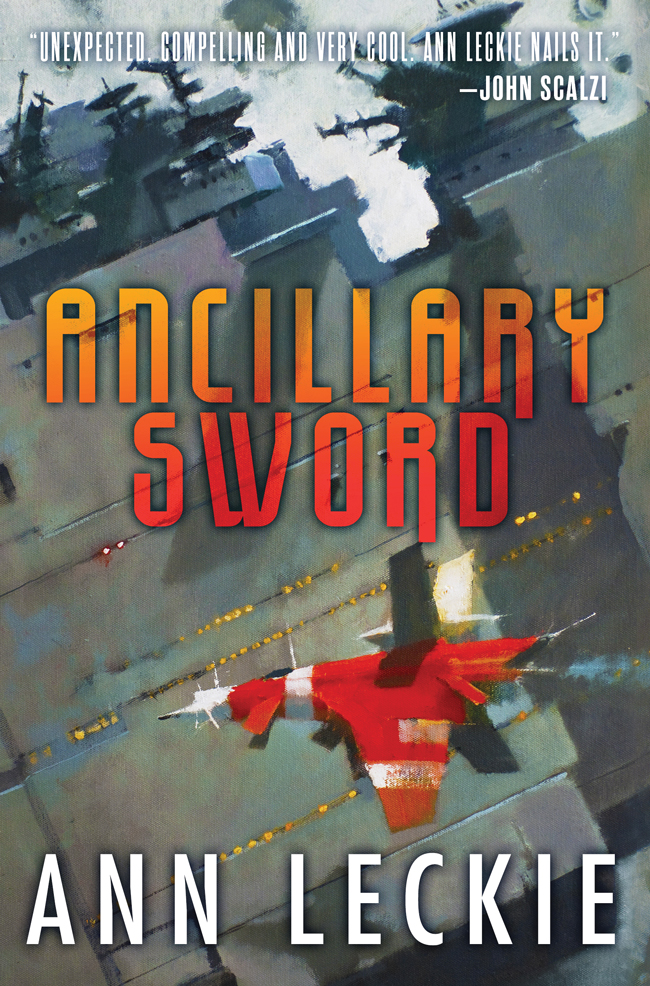
Ancillary Sword picks up almost immediately after the events of Ancillary Justice. Familiarity with the first book is assumed in what follows (ergo, a slight spoiler warning for the first book, though you probably shouldn’t tackle this book without having read Ancillary Justice). After the revelation that the Lord of Radch is suffering from a very bad case of split personality disorder, Breq finds herself loosely aligned with the Anaander Miannaai faction that was victorious in the conflict at Omaugh Palace at the climax of the first book. This faction appears committed to a policy of banning the use of the reanimated-corpse soldiers, called ancillaries, and maintaining peaceful co-existence with the super-powerful aliens known as the Presger. In opposition is the faction of the Lord of Radch that seems intent on maintaining a force of ancillaries and employing a much more aggressive policy towards the Presger. The former Anaander faction has promoted Breq to the position of Fleet Commander and provided her with a battleship named Mercy of Kalr. Anaander gives Breq instructions to travel to a space station in the system of Athoek in order to maintain stability, bolster defences against the opposition Anaander faction, and manage the relationship with any Presger presence. Breq decides to comply with ‘the tyrant’s’ command, not for some small part due to the fact that the deceased Lieutenant Awn’s sister works at the station.
When Breq arrives at Athoek she finds the system mired in political intrigue. At the station itself, the elite Xhai live above the underclass Ychana. The Ychana reside in the dilapidated floors of the station, known as the Undergarden, while the Xhai enjoy opulence in the better-maintained higher levels. Tensions between the two societal strata seem to be reaching a breaking point. What’s more, peoples from another conquered system, the Valskaayans, have been shipped by the Radch into the system to work in the lucrative tea plantations that grant the system with some economic and strategic importance. It would be fair to say that smoke still lingers from the fires of the last Valskaayan workers’ uprising in the system. Not only does Breq need to negotiate this political quagmire, she also needs to win the trust of her new crew. Accompanying Breq is Lieutenant Seivardan, her companion for much of the previous book, who continues to recover from both her long cryogenic sleep and drug addiction. Another newly promoted officer on board Mercy of Kalr is the very young Lieutenant Tisarwat. Without wanting to give away an early plot twist, all I can safely say is that Tisarwat is more than what she seems. To complicate matters even further for Breq, sitting in the system of Athoek is something known as a Ghost Gate – a disused portal leading to a long abandoned system. However, the longer Mercy of Kalr docks in Athoek the more there is a growing sense that something sinister lurks on the other side of the Ghost Gate.
I cannot imagine anybody who liked Ancillary Justice not also liking Ancillary Sword (but, see the ‘but’ to come). This book retains most of the strengths of the previous book and Breq’s narrative voice remains one of the strengths. While her consciousness is no longer dispersed amongst multiple ancillaries like it was for much of the first book, she maintains an ability to link with Mercy of Kalr and observe through the eyes of the ship’s various officers and soldiers, almost in an omniscient way. This is a neat technical trick for Leckie, one that allows her to simultaneously do some interesting things with narrative voice, while providing a view point for important plot points that would otherwise occur ‘off-screen’. Breq herself remains an intriguing and compelling character. As the former artificial intelligence for a warship, she presents as very dispassionate and emotionless, but she moves through the book with a strong sense of morality and compassion that makes her very relatable for readers. The effectiveness of this narrative voice is vital to the success of Ancillary Sword, as the book has to balance the personal aspects of the story with more epic galaxy-spanning elements of the overarching trilogy. Leckie handles this beautifully, and the ending of Ancillary Sword certainly packs an emotional wallop – subtly, yet powerfully evoking that irrevocable gulf of sadness that comes from personal loss and guilt. I must admit, I got some grit in my eye at the end of the novel.
But, here’s the ‘but’ I warned you about. An interesting narrative structure and a revenge-based plot engine that pulled the reader relentlessly through the book marked Ancillary Justice. In comparison, the plot of Ancillary Sword is much more introspective and, at times, somewhat directionless. Momentum does indeed build towards the book’s finale, but for the most part it lacks the same sense of urgency that its predecessor was imbued with. Ancillary Sword tends to fall into the trap of reading like a bridging book in a trilogy and doesn’t move the overarching story arc relating to the conflict between the two factions of Anaander Miannaai very far forward (though it does set things up nicely for the third book, Ancillary Mercy, out later this year). Furthermore, the major themes of the book are again power, colonialism, and gender, and without a doubt Leckie handles them in a way that offers both a thoughtful and intelligent critique, not only of the space opera sub-genre, but also broader society. Nevertheless, Ancillary Sword cannot possibly make the same impact that Ancillary Justice did in its treatment of these thematic concerns, as that first book had the benefit of being strikingly original in that respect. To make this point another way, in her handling of her key themes, Leckie does not seem to build on anything she hasn’t already done in Ancillary Justice. Though, admittedly, it seems churlish to criticise a book for being more of the same when the same is as good as this. Also, more of the same is kind of what you expect from the second book in a trilogy.
Leckie continues to play in the same space that authors like Lois McMaster Bujold and C.J. Cherryh did so effectively early in their careers. She writes character-driven science fiction that sits on the dividing line between hard science fiction and social science fiction. Having read Ancillary Sword I would not have predicted it would be in line for the same slew of awards as Ancillary Justice, if I didn’t already know it won the BSFA Award earlier this year, and was nominated for the Nebula, and has a chance at picking up the Hugo later this month. Having said this, Leckie continues be an exciting and vital new voice in science fiction, and while I look forward to the conclusion of this trilogy, I feel a greater sense of anticipation about what she might go onto afterwards.
Ancillary Sword by Ann Leckie
Published by Orbit, October 2014
356 pages
ISBN: 9780356502410
Review by Luke Brown, July 2015