
Armada is Ernest Cline’s new – and if I may say so, very highly anticipated – novel. His previous novel, Ready Player One, hit the shelves and racked up acclaim like it was going out of fashion. I remember reading it after its release in 2011 and falling in love with the characters, story, setting, and geek culture references that permeated every page. So, to say I’ve been waiting for Cline’s follow up since finishing Ready Player One is a gross understatement. However, as can often be the case in these situations, expectations take hold and run away with themselves – leaving the possibility of Armada living up to them very slim indeed. Be warned – mild spoilers ahead…
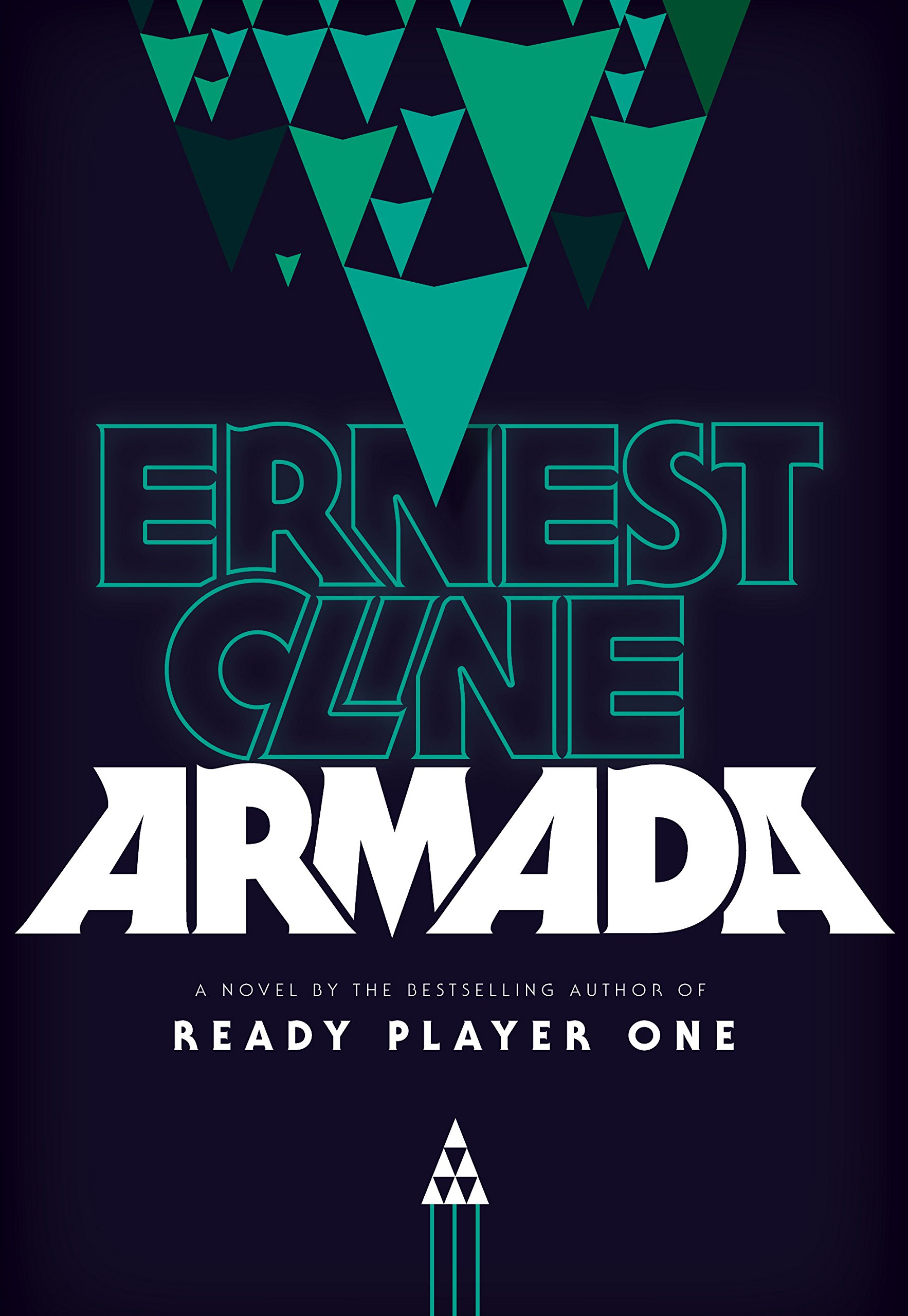
Coming up to high school graduation, Zack Lightman doesn’t have any plans for his future. His part-time work in a video games shop allows him to indulge his passion, though he dreams of something more. With his father killed in a work accident before his birth, Zack has grown up surrounded by his possessions, and inheriting his father’s love of geek culture, science fiction and fantasy, and gaming. When he finds his father’s diaries he gets a further glimpse into the man he never knew, but they come across as obsessed ramblings with far-fetched ideas.
And then one day while sitting in his classroom staring out the window, an alien spaceship appears in the sky. While this in itself is hard to believe, the fact that it resembles one of the alien crafts from the MMO game, Armada, that he spends hours playing each night makes it doubly so. But real it is, and it’s only the first event that leads to the truth coming out to the world: the aliens are on their way, and Armada has been a training simulator that gamers the world over have been honing their skills on.
Left with this startling revelation – only the first among many – Zack finds that he and his fellow Armada players, and its companion game, Terra Firma, could be the last line of defense against the incoming attack of Earth…
I’m not too sure where to start with Armada, or what exactly to say. It’s certainly an enjoyable novel on many levels, but it also has many failings that can’t always be ignored. The story, for example, is one many who grew up in the 80’s with films like The Last Starfighter and novels such as Ender’s Game will find shockingly familiar. Is this a bad thing? Not necessarily, and Cline’s referral to many of these in the text of Armada tells us he is all too aware of them, paying homage to what he’s grown up with. Of course, this also has its drawbacks, and often it can get tiring and repetitive. Fortunately, Cline’s prose mitigates these issues to some extent, and it’s easy to power past them to see what else he has in store for us.
Another aspect that often feels like it’s shoehorned into the narrative are Cline’s constant references to 80’s geek culture. While this worked on pretty much every level in Ready Player One, the setting and story allowed it to do so. Armada is a different kettle of fish, and while premise is ripe for such references, there is a limit to just what constitutes adding to the story, and what feels like it’s been piled on above and beyond acceptability. It can get very tiring, very quickly, though once again Cline’s storytelling prowess manages to push these under the surface, at least to some extent.
Quite often in the early parts of the novel Cline, through Zack, highlights just how implausible the notion of the Armada game story is, and once the alien cat is out of the bag he brings it up once again:
I couldn’t keep my doubts to myself any longer. “This story doesn’t make any damn sense,” I whispered to Lex. “If these aliens want to wipe us out, why wait forty years to attack? Why give us that long to figure out their technology and prepare to fight them off, when they could have wiped us out back in the seventies? Why wait?” I shook my head. “It didn’t make sense when it was backstory for the game, and it doesn’t make sense now either. I mean, why send a fleet of robotic drones? Why not hit us with a virus or a killer asteroid or-“
“Christ, who the fuck cares, man?” Lex hissed back.
It’s a reply that, I believe, Cline wants the reader to side with, and while the issue is raised a few more times during the novel, it’s forgotten about quickly and we’re left with answers that are leave you wanting. A lacklustre and too-quick conclusion really don’t help Armada’s cause either, though possibilities are certainly opened up for a potential sequel.
I know I’ve been negative of Armada during this review, though it truly isn’t a bad novel, not by a long shot. It is, however, far from the greatness displayed within the pages of Ready Player One. Put on screen this could be a great summer popcorn flick, and it’s one I can imagine watching repeatedly. On the page, however, it doesn’t have the depth needed to raise it above average, which truly is a shame.
Publisher: http://www.randomhouse.co.uk/
Author: http://ernestcline.com/
July 2015, 368 Pages
Hardcover, ISBN: 9781780893044
Review copy received from the publisher
© 2015 Mark Chitty




My take: if you ask questions in a novel you’d better answer them. If you have a point of improbability (as John Braine puts it) then disguise it or run straight past it. Don’t pick it up and say “Gosh, this doesn’t make sense. What the hell!”
Oh yes, and the profanity doesn’t do much for the problem either.