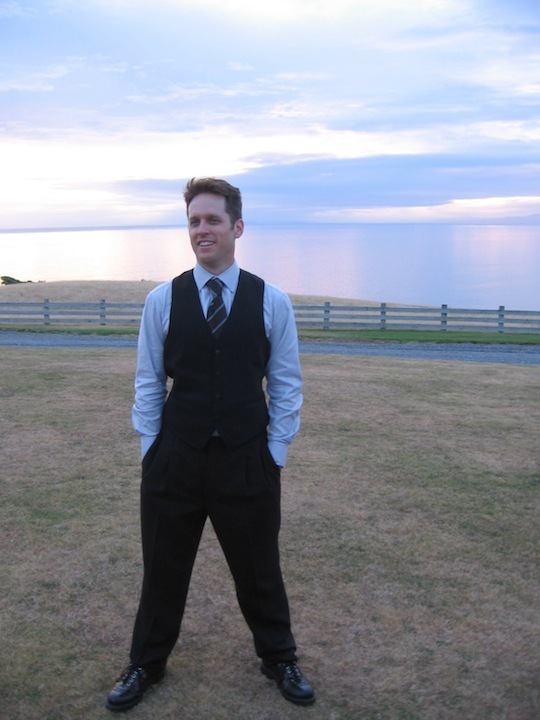
 Hello, Adam: many thanks for giving us some time here. Welcome to SFFWorld.
Thank you! I love what you’ve done with the place.
First of all can you tell us a bit about your new novel, Windswept?
I’m calling it a science fiction screwball noir. The heroine, Padma Mehta, is a labor organizer who’s burned out and wants nothing more than to quit her gig, buy a rum distillery, and spend the rest of her life on the beach. Unfortunately, she needs money to do that, and the only way for her to get paid is to convince people to breach their corporate indentured servitude and join her union. The Big Three companies, being the clever monkeys they are, have cut down on traffic to Padma’s planet, so she’s getting desperate to make her numbers. When the neighborhood scam artist comes to her with a deal that’s too good to be true, she takes it out of desperation. Complications and hijinks ensue.
You are bringing the Union into a SciFi setting with labor rights and corporate power. How did you come up with this idea and how do you feel the SciFi setting allows you to explore these subjects in a different way?
Workers versus management is a great conflict for a story, and I’m convinced it’s one we’ll have until we are all sublimed into a Banksian future (and, even then, someone’s got to work to maintain the Minds). Also, I’ve always wondered about the nuts-and-bolts of trans-stellar economies. Who does the work? What work has to be done to keep things going? What if someone didn’t want to be a part of the grind? Where would they go? I wanted to play around with all those ideas, plus have spaceships.
You have to tell us a bit about the tattoos. Why tattoos?
I got the idea (or, rather, stole outright) from Warren Ellis and Darick Robertson’s Transmetropolitan. The police had their badges tattooed on their faces, and I really liked that. We talk about wearing our hearts on our sleeves, but what if we wore our jobs on our faces? Also, it seemed appropriate for the kind of casual corporate cruelty the Big Three would pull. “Oh, you want to work for us? You want pay and benefits? Sure! First, hold still so we can mark you as ours.”
You also have to tell us a bit about your main character Padma Mehta, why does she so desperately want to recruit 500 people into this Union? She seems like a fascinating character with classes in Crisis Management, specialized in strategic lying.
Padma is tired of the rat race, but she doesn’t have the cash to quit. If she brings in five hundred Union recruits, then she’ll get a sweet bonus and an early pension payout. Also, she wants to buy a rum distillery. My friends talk all the time about quitting the rat race and opening a brewery, usually without realizing that running a brewery is also a rat race.
Can you tell us a bit about the process that led up to this book being published?
I started writing Windswept during my lunch breaks. Then, in 2009, I got to realize my dream of becoming a full-time writer. Granted, it took the global economy imploding and me getting laid off for that to happen, but I’ll take it. My wife insisted I finish the first draft before getting another job, so I finished. Then our daughter came along, and I got my current gig: stay-at-home dad.
It took a while for me to find my footing between parenting and writing, but I kept tooling away at Windswept. I got feedback from my friend Daryl Gregory, who ripped the thing apart (for the better, I should add). I was invited to the Starry Heaven Workshop in 2010, and then had ten smart writers rip the revised draft apart. By the end of 2012, I felt good about the book, so I started submitting it to agents. My list had sixty-eight names. Sixty-seven rejected it.
In the meantime, I’d just gotten a story published in F&SF, thanks to the feedback from my writing group, the Freeway Dragons. That story caught the attention of Joshua Bilmes, who emailed me while I was on a family vacation. Did I have a novel he could look at? Yes, I certainly did.
Then one of those sixty-eight agents got back to me, and I had to choose between the two. It was hard, but I went with Joshua, who then passed me on to Sam Morgan, who is busy absorbing all of Joshua’s Super-Agent Powers. Sam hustled like hell and got me a two-book deal with Angry Robot Books, which is exciting because they put out great stuff. All told, it took seven years to get from first words to holding a copy of Windswept in my hot little hands. I hope to move faster with my next book.
What are your hopes and expectations now that Windswept is being published?
I just got back from Worldcon in Spokane, where we sold out all the pre-release copies of Windswept that Mike Underwood (Angry Robot’s sales & marketing guy) brought. My hope is to do that one thousand more times, then to have Rakesh Roshan turn Windswept into Bollywood’s biggest SF blockbuster EVER.
My expectation is that I’ll sell enough books to buy tacos to eat while watching a Rakesh Roshan movie on Netflix.
What is it with Science Fiction you find fascinating?
You get to build drafts of the future, which will help you edit reality so those futures don’t come true.
How did you start writing? Was there a particular book or moment in your life that spurred you on?
I’ve always been a scribbler, and I was really into writing on the personal web back in the mid-90s. But I had no idea how professional writing worked until I read Stephen King’s On Writing. I hope I can buy him a taco to thank him for that book, because it changed my life. I had never seen the process of writing and getting published laid out like that. I think it should be a part of high school curricula.
Humour seems to be important to you in your writing. Who or what has influenced your writing, and in what way?
My parents, because they insisted I read as much as possible so I could get as many jokes as possible. I grew up in a family of readers, and I always levitated to the funny stuff like James Thurber, Leonard Q. Ross, and, of course, Douglas Adams. I also grew up in the age when Monty Python and Doctor Demento flew below mass culture’s radar. Being funny and smart just appealed to me.
What is your favorite and least favorite part of the writing process, and why?
I have days when the words aren’t clicking, and it’s easy to let myself get distracted instead of sitting down and focusing. The hardest thing I had to learn was that it was okay for first drafts to suck. In fact, it is now vital to me for that first draft to suck, because that means it gets done. Editing is now my favorite part, because I can take the wreckage of the first draft and make it work well. I live for those moments when I need to find connective tissue between ideas and my brain says, “Hey, how about this?”
I guess you’re in the middle of this at the moment, but how do you go about the marketing aspect and especially related to your online presence? Anything you’ve seen work better than other things?
I’m a big believer in the Try Anything Once method, so I’m Trying Anything: blog posts, interviews, readings, promotional schwag, contests. My online presence is small right now, and I don’t want to grow it by becoming one of those people who butts into someone’s Twitter feed with “Hi, I see you like books! I have written a book!”
The best thing that’s worked has been sitting down at the Angry Robot table with Angry Robot authors Alyc Helms and Patrick Tomlinson and telling passers-by that we had books for sale and signing. Plus, even if the books didn’t move, I had a great time talking with them. I don’t like networking. I like making friends.
What are you doing when not writing, any hobbies?
I play the cello, though not very well. I can saw my way through Bach’s First Cello Suite without embarrassing myself. I like music because it gives me an immediate feedback that I don’t get from writing. When I screw up a cello piece, I know it right away. When I screw up writing, I have to wait to find out.
Finally we also have to ask the “what’s next” question? What projects are you working on at the moment?
Revisions for Windswept 2: Real Title To Be Determined. Those are due at Angry Robot on Labor Day, which I find appropriate. After that, I have ideas for a book about family secrets and talking guns.
* * * * * * *
Interview by Dag Rambraut – SFFWorld.com © 2015