

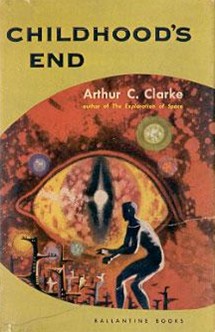
 Some of you may know that Arthur C Clarke is one of my favourite authors. It was his books, along with those of HG Wells, Heinlein and Asimov, like so many other readers at the time, that got me started reading science fiction. So returning back to this one was a bit of a treat. The recent announcement of a new TV series of this novel got me to thinking that I should read the original novel again before the series began later this year.
Context first. Childhood’s End is one of Sir Arthur’s earliest novels – his fourth. It was published in the 1953, after Prelude to Space, The Sands of Mars and Islands in the Sky, and was followed by Earthlight. Looking forward, the book 2001: A Space Odyssey (perhaps Sir Arthur’s most famous novel) was fifteen years away from publication.
Childhood’s End is regarded by many critics as one of Sir Arthur’s greatest, if not his best novel. Adam Roberts calls it “Arthur C Clarke’s most perfect novel…. His most expertly and compellingly handled piece of long fiction; a masterclass in Golden Age pacing, mystery and sense of wonder.”
You may recognise elements of the tale, at least to start, for Childhood’s End is initially a story of an alien invasion of Earth. You perhaps don’t need me to tell you that this was an extremely common story in the Space Age days of the 1950’s (and seems to have been later borrowed by both the TV series V and the film Independence Day.) Interestingly though, this one is different to most tales of the time in that the invasion is a peaceful one on the part of ‘the Overlords’. It is also different in that much of the first part of the book is not about the invasion itself, which takes up a couple of paragraphs, but the years afterwards, at the point at which Earth’s ambassador, and only means of communication to the aliens, is due to retire.
Since their mysterious arrival, the Overlords have ruled Earth with a benevolent stewardship. Their power is phenomenal, should they decide to use it, though their use of it is remarkably restrained. Even their appearances on Earth are extremely limited, in that they are never seen. The alien leader, Supervisor Karellen, only discusses matters through Secretary-General Rikki Stormgren, the representative for the United Nations and Earth, chosen to be their liaison for five years. They meet weekly in a conference room over New York, in the alien spacecraft hovering there.
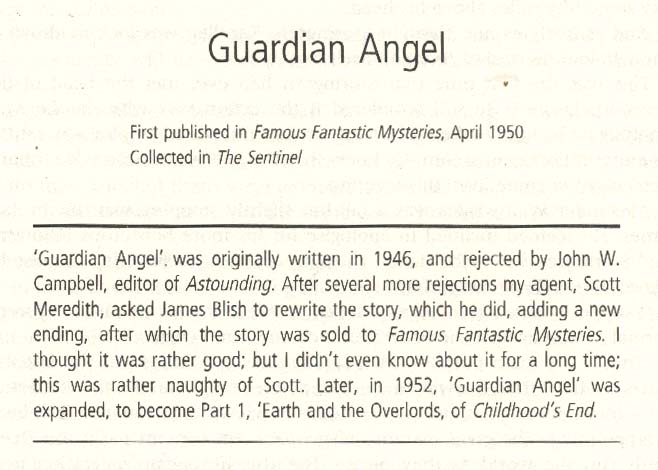
In the first part of the book (“Earth and the Overlords”), originally written as a short story named Guardian Angel and published in 1946, much of the story involves the setting up of this scenario and simultaneously raising a number of key questions, such as “What do the aliens look like?” “Are they as benign as they appear to be?” and perhaps most importantly, “Why are they here on Earth and what do they want?”
The answers to that part of the story hinges on a big reveal, which I would spoil if I told it here, but the answer is brilliant, and the reasons for not showing themselves (“We are not ready”) equally sensible.
The second part of the novel (“The Golden Age”) looks at the effects of the Overlords being on Earth – a time of Utopia, with an increase in culture, little crime, relatively easy transport and enough for everybody. The downside of this is that the race becomes rather bland and indolent, as the need to create and invent things becomes less important – why bother inventing something when the Overlords may have something better already? We meet Jan Rodricks, who is determined to go to the Overlords’ homeworld and George and Jean Greggson, whose children we eventually discover have a major role in the future of Mankind.

In showing the consequences of the alien’s supervision, this part of the book is well thought out and yet has some stunning consequences that may not sit well with an audience of the twenty-first century. Most religion disappears as the Overlords show a means of viewing things from the past that makes them meaningless. Cars become increasingly rare items as everyone flies easily from place to place. Everyone communicates through English as a universal language. National boundaries and states become less important. It is an interesting read, though it is very much an imperial view of alien invasion, written at a time when Britain and the British Empire were still of global importance, admittedly declining.
In the third and final part of the book, the role of the Overlords in the galactic scheme of things and the future of Earth is revealed. Here we see a bigger picture and a grander purpose, leading to an unknown future.
I wrote earlier that many critics feel that Childhood’s End is Sir Arthur’s best book. I wouldn’t go that far myself. It has dated, more than some of his work, and although I did enjoy it, there are others I have enjoyed more – The City and the Stars, Rendezvous with Rama and A Fall of Moondust, for example.
What strikes me most now is that how much it is a product of its time, a world sickened by war and with a need for peace. I am sure that it is deliberate that we have a tale told with the United Nations at its centre and with a ruler who is about as un-Hitler-like as you can imagine.
Secondly, it is a thoughtful book. It deliberately supports a view that is different to the zeitgeist of the time, that aliens, if they exist, are to be feared and destroyed – think about all the B-movies and pulp novels about in 1953. Here Karellen comes across as intelligent, knowledgeable and even with a sophisticated sense of humour. If humans are to be ‘supervised’, then they could do worse than have a supervisor like Karellen.
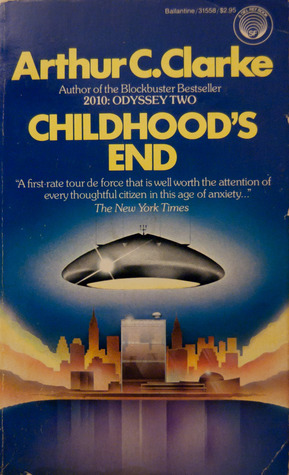
More surprisingly is the view given that Space is not an option for humans. Written at a time when the future seemed optimistic and Mankind’s future seemed to lie in the exploration into the Solar System, a book that has an alien race pointing out (very nicely, of course) that “The stars are not for Man!” is one that creates a pause for thought. There is a reason that the first edition of the book had written after the title page, ‘The opinions expressed in this book are not those of the author.’
There’s much to enjoy here. The reveal of the alien’s appearance is a masterstroke of prose and planning. Sir Arthur’s description of polite society to show the effect of the alien’s interest in culture is wonderfully anarchic and yet so out-of-date. When the bigger picture is finally revealed, the description of the grand vistas beyond our world are both impressively imaginative and yet also memorably reflect Mankind’s minor position in the universe.
Other parts work less well for me. One of the key points of the novel is that the eventual evolutionary uplift is in part due to paranormal phenomena that neither we (nor the Overlords) understand – psychic powers, ESP or the like. This was quite en-vogue at the time – John W Campbell’s Astounding/Analog was full of such stories about the power of the mind at this point as well – but these days doesn’t sit well with minds perhaps better grounded in science (or even science fiction.) Even Sir Arthur has put a rather embarrassed update at the end of the edition I’ve read, saying that following his investigations in the 1980’s for his Mysterious World TV series he is 99.9% sure that they are not views he subscribes to.
What is most surprising is the way that I responded to the ending.
(Note: there may be spoilers here, though I’ll try and keep it general.)
As a youngster I liked the positive touch that it is through the children the future of the human race, albeit in a different form, is assured. Reading it again, now on the other side of fifty, I felt rather more saddened by the demise of Earth and Earth’s adults. Even the Overlords are revealed to be no more than stewards without a possibility of uplift themselves, a much gloomier situation than I remembered. The children themselves come across as familial cousins of those in John Wyndham’s The Midwich Cuckoos (1957), and to my older brain much creepier than I remembered them as, thirty-odd years ago.
(You can look now. Spoilers over.)
Imagine the original story of alien invasion but then expanded to a 2001-ish theme of species evolution, of cultural uplift, as it were, and you’ve pretty much got Childhood’s End. In fact having read everything else Sir Arthur has written, I was surprised to discover that many of Sir Arthur’s future themes can be seen here – deep sea oceanography (The Deep Range and The Ghost from the Grand Banks ), space travel (Earthlight, Imperial Earth), aliens (Rendezvous with Rama) and evolutionary uplift (2001), for example – but here in a proto-form that only becomes clearer and more obvious once you read some of his later work.
Childhood’s End is worthy of a read, providing that you can cope with the dated inaccuracies. It shows both the strengths and weaknesses of Sir Arthur’s work, but the overriding impression at the end is one of a thoughtful if rather depressing novel that is quite different from much of what was prevalent at its original time of publication. It is a success, if not an unqualified one. I’ll be interested to see how much of the book survives to the TV mini-series.
Childhood’s End by Arthur C Clarke
First published 1953.
214 pages
Review by Mark Yon




Thank you for the review! I don’t think you can call dated science fiction “inaccurate.” After all, the purpose of science fiction is to illuminate the present and fire the imagination–not to be a crystal ball.
My only major beef with the book was the virtual absence of females.
This book happens to have been the Journey’s inaugural fiction article!
http://galacticjourney.org/?p=8
Good point. Whilst I agree with it myself, I am also of the opinion (rightly or wrongly) that in the 1950’s that crystal ball aspect was the view of many about SF – that it was to present ‘a future’. Which was the point I was trying to make, I think.
The lack of women is a sign of the times it was written, sadly, though Heinlein and others at the time were trying to change that. How things are different now – not quite there, but definitely better in that respect.