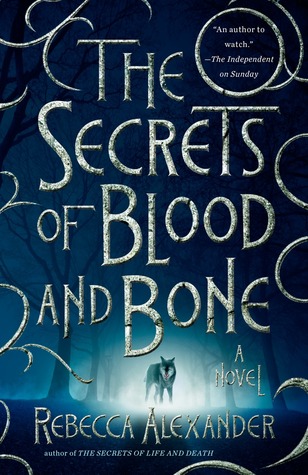
Hi Rebecca, Thanks for giving us some time here at SFFWorld. We’re writing these questions as The Secrets of Blood and Bone, the follow-up to your debut The Secrets of Life and Death has just been released in the US.
Can you tell us a bit about The Secrets of Blood and Bone?
The Secrets of Blood and Bone starts a few months after the end of the first book. Jackdaw, our protagonist, has taken Sadie into the north to renovate an old cottage, after the owner, an elderly witch, burned to death. Jack’s old ally, the professor Felix Guichard, knowing Jack is suffering cravings after tasting human blood—his—travels to New Orleans to find out about modern vampirism and look for a cure. While Jack finds out more about the powerful Dannick family who lives nearby in the present day, the 16th century Edward Kelley undertakes a mission for their ancestors, travelling into Venice and meeting Franco Marinello, a sea captain with the heart of a pirate. He comes closer to understanding the nature of the sorcery he did when saving Elizabeth Báthory—and the consequences of that unnatural existence.
How do you feel Jackdaw Hammond as a character has evolved from the first book?
Jack has been given a new energy for life, as well as new relationships with Sadie and Felix. She’s come out of her isolation, engaging with the locals in a small Lake District village. She’s found a maternal protectiveness for Sadie and is trying to keep her safe—and out of the news, since Sadie was believed to have been killed in a fire. Jack has gained in confidence both with the world and in magic. However, the dark magic that kept Elizabeth Báthory alive has changed Jack, and she struggles with a new force in her life.
You write about New Orleans and Venice. What kind of research into the places and historical settings you write about have you done? Have you travelled to the places yourself?
I haven’t been to either, but I am fortunate to have friends who grew up in Venice and New Orleans. They had to get used to being endlessly interviewed about details of streets and views, ambience and climate. I also read extensively, Venice was helped by a series of books and TV programs by Francesco da Mosto, a historian and architect whose family grew up in Venice over many centuries, giving me a historical perspective. It would be great to be able to travel back in time, but I don’t think a modern person would last very long—even Kelley found Venice a harsh place for a visitor. I would love to go to New Orleans, it’s one of those melting-pot places (like Venice) where several cultures met and melded and created something special.
What is it with this blend of history and fiction mixed with occult magic you find fascinating?
When I was a teenager I read a lot around the occult, like a lot of kids I was fascinated by the mix of death and sex and sorcery in gothic novels like Dracula or the books of Dennis Wheatley. A family member knew Doreen Valiente, a writer and published ‘witch’. It played with my imagination that fairy tales and ghost stories may have a germ of truth in them (I still like to believe that). It made the mundaneness of homework and chores more interesting. When I was writing what I thought was a purely contemporary story I found I had to keep explaining the ‘real’ story of Dee and Kelley, filling in the gaps with my fictional ideas as I went along. I realized it was easier to write this as a narrative too. Dee kept an almanac, a kind of journal of his and Kelley’s travels. That is extraordinary in itself, but months were missing, ending with one of them being arrested or them ‘sharing their wives’ or some other extraordinary occurrence. What fiction writer could resist filling in the gaps?
If I’m correct the third book in the trilogy will be out in 2016 and I think it’s tentatively called The Secrets of Sorcerers, anything you can share with us?
It’s now going to be called The Secrets of Time and Fate, and it will follow straight on from The Secrets of Blood and Bone. It will expand on the story of Dee and Kelley by following their adventures with Marinello, through the corsair-infested waters of the Mediterranean to Alexandria, in an effort to control the monster they have created. In the contemporary story, they have to resolve once and for all the danger from the monstrous presence threatening all the revenants—people saved from death by sorcery. At its heart, the book is about possession and exorcism, and introduces a new character, a Vatican exorcist called Robert Conway.
Can you tell us a bit about the process that led to the series being published?
Like many people, I wanted to get a novel published, but it’s a very long journey. I decided to start a master’s degree in creative writing and began my best effort at a literary novel. To keep myself entertained, I wrote The Secrets of Life and Death. I could let my imagination run riot, and when a competition came up for novels, I entered it. The first few chapters were longlisted and I had a weekend to finish the novel. Fortunately it only needed six more chapters, completed overnight. I sent the whole novel off to Mslexia, the magazine for women writers, and was astonished to be a runner up. Then I really had to sit down and rewrite, because the competition had attracted agents and one liked the book. She sold it that year, along with two more books in the series. The publisher, a new imprint called Del Rey UK, had a very forward thinking editor, Michael Rowley, who thought it might also be suitable for Broadway Books in the US.
How did you start writing? Was there a particular book or moment in your life that spurred you on?
I remember being in the primary school library, looking for a sequel to a book for children, when the librarian explained that the books were arranged according to the authors’ names. The authors? She told me that people were paid to sit down and write books and it was their job. That was it for me; I knew what I wanted to do. Through all the years of writing short stories and articles, through training as a psychologist and working with people, it stayed in my consciousness. I wanted to be a writer, and carried on writing novels. Over the years I have written millions of words for my own amusement, and now I get to share my characters with others as well. If there is one book that inspired me as a child is was Dracula by Bram Stoker, which I have read again recently and still sent shivers up my spine. More recently, Elizabeth Kostova’s The Historian showed me that good writing can enhance big, fantastical stories.
How do you feel you have evolved as a writer throughout your career?
I am still evolving as a writer, and it feels like a steep learning curve sometimes. I try to make each book better than the one before it. There are always things I could have written better, pace I could have evened out more. But the characters are very strong in my mind. Some speak directly to me, like Edward Kelley, who just dictated his whole story to me while I struggled to type as fast as I could. With Sadie, I heard her voice too, perhaps because I had a young daughter the same age with some of the same attitude. I’m writing in other genres too, it help keep me on my toes, and makes me think about the writing itself. Ultimately, it’s about making fiction so convincing it’s believable. That needs constant work and development.
You have worked in psychology, how has that influenced your writing?
Like many people, I’m fascinated by what goes on inside the human mind. Elizabeth Báthory was a sexual sadist and a psychopath. She lacked empathy on an epic scale, tortured and dying girls were found in her castle when the authorities arrived to stop her. That’s a mind that doesn’t have the normal inhibitions or constraints. Recently I’ve been looking at a psychological phenomenon that sometimes occurs with twins, especially identical twins—a difficulty in establishing a separate identity. I think everything you know and care about can creep into your writing. A new project I am researching is about how we don’t listen to people we perceive as ‘mad’, even if they are telling the truth. ‘Madness’ is frightening, and when we lock people up for their own safety or others’, we take away their voice. It’s all fascinating to write about.
Have you ever struggled between what you would like to happen to a character and what you considered more sensible to occur? Can you tell us when and what did you do at last?
All the time! Some writers plot their books out in advance, but I can’t do that. For me, writing is like reading a book very slowly, about as fast as I can type. This means my characters constantly surprise me. I had no idea that Jack and Felix would be attracted to each other, for example. When I have a whole first draft, I tuck it away and work on something else for a while to get some perspective on it, then I start the first rewrite—when common sense kicks in. But often the more imaginative ideas become really important. I recently found that two sisters, reunited after decades apart were carrying a secret—one had tried to kill the other. I had to spend a few weeks thinking about that until I saw that actually, the characters themselves had evolved during my writing of their book, and it made sense. It stayed in.
I believe you’re also working on another series centered around archaeological puzzles and a teenager living in the late 16th century. Can you tell us a bit about it?
A Baby’s Bones is a prequel to The Secrets trilogy, as Felix tries to help an archaeologist called Sage understand a mysterious well. It appears to have been filled in with the bodies of a woman and a tiny baby, and in a historical narrative a very young woman, Viola, is awaiting the birth of her stepmother’s baby and the illegitimate child of her fiancé, the sorcerer Solomon Seabourne. He is trying to conjure a demon to make gold, within an old well outside his house… I’m also working on the sequel.
Do you also have other projects you’re working on?
I always have projects. The book about the strange enmeshed twins is almost finished, I have a biographical book in the research stage, about a woman called Lorina Bulwer who was plucked from her normal, Victorian life and placed in a lunatic ward of a workhouse as a pauper, and embroidered her rage and madness into lengths of patchwork. I also have an early draft of a new book for Jack, Sadie and Felix, exploring the strange character from the first book called George Pierce, who may be not quite human.
Once again, thank you very much for your time, Rebecca.
* * * * * * *
Interview by Dag Rambraut – SFFWorld.com © 2015