

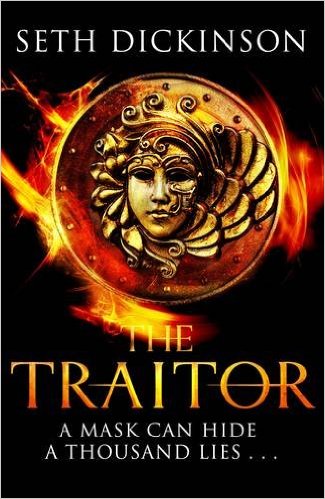
Let’s start this review with a question – how many Fantasy books do you know of that have Accountants as their lead character?*
I must admit that it’s not an occupation that I have high on my list when discussing Fantasy, but here’s a richly written, eloquent novel that manages to make what could seem boring actually become exciting.
From the publisher: “Baru Cormorant believes any price is worth paying to liberate her people – even her soul.
When the Empire of Masks conquers her island home, criminalizes her customs, and murders one of her Fathers, Baru vows to hide her hate, join the Empire’s civil service, and claw her way up enough rungs of power to put a stop to the Emperor’s influence and set her people free.
As a natural savant, she is sent as an imperial agent to distant Aurdwynn – a post she worries will never get her the position and power she craves. But Baru soon discovers Aurdwynn is a complex and secretive country, seemingly on the brink of rebellion. All it would need is a match to the tinder . . .
Drawn by the intriguing duchess Tain Hu into a circle of seditious aristocrats, Baru may be able to use her position to stoke a revolution that will threaten to bring the Empire to its knees.
As Baru maintains a precarious balance between the rebels and a shadowy cabal within the Empire, she orchestrates a do-or-die gambit with Aurdwynn’s freedom as the prize. But winning the long game of saving her own people may be far more costly than Baru imagines.”
Now, that’s more like it! Even if accountants are not the usual material of choice, then revenge, subterfuge, sedition, and revolution are the mainstays of many a Fantasy novel. And while there may be a worry that some of the prose of accountancy may turn into something akin to George Lucas’ diatribe on treaties in The Phantom Menace, Seth manages on the whole to restrain himself from doing so.
But what struck me most, at first, is the sheer poetry of the prose. The Traitor is a book that uses many a lovely turn of phrase and isn’t afraid to use a mellifluous vocabulary to do so. Try this, from the third page of the book:
“Where the sea curled up in the basalt arms of the Iriad cove, beneath the fields of sugarcane and macadamia and coffee that grew from the volcanic loam, the market preened like a golden youth.”
The Traitor (also known as The Traitor Baru Cormorant in the US) is a book that luxuriates in language, though never over-complicates things to do so. We’re not talking Thomas Covenant here, which some readers may baulk at, more of a Guy Gavriel Kay or an Ursula K LeGuin tone.
To this the world-setting and the characterisation is simply breath-taking. Rarely info-dumped, there is a depth and subtlety that belies the fact that this is a debut novel. Baru is a complex character that develops through the book, who appears to grow in stature and confidence until she is capable of dealing with the wider world. Through Baru Seth manages to balance intelligence with skill to show a troubled character, an auteur who manages to persuade and cajole others to do what she needs and also make difficult choices.
We begin the novel with Baru in her remote island home of Taranoke, happily growing up with her two fathers and mother. The arrival of the Masquerade, or Imperial Republic, leads to treaties, the reformation of the village and Baru’s education in the ways of the Republic. Her lively, intelligent and questioning mind soaks up knowledge like a sponge, but also gets her to question her own background, especially when the Republic insist on one mother and father in a family.
Baru realises that it is easier to change things by working from within than from without, hence the ‘traitor’ of the title. She attends state education, even though this isolates her from her family and city. When she passes the examinations she is then promoted to the position of Imperial Accountant. Despite hoping that she will be sent to the Empire’s capital city of Falcrest, she is instead sent to Aurdwynn, a relative backwater where the previous two accountants have been murdered in post.
Baru is set adrift, having to deal with situations which would destroy a person with less resilience. She instigates change and revolutionises the pattern of mercantile trade in Aurdwynn to bring an uneasy peace to the warring state leaders, eventually declaring plans to lead Aurdwynn from the Empire. When she manages to supply the revolutionaries with coinage, she unexpectedly finds herself having to become a figurehead for the new way forward as Baru Fisher, the Fairer Hand.
Her reputation spreads throughout Aurdwynn. Revolution follows and the Empire withdraws, hoping to starve the country or at least cause it to collapse without state support. With a group of states allied to the revolt Baru finds herself preparing over the autumn and winter for a renewed assault from the Masquerade determined to win back Aurdwynn and depose the seditionists.
The last part of the book is about whether master savant Baru and her revolutionaries can survive such a resolved opposition and raises questions for the future.
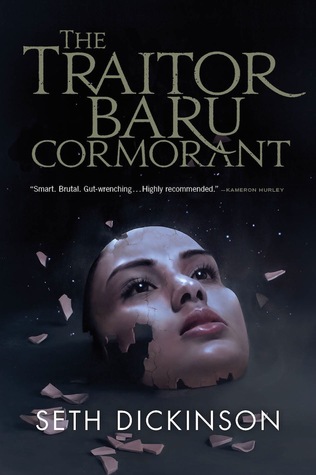
Oh, The Traitor is a clever book. This is one of those where not everything is explained, nor signposted in advance. You have to think about what you are reading and follow carefully. In places, that means that you have to follow carefully, for there are things in the middle that can become a little confusing if you don’t keep up with the names and their respective roles, for the characters can be complex and their actions not always expected. But if you do so, it will pay off handsomely.
The Traitor is a tale of secrets, of repression and even cultural rape, the desecration of old traditions and cultures for the sake of stability, conformity and order. The book subtly raises issues of the role of a conquering society and whether their dominance is a good or a bad thing. From Ancient Roman times to events going on in the Middle East today, it is a valid discussion point. Many of you, as I did, will find yourselves thinking of that long after you put the pages down. Is it right to accept a loss of traditional values in return for the use of good roads, prosperity and better medicine? Who is right? Who is wrong? These are not easy questions to answer and Seth, through his characters, does well to put points forward for both sides of the argument.
Of course, part of the initial interest in the plot is maintained due to the fact that there is always a risk that indoctrination from an early age can actually lead to you conforming to the thing you initially wish to destroy. Seth keeps us guessing, and there are times here when you are never quite sure that Baru has turned to ‘the Dark Side’ or not, as it were. Even the title of the book is enticingly enigmatic – is Baru a traitor to her family, her revolutionaries, her culture and her village, or is she a traitor to the society that has transcended her into a wider world, raised her and nurtured her?
But most of all this is a book about deception: deception on the part of the characters within but also on the part of the author, who often does not go where the reader expects him to. Masks are obviously an important motif of the novel, being not only a physical symbol, worn by agents of the Empire, but also important in your personal dealings as well. In the Empire of Masks Baru wears a mask, not only physically as part of her occupation but also psychologically in herself, often shielding her real feelings from those around her. In a world where lesbianism is seen as deviancy and treated ‘with the knife’, Baru treads a fine line, never quite knowing what her feelings are or allowing them to show.
The last part of the book is quite brilliant and I suspect that, like I did, you will find yourself both impressed and awestruck at the revelations there.
“ If you want a picture of the future, imagine a boot stamping on a human face — forever.” (1984, George Orwell)
In the end, what happens is so surprising that you will question everything. I was left feeling that ultimately the monolithic concept that is the Big Brother society, the big bad Empire, is watching you, crushes you, conforms you. And that is the saddest, the most heart-rending and most telling thing of the whole novel. It is done brilliantly, and not what you expect, to the point where I can see revelations here being for some readers at a Sean Bean/Eddard Stark level of surprise.
In summary, The Traitor is a book that grabs your attention from the off. Dealing with many of the key concepts of the genre, this is not your run of the mill Fantasy. There is no magic, but there are battle scenes that Fantasy readers will love and characters that will impress. The plotting is such that you may find yourself wanting to read it again, to discover what precisely happened, exactly where in the book it happened and why it happened. The clues are there, but many of them I only really noticed them when looking the second time.
The Traitor is one of the best debut novels I’ve read in years, with a lot to say and think about. This is eloquent, grown-up, intelligent Fantasy that will keep you thinking long after you finish and will demand that you read and reread it.
I won’t be too surprised if this is one of my books of the year.
Highly recommended.
The Traitor by Seth Dickinson
Published by MacMillan, September 2015
ISBN: 978 144 728 1139
400 pages
Review by Mark Yon
*For me, it’s one-and-a-half: Paul Jhered from James Barclay’s much-underrated Ascendants of Estorea series and the half goes to Daniel Abraham’s The Dagger and the Coin series. The half is because, strictly speaking, Cithrin is more of a banker than an accountant.





“Let’s start this review with a question – how many Fantasy books do you know of that have Accountants as their lead character?”
Another one for you: Owen Zastava Pitt from Larry Correia’s *Monster Hunter International* series.
Thanks, Joshua! Yes, I should have got that one. 🙂