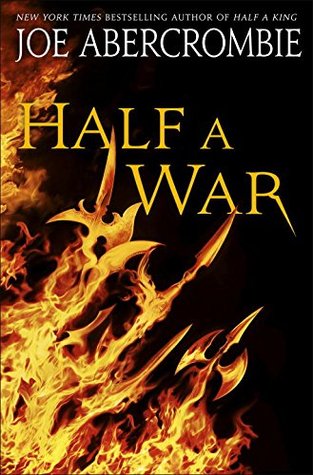
 Half a War by Joe Abercrombie marks the conclusion of his Shattered Sea trilogy. Abercrombie is a perennial favourite of ours at the SFFWorld forums, but it strikes me that this latest series has received a less than enthusiastic response compared to his previous novels set in the world of the First Law, with some treating the book, ostensibly marketed as YA, as being “Abercrombie-lite”. To my mind this is a shame, as I believe this latest trilogy from Abercrombie is up there with the strongest work he’s done to date, being more focused and efficiently plotted than much contemporary epic fantasy.
Having said this, and keeping in mind the high esteem in which I hold the previous two books in the trilogy, I did find this third book in the series not quite as tightly written and a little more laboriously plotted than the previous books. You see, book one, Half a King (reviewed by Mark Yon here), was told through a single perspective; with book two, Half the World (reviewed by Mark Yon here), we had a couple of viewpoint characters; and, this time, book three offers, no prizes for guessing, three view point characters. Sure, there is a certain aesthetic harmony to this pattern, but it also means that this third book is more sprawling and perhaps more in the vein of other similar epic fantasies, being, well, more epic. Though, admittedly, Abercrombie doesn’t lose much of the intimate focus of the previous volumes, aided by his usual skill in thrusting the reader into close-up third person perspectives.
The first point of view character in our trio starts the book as Princess Skara of Throvenland. It’s really not much of a spoiler to say that she soon becomes Queen of Throvenland, when her father, King Fynn, is slain by the High King’s emissary, Bright Yilling, in chapter one of the book. This killing is retribution for the fact that Throvenland had made a short-lived alliance with the two kingdoms in rebellion against the High King, being Getland and Vansterland, and even though Fynn got cold feet at the last minute and tried to realign with Skekenhouse, it was obviously too late to win back the High King’s favour. Skara barely escapes with her life with the aid of an old sea raider named Blue Jenner and seeks refuge with King Uthil and Queen Laithlin in Getland, where she starts to carve out alliances and makes plans to return to her throne, secure her kingdom, and take revenge for her father.
The second point of view is that of Raith, a character mentioned in passing in both previous book in the series, as one of the white-haired twins who carries the sword and shield for Grom-Gil-Gorm, King of Vansterland. Raith, a self-declared “bloody little bastard”, is a typical Abercrombie anti-hero. He starts the book mean and vicious, trying to make a name himself and win the favour of his king through violence. But when his king nominates him as first sword to the Queen of Throvenland, who is severely lacking in a court after her exile, Raith begins a journey of redemption that is somewhat reminiscent of Caul Shivers in Best Served Cold. Raith falls in love with Queen Skara, and defies Gorm’s expectations that he serve as a spy in her court, leading to conflict not only with his previous lord, but also his twin brother Rakki.
The last point of view character is one that got a fair bit of screen time in the previous novel. Koll, who was a young thrall with his mother on board the South Wind in Half the World, has grown up some and been made an apprentice minister under Father Yarvi. The problem is that Koll, sworn to chastity, also has a little something going on the side with Rin, the metalsmith and brother to Brand, who also featured in book two. Koll is torn between his loyalty to Father Yarvi, who freed him and his mother from slavery and offered Koll a chance at a life of power and influence through the ministry, and a life of love and contentment at Rin’s side. Of course, all three personal struggles I’ve just outlined play out as the last battles between allied Getland, Vansterland, and now Throvenland and the armies of the High King.
Those that felt disappointed by the YA tones of the previous book may be interested to hear that, as far as this trilogy goes, Half a War is the book most like the Abercrombie of old. There’s lots of gritty violence and the book is also very raunchy for its age bracket, though most of the actual sex happens just off page. Another major distinction is that Half a King and Half the World were books on rails. They were essentially road books or quest stories, detailing adventures on an arduous journey. Half a War is, as shouldn’t be surprising from the title, a war story. Essentially it tells about of a series of battles and the personal turmoils that occur in between the downtime between fighting. There is a short quest into elf ruins for some ancient weaponry that is recounted in the middle part of the book. However, whereas this journey might have been the entire subject of a previous book in the trilogy, it is told here over a few chapters from Koll’s perspective.
“Half a war is won with the sword … the other half with words,” is a regular refrain in the book. The book explores the cost of these words on the person who uses them. Another motif throughout the books is that people must “find the lesser evil… And weigh the greater good,” and the book, like many war stories before it, shows the moral injury done to people who are forced to make decisions in positions of command during wartime. In this way, the book is most interesting in its contrast between Father Yarvi and Queen Skara. In the case of the former, we have a character who essentially commenced the trilogy as a good person, and becomes more and more morally damaged by the decisions he makes. Abercrombie suggests this is because at the root of this decision-making is a self-interested quest for revenge. On the contrary, Queen Skara, who makes and ponders on many of the same horrendous decisions, costing many lives, avoids the same moral degradation. Her decisions, in contrast to Yarvi, seem genuinely motivated by a desire for the greater welfare of her people, and result in much personal sacrifice. However, these moral quandaries are mirrored more or less to a greater extent in all the significant characters in the book.
This is familiar territory for Abercrombie and he handles it well for the large part, and, as I indicated earlier, this is the book in the trilogy most like previous Abercrombie novels. This is probably why I, in fact, found it the weakest book in the trilogy, though at the same time I enjoyed it immensely. Not only did I enjoy the more-quest driven plot engines of the previous books, and found the war story here, though well executed, a little bit too much like much of everything else in the epic fantasy market, but I also found this book somewhat predictable. The equivalent of the genuinely surprising plot twists in the previous books were written on the wall in this book, and everything plays out largely as suspected. Also, Abercrombie’s wearying cynicism is not as well balanced with his black sense of humour and sense of farce in this volume, and the book has a sense of gloom and doom that borders on ponderous. Towards the end of the book the word “Death” feels like a hammer blow on the reader’s eyeballs, it is used so much. Abercrombie seams aware of this, and does try to inject some hope and sweetness into one particular character’s storyline, but it comes off cloying and disjointed in comparison the tone of the rest of the book.
But these criticisms should not be over-emphasised in what is otherwise a splendidly executed conclusion to a very rewarding trilogy. I like Abercrombie in this lean, mean YA mode, and I hope he takes some of the skills his honed in this trilogy with him when he returns to writing more “adult” fiction. Half the World was released earlier in 2015 and, as I indicated on my blog at the midpoint of the year, that book is one of the best fantasies of the year I have read, so far. This makes Half a War Abercrombie’s second book for 2015, and while it won’t sit higher on my list of books of the year than its predecessor, it still has a good chance of making the list in its own right. If you’ve read the previous two books in the trilogy you must read this to see how the story concludes. If you haven’t read the previous two books in the trilogy, you could probably read and enjoy this for the solid epic fantasy war story that it is. But seriously, why wouldn’t you go back and read the entire trilogy?
Review by Luke Brown
Half a War by Joe Abercrombie (Shattered Sea #3)
Paperback, 500 pages
Published 2015 by HarperVoyager
ISBN 9780007560851