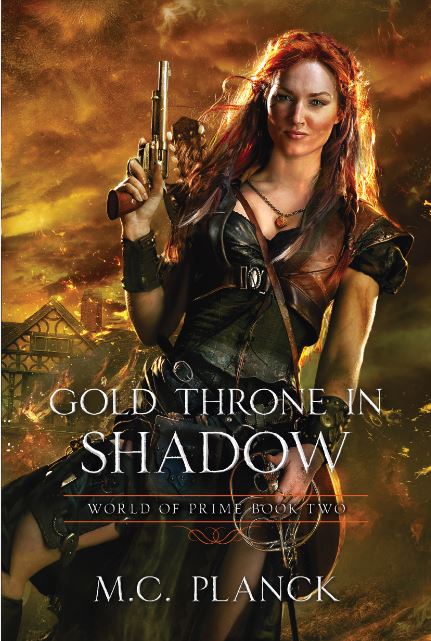
M. C. Planck is back with the second World of Prime book. This flintlock fantasy follows a 21st century man as he fights his way out of the magical realm he wandered into.
Your second book in the World of Prime series is being released tomorrow. Can you tell us a bit about the series and the new book, Gold Throne in Shadow?
The series is about a modern man going through a portal into a world of magic, which is a pretty well-trod path. I think what makes it interesting is the world he goes to. In many ways it will be familiar; for example, people there can gain ranks in various professions, giving them supernatural powers such as spells or incredible vitality. What makes it unfamiliar is that I take the traditional method of gaining these ranks quite seriously; that is, one becomes more powerful by killing other people and eating their souls. I was curious if it was possible to remain a good person when the power to do good stems from such an awful act. So far our hero is holding onto his humanity; but there are still several books to go. We’ll see.
Gold Throne in Shadow finds him elevated to the head of an army regiment. He’s now become a player in politics and has to make alliances, other than the very nice people who have put up with so far. In this book he discovers that although everyone’s moral character is visible to him with the casting of a minor spell, that does not actually tell him who is on the side of the angels.
Can you give us some insight into your main character, Christopher Sinclair?
His greatest power is that he knows himself. This isn’t a book about a teenager finding his destiny; Christopher already knows who he is, and more importantly what he deserves out of life. He just wants to go home to his wife and the mechanical engineering firm he built, and be an ordinary person. The world he is in has other plans: with each book he gains ranks, and with each rank he becomes less and less of an ordinary person. I keep layering the super-powers on him, wondering when he’ll break.
What new challenges did you set for yourself with Gold Throne in Shadow?
It’s an epic, spanning about half a million words. That’s a lot of time in a single world with a single character. Keeping him interesting and the world consistent has been… invigorating, let us say.
What is it with flintlock fantasy you find fascinating?
Technology (despite what you see in the movies) is a collaborative endeavour. There are no genius engineers, only genius engineering teams. Technology is about ordinary people giving other ordinary people extraordinary powers. This strikes me as a natural contrast to fantasy, which is about individuals giving themselves super-powers that elevate them over the common folk.
You also write Science Fiction, which genre do you enjoy the most?
To me, science fiction is about real people in an unreal world: you change the laws of physics and see what happens to the people who live there. Fantasy is about unreal people in a real world: archetypes (the Warrior, the Crone, etc.) operating in the realm of the ordinary. By that definition I only write science fiction. Someday I hope to write true fantasy, but I am not sure I can.
Rumours has it that you are also working on a new SF novel named Sirius. Can you give us a sneak peak?
Someone else just released a book called Sirius, so mine has a new title: Orion’s Dog. In true artist fashion I have convinced myself that should have been the title all along. The premise is a super-intelligent dog trying to destroy the world; the plot is about a very intelligent woman and the limits of human endurance.
What got you into writing in the first place? Any particular authors that have been huge inspirations?
I always told stories, either in role-playing games or just in my head while I was supposed to be doing something else. However, the reason you are talking to me now is a direct influence of the author Sara Creasy. I wrote The Kassa Gambit specifically for her, which sounds generous, except we are married, so by common law half of it is hers anyway.
Jack Vance and Dave Duncan are my biggest inspirations: Vance for his mastery of language and razor-sharp wit which, while setting the standard for cynicism, always has an edge of compassion peeking out from underneath; and Duncan for his ability to take the most common tropes and stand them on their head while still creating characters that are real and empathetic.
What is your favorite and least favorite part of the writing process, and why?
My favorite part is writing. The least favorite part is editing: i.e., fixing my writing so it makes sense to other people.
How do you develop your plots and characters? Do you use any set formula?
I don’t know how I do it. Karl, from Sword of the Bright Lady, was completely unexpected: I needed a captain of the guard, and then this young fellow walked up, glared at me grimly, and started telling me his story. I was honestly surprised by what he had to say (which, given that my fingers were on the keyboard, was itself a surprising experience). When I started Orion’s Dog, I was sure I knew which side won, only to discover halfway through that I was wrong.
What has been most surprising to you in your writing and publishing career?
Ebooks. Just when I finally got a big-time agent and a traditional publishing contract, Wool and Twilight happened.
For your own reading, do you prefer ebooks or traditional paper/hard back books?
While I am theoretically in favour of ebooks, I refuse to buy any reading device that has a keyboard. You don’t see keyboards on books, do you? Because they’re not necessary! Also, I have a lot of old paperbacks that have not made it to ebook, and I can’t lend ebooks to other people. I’m waiting for those issues to be addressed. Some people are early adopters; I prefer my technology well-baked and crunchy.
What kind of books do you read, any favourite authors?
I read SF&F and history. I’ve read everything by Vance (except the mysteries) several times, although I confess I can’t quite keep up with Dave Duncan (that man writes three or four books a year!). I actively seek out Flintlock Fantasy such as Promise of Blood and Temeraire. And I am eagerly awaiting the next in The Red Knight series. But I don’t read as much as I used to; writing takes up too much time.
What are you doing when not writing, any hobbies?
Once I had really interesting hobbies, like karate and motorcycles. Now I have a five-year-old. My hobbies are Lego and My Little Pony.
What’s next? Do you have more exciting new projects you’re working on at the moment?
I have to finish off the Sword series; I have readers that have been waiting over a decade for the 4th book. After that I want to tell more stories in the same world: in particular I keep seeing an image of a little girl in an abandoned and decaying castle, with a great bronze golem looming over her. I think her story has to come next, ahead of the Elizabethan giant ants, colonization of Venus, or Prudence Falling’s marriage.
* * * * * * *
Interview by Dag Rambraut – SFFWorld.com © 2015