13 Minutes by Sarah Pinborough is a mystery thriller about teenage girls, reminiscent of works by Gillian Flynn and Megan Abbott. The latest novel from this British author follows her critically acclaimed novel of last year, The Death House (review), which sported impressive blurbs from the likes of Stephen King. Clearly, Pinborough is an author worth watching, and I enjoyed this competent and well-crafted novel (the first book of hers I’ve read), even if I was expecting a stronger flavour of fantasy or SF thanks to the publisher’s marketing (ironic for a book thematically about appearances). Truth be told, I was somewhat surprised (and maybe a little disappointed) that 13 Minutes is a more straightforward and predictable novel than I, err, predicted.
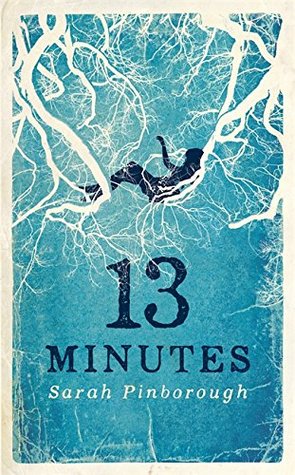 The story centers on Natasha Howland – Tash to her friends – the coolest teenager at Brackston Community College, an only child of affluent and doting parents, and the leader of a trio of popular girls known as the Barbies: “Empty, plastic, beautiful people. I [Tash] was still proud of it. I can’t help it. I am the Barbies.” Tash’s life at sixteen years of age is perfect. Until one morning she is found at five forty-five am one morning, floating in the icy water of the meandering river running through the woods nearby her suburban home, where “she was dead for thirteen minutes… a miracle that they revived her.” After being revived, Tash has no memory of how she ended up in that icy river in the very early hours of the winter morning. Tash’s best friends and fellow Barbies, Hayley and Jenny, show initial concern and sympathy for their friend, but something is not quite right and Tash begins to suspect they might be hiding something.
Determined to uncover the truth about her thirteen minutes of death, but unable to trust her closest friends, Tash enlists the help of a former childhood pal, Rebecca Crisp. Becca, or Bex, was once part of the Tash’s friendship group when they were smaller children, but the other girls dumped her as they grew older and she clearly doesn’t fit in with the Barbies. Becca is a rocker chic with a musician boyfriend two years older than her. Becca and her geeky friends are unpopular at school and spurned by the Barbies. She yearns to escape her tedious high school existence:
“Two more years and then she could escape to university. Out of this house, out of this suffocating town, and onward to freedom. London maybe. A big city, definitely. Somewhere Aiden could come with her and work on his music career.”
Becca is drawn back into Tash’s circle of influence to help her childhood friend uncover the dark secret that lead to Tash’s drowning in the river that cold morning. This is reluctantly at first, but eventually more and more willingly:
“It brought back how much I [Becca] wanted to keep them. How I would have let them be bitches to me forever if I could have stayed in the circle. I was such a loser.”
The book is told mostly from Becca’s point of view, but interspersed with a cutup narrative technique, constructed from snippets of other characters’ points of view (most notably Jamie McMahon, the young man who fished Tash from the river), extracts from diary Tash’s diary, smart phone text messages, transcripts, from psychology sessions, notes from the police investigation, and excerpts from local newspapers.
Throughout her investigation, Tash remains haunted by her drowning in the dark waters of the river. She finds it difficult to sleep and when she does she remembers reaching and grabbing tendrils, and voices calling to her from the riverbed. She starts to see the number thirteen everywhere she looks: “I counted the turns on the streets between them. Thirteen.”
The book deftly contrasts the teenage notion that adolescent relationships will continue to exist forever against a moment – 13 minutes – that devastates the lives of its characters. Early in the novel, the police officer investigating Tash’s drowning quips about “Teen dynamics [being] interesting” and it’s true, Pinborough succeeds at making the petty world of squabbling teenage girls as immersive and chilly as the icy river featured in the story. This is a nasty subculture, where beauty and popularity fuel a vacuous and spiteful existence:
“If Tasha was going to kill herself she would choose something far more romantic… ‘People bloat when they drown, don’t they?’ she said. ‘If she hadn’t been found quickly, she’d have looked like shit. She wouldn’t have liked that.’”
The book applies a scalpel to the anatomy of the relationships of its teenage characters. Unsurprisingly, at the heart of many of these relationships is sex:
“As they passed the joint between them, Aiden looked at her, almost in awe, and she was hit by the thought that there was nothing dirty in enjoying her body or his, and that he might actually like it if she did just do whatever she wanted.”
The book convincingly portrays young female characters discovering their sexuality, but not only learning how to enjoy (or not enjoy) sex, but how to use it as a tool for manipulation:
“Sex is ugly in my head. It shouldn’t be, I know. But it is. Maybe I’ll never do it. I think sometimes power comes from not doing it.”
This examination of the turbulent relationships between its characters is intriguing, and heads into some very dark territory, but unfortunately the book’s plot does hit predictable notes. Pinborough seems aware of this and even has one character reflect early on “I am a cliché, was his next coherent thought. I am the early morning dog-walker who finds a body.” But this level of awareness doesn’t help Pinborough avoid some obvious signposting of her intentions early on in the narrative, including a twist that will only surprise the most unsuspecting readers.
Furthermore, while I believe comparisons between Pinborough with writers like Flynn and Abbott are apt, Pinborough’s work lacks the tight feeling of dread that permeates the works of those authors. Pinborough’s prose is well crafted and polished, perhaps too much so, and her book lacks the gnarly energy that gives similar thrillers their raw edge. It is only during the novel’s denouement that this thriller truly becomes thrilling.
Noting my own reading biases, I can’t help feeling that the book would have benefited from stronger speculative flavour. While Gollancz’s marketing suggests that the book sits within the broader speculative fiction genre, there really are only a few subtle horror overtones to the book. For example, it’s suggested that perhaps the river Tash falls into is haunted, though this can be explained as Tash’s delusional state of mind. Also there are allusions to Arthur Miller’s The Crucible throughout the book, including spells and witchcraft. Failing to build more on some of these elements feels like a missed opportunity to me, a chance for a more unique and surprising novel that would standout more from similar works.
These reservations aside, I enjoyed 13 Minutes and Pinborough is an author I’d like to read more of. Her prose is well crafted and she immersed me thoroughly in a narcissistic and dark world of teenage girls. Though the novel’s plot fails to surprise or defy expectations, the book nevertheless works as a fascinating exploration of the relationships between its adolescent characters. I would recommend 13 Minutes to those looking for a competent thriller buoyed by solid writing, and an insightful examination of the adolescent notion of best friends forever … and how it can be shattered in an just a short and unlucky number of minutes.
13 Minutes by Sarah Pinborough
ISBN: 978 147 3214033
320 pages
Published by Gollancz, February 2016
Review by Luke Brown