Pippa DaCosta is a relatively new name in the British spec-fic scene, but seems to have hit the ground running with two pretty substantial series in The Veil and The 1000 Revolution, which are fantasy and sci-fi respectively. This year she will be two books into a second fantasy project, London Fae, with another one on the way…
Hi Pippa, maybe you could start by thumbnailing your current series for us.
 The Veil is kick-ass demon-riddled urban fantasy, and London Fae is what would happen if you tossed a bunch of life-sucking fae into modern London. Each world brings a blend of action, morally ambiguous anti-heroes and gritty realism.
The 1000 Revolution (Girl From Above) is a space opera series and has been an absolute blast to write. The main character is an ex-con and a fixer, meaning people pay him to deal with unsavoury problems. He’s selfish and does anything for credits, but like any great character that’s not all he is. He’s got secrets, and a past about to catch up with him in the form of a synthetic woman who could kill him in the time it takes to blink. On release of the first book, when readers compared the series to Firefly, I knew I had something special. It’s been a crazy, wild ride since then.
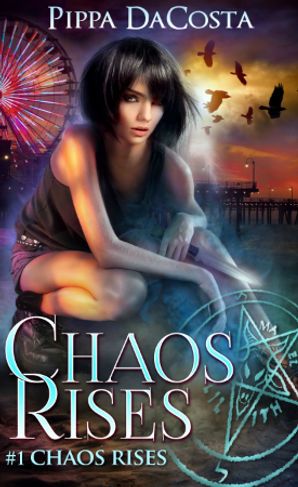
2016 also sees the beginning of something new with Chaos Rises, which will feature another demon-infested real-world setting. Is this to be a whole new story, or are you expanding on the setting you established with The Veil?
The Veil series was—and still is—incredibly popular. Readers demanded more as soon as they’d read the final book. But while I love that world and it’s characters, the story arc had come to its proper and satisfying conclusion. Adding more to the story for the sake of demand just felt wrong. However, the potential for a spin-off series had always been in the back of my mind. Chaos Rises is the first of what will be at least three books set in the same world as The Veil, but this time we have an all new cast of characters (all bar one; Li’el—also known as the Lightbringer and other more infamous names—was a surprise hit with Veil fans), a new location in Los Angeles, and a whole new story for fans, old and new, to enjoy. I have to admit, after my sabbatical in gritty space opera, it feels good to be back in urban fantasy waters.
With twelve titles since late 2013 you seem to have rather exploded out of nowhere. Do you have a longer creative history, lurking unseen and unsung?
I’ve been writing on and off for twenty-five years, give or take a few. But it’s only recently that I’ve switched to writing full-time. My high school friends will attest to my credentials, I often pushed handwritten manuscripts with pencil-drawn, home-made covers into their hands. I took a hiatus from writing in my twenties to work as a marketing manager for an overseas property development company. Once my two little girls arrived on the scene, everything got turned upside down (as it does!) and it’s only recently that I’ve returned to writing. When I decide to go after something, I throw everything at it and don’t stop for air until it’s done, writing into the wee hours, every night, every day. But now I have a strong team of editors, proofreaders and cover designers on speed dial, and together we bring life to the crazy ideas in my head.
Your family background is quite a mélange, how does this influence your writing?
My ancestry doesn’t necessarily influence my writing, but it does influence how I go about the business of writing. I mentioned my determination? It’s in the genes. My family history was something I only recently discovered. My mother died when I was sixteen, and my father more recently from cancer, so unfortunately I was too late to ask questions. If I wanted answers I’d had to search for them, but I’d always had a fascination with my mother’s family name and vowed that if I was ever published I’d use that name. So ‘DaCosta’ was my starting point, and from there I discovered a mix of Spanish-Jewish and Irish ancestry. I’m 5’ 3” with red hair, feisty attitude and a strong-willed, never-quit outlook… yeah, I can’t imagine where that came from!
 You now live on the border between Devon and Cornwall, a largely rural area of Britain with a rich history—but your main focus to date has been urban fantasy, and now you’re branching into sci-fi! Is writing an escape from this environment?
Hell no. I love urban fantasy, because I enjoy mixing fantastical elements with the mundane of every-day life, but I’m lucky enough to live in one of the most beautiful parts of the UK and I draw inspiration from every aspect of it. I use writing as an adventure, as a way to explore what I see, hear, and experience. I soak it all up and then fuse it together in new worlds and characters. I do have an unpublished piece of work, currently with my agent, which is a more traditional fantasy (dragons!), and for that I’ve pulled a lot of inspiration from Cornwall’s mining heritage. I’m a sponge. It’s all going in for later use.
It’s no easy task to dive into writing professionally, and you swam the indie-author waters before landing a publishing contract. Was that always part of a plan, or were you just eager to show the world what you could do before people started paying proper attention?
Well, it occurred to me that if I was a hit on my own, why wouldn’t a savvy agent or publisher be interested in my work? I’d heard that agents/publishers wouldn’t touch self-published authors with a ten-foot pole, but I shrugged and self published anyway. If it was true I figured it was their loss, because snubbing someone who’s a success seemed absurd.
I’ve mentioned my background in marketing. I knew success wasn’t going to land in my lap, so I went looking for it, knowing I could make it work. As it happens, agents and publishers did sit up and take notice. Two years later, I have a fabulous agent and a great relationship with my publisher, and both understand that self-publishing, for me, is an important part of my business strategy.
How has self-publishing prepared you for the “traditional” path, or influenced how you walk it?
The main different between traditional and self-publishing (if you pay freelance editors, designers, etc.) is time. For someone like me, who likes everything done yesterday, waiting on publishers to go through their processes can sometimes be frustrating. Self- and traditional publishing are very different means to market, each with their benefits and pitfalls. I think being hybrid means I get the best of both worlds, just as long as I can juggle both commitments (and the husband, kids, and so on!).
Now you’re embracing both sides simultaneously, what’s your experience of balancing a hybrid career?
It can be tough. I have precise control over self-publishing, and not so much in traditional. I schedule my year in advance, so I know what draft I’m writing and when, when to hire cover artists, when the draft goes to editors. I manage pre-order dates, new release events, audition audiobook narrators—the list goes on. But I have to factor in a lot of contingency time, just in case something happens that’s out of my control. Thankfully, my publisher is very understanding, and on the self-publishing side I can be flexible should the house of cards come tumbling down. It is a balancing act, but one I absolutely love.
Although you’re obviously committed to the fantastical genres, I sense that you decided on a change of direction after your first title, Hunted.
That little book was my proving ground, me dipping my toe into self-publishing to see if anything bit it off—but it was while writing its sequel that the idea for Beyond The Veil sank its teeth in and wouldn’t let go. I (perhaps naively) set aside the sequel to Hunted and figured I’d type out a few pages of Beyond The Veil and then forget about it… that didn’t happen. A few pages turned into a few thousands words, turned into a novel. And another novel. And a series. In short, I’d found my calling.
 More recently you’ve tried writing from a male character’s perspective again, splitting the action between male and female leads in the Girl From Above books.
What I especially loved about Hunted (and that unpublished sequel) was immersing myself in a male point of view and turning my ‘hero’ into the villain. In The 1000 Revolution series, every one of the main characters leans so far into anti-hero territory they’d be villains anywhere else. I adore writing anti-heroes, they’re complex and fascinating. My main character, Caleb, rages against the world, and it can be a cathartic experience writing such an angry, damaged individual. That’s certainly reflected in Girl From Above’s darker themes and adult content.
Is there anything you consciously avoid in your writing?
No, I go looking for themes and content that walk the edgier side of life. All the fascinating and interesting things happen on the fringes. Having said that, Caleb did make me uncomfortable pretty much the whole time I was writing him. As soon as I recognised that I might be shying away from a certain behaviour—one that would fit the character, but made me squirm—I quickly got a handle on it, telling myself that if I was uncomfortable then the reader would be too, and that’s the reaction I’m looking for. I’ve also written a short prequel to the Veil series called Wings of Hope, which deals with themes of slavery and abuse in the demon world. Wings made me uneasy for all of the above reasons, but it was necessary and I consider it some of my best work.
I know you’re a keen reader, it’s not an uncommon trait amongst writers. When it’s time to relax with a good book, do you bring your working genre home with you or stray further afield?
I binge on genres, but I do tend to write what I enjoy reading, and vice-versa. I have Goodreads shelves overflowing with sci-fi and fantasy books I’ve bought and not yet read. Goodreads feeds my reading addiction, and I’m a happy addict. Occasionally I’ll dip into other genres and get sucked into another binge. I stumbled across a fabulous steampunk series recently and didn’t touch any other genre for weeks. It’s important for writers to read widely, but it can be tough to find the time, hence my ever-growing unread shelves.
Favourite authors? Influences, or just people you love to read?
I have a lot of respect for Stephen King. How he continues to think up with fresh ideas after so many years. That longevity in this business has to be tough. His books were the ones I gravitated toward as a kid, partly because they were on my mom’s top shelf. She wouldn’t let me near them, so of course I was fascinated by their moody and evocative covers. King is all about entertainment, and giving the readers what they want. He makes it look easy, which is the hardest part of writing!
 So, a high-powered publishing magnate steps into the elevator and hits the top button. He sees the manuscript in your hand, and—in a non-creepy, make-your-career-between-floors kind of way—says “You’re a writer, are you?” You’ve got thirty seconds to intrigue: Go!
Good bad guys, bad good guys, action, suspense, sex—and that’s just the first chapter. Look me up.
(Leaves elevator early because: intrigue!)
…maybe mention your name too? Thanks for talking to us, Pippa.
You can find out more about Pippa and her writing at her website, PippaDaCosta.com, as well as on Pinterest, Twitter and Facebook.
Interview by Andrew Leon Hudson – SFFWorld.com © 2016