

 Taylor Anderson is a man with many titles, but the title I’m most interested in today is “alternate historian”. He is the author of the long-running series, Destroyermen, and I got a chance to talk with about his newest entry in the series, Blood in the Water, along with working and acting in historical films. Check it out below:
In your own words, who is Taylor Anderson?
Well, in a lot of ways, I guess I’m a fairly “old-fashioned” sort of guy. And I didn’t even really realize it until recently. Just as I gradually became aware that other people were acting “weird”– wearing hats indoors, staring at their phones all day, wearing PJs on a plane, cussing on TV . . . my daughter looked at me with a funny expression and asked “how can you be so strange?” I was a little taken aback. I’m not OLD enough to be “old fashioned!” I guess I am old-fashioned, though, and maybe my interests have made me so. I do like old things, old ways—and history. And history is what made us what we are.
Who am I? First and foremost, I’m a husband and father. After that, for the last decade, I’ve identified myself as a novelist. Beyond that, I’m a teacher, historian, reader of books of all kinds, outdoorsman, sailor, ballistician, machinist, builder of 18th and 19th century firearms, artilleryman . . . I could go on and on until I got to “roofer” and “auto mechanic,” but perhaps “gentleman adventurer” sums it up. The point is, I’ve done an awful lot of things. They’re my “history,” and they’ve made me who I am. Maybe they’ve made me a little “old-fashioned,” too, but life experience is essential to becoming a good writer, and considering what I write, maybe “old-fashioned” is an asset?
Your biography says you have acted in historical films. Care to list a few where we might see you?
I have. My main job has usually been supplying cannons and training artillerymen, infantrymen, etc. I’ve also taught the actors how to use small arms and artillery, and spent a LOT of time fixing the weapons when they break. General “armory stuff.” I also tell people what to SAY when they’re messing with cannons or period small arms, or ordering troops what to do. The commands and terminology for that sort of thing have sort of fallen out of the everyday lexicon. But I always wind up on screen somewhere around the big guns. This started as a safety precaution. Everybody loves cannons, but they’re big, heavy, dangerous brutes that do NOT love you back. It’s amazingly easy to get hurt around them if you don’t know what you’re doing—so I generally “command” the cannons and make sure everyone knows what they’re doing—and then I watch them like a hawk. In pictures with lots of cannons, I obviously can’t command them all onscreen, so I’m just behind the camera—still watching the crews like a hawk. I’m proud to say that of the hundreds of crews I’ve trained, no one has ever been injured using cannons or small arms on set.
I’ve been behind the scenes on too many movies to list, but you can see me yelling “Fire!” or otherwise goofing around with cannons in Two for Texas, Rough Riders, American Outlaws, The Alamo — to name a few–and there have been several I’d just as soon NOT mention, for various reasons . . . And I’ve done lots of documentaries. Those are usually more fun than movies, (and you’re not away from home as long). I spent seven and a half months on the set of the Alamo, for example. I haven’t done much of that in recent years because, believe it or not, writing is a fairly time-consuming occupation!
Out of the fictional films you have worked on, which one did you find to be the most historically accurate?
None of the purely fictional films I’ve worked on were very historically accurate, though the portrayal of the Battle of San Jacinto in Two for Texas was GENERALLY fairly good. The “Twin Sisters” were iron 6pdrs (though their carriages probably weren’t olive-colored), and we used two iron 6pders—and advanced them with the infantry just like they did. The funny thing is, some friends and I had been serving as “assistant” armorers, teaching and repairing flintlock small arms. After the cannon scenes were “wrapped,” we went home. The “credited” armorer was a nice, knowledgeable fellow, but he didn’t know flintlocks. (Several amusing side stories, that I can’t possibly insert here). Anyway, as soon as we got home and began sorting all our gear, they called and told me the armorer had quit! I had to round up an armory crew and go back to finish the picture, including the most demanding combat scenes, yet we never got any credit for that.
Rough Riders was a very good—probably the best—depiction of the Spanish/American War in Cuba. There was a fictional side story, so I guess that counts. The acting was great, as was the depiction of that “time” in American history. The Alamo had interpretive portrayals of numerous historical characters, but was otherwise very good—although the “Twin Sisters” at San Jacinto were depicted as bronze guns, with RED carriages—a very doubtful color! Oh well. Otherwise, it was much better done than most will ever know. Sadly, many wonderful scenes were cut, that would’ve made it the definitive picture, from a historical standpoint.
What got you interested in alternate history?
I committed an unforgivable sin in college. I wrote a paper on the Battle of Shiloh—and proceeded to speculate about what might have happened had A. S. Johnson noticed he was bleeding rather badly from a relatively superficial wound. I proposed that the simple application of a tourniquet at the proper time might have altered the course of the battle, possibly the war—ALL OF HISTORY! My professor was horrified, and gave me a “C.” At the same time, however, I got bitten by the “what if” bug. It remained a hidden disease for many years, like Malaria, and I kept on doing things that required me to get history as close to accurate as humanly possible. Finally, I guess I cracked. I realized I wanted to write an Asiatic Fleet story, but knew I had to have fun with it. I’d keep the history “hard,” so it would maintain the “feel” of true history, but the weird part would get REALLY weird. Thus was born the Destroyermen series, and I’ve never had so much fun with history in my life.
The episode with your professor reminds me that not a lot of professional historians like asking “What if?” Why do you think that is?
Oh, I’m sure that’s because “what if” distracts from “what was,” from their perspective. The weird thing is, with “revisionist history” so rampant, many professors are engaged in a kind of “alternate history” of their own. Not that all revisionist history is a bad thing—hindsight can grow clearer with time–but some professors tend to focus on obscure elements better reserved for advanced classes at the expense of big picture events. This skews the perception of the student away from broader understanding, in my view, and eliminates an appreciation for “why” the subjects they focus on are relevant in the first place. Even more ironic, much new discovery, even in “hard” history, is predicated upon “what if?”
Your next novel in the Destroyermen series, Blood in the Water, will be out in June. What is next in store for the crew of the USS Walker?
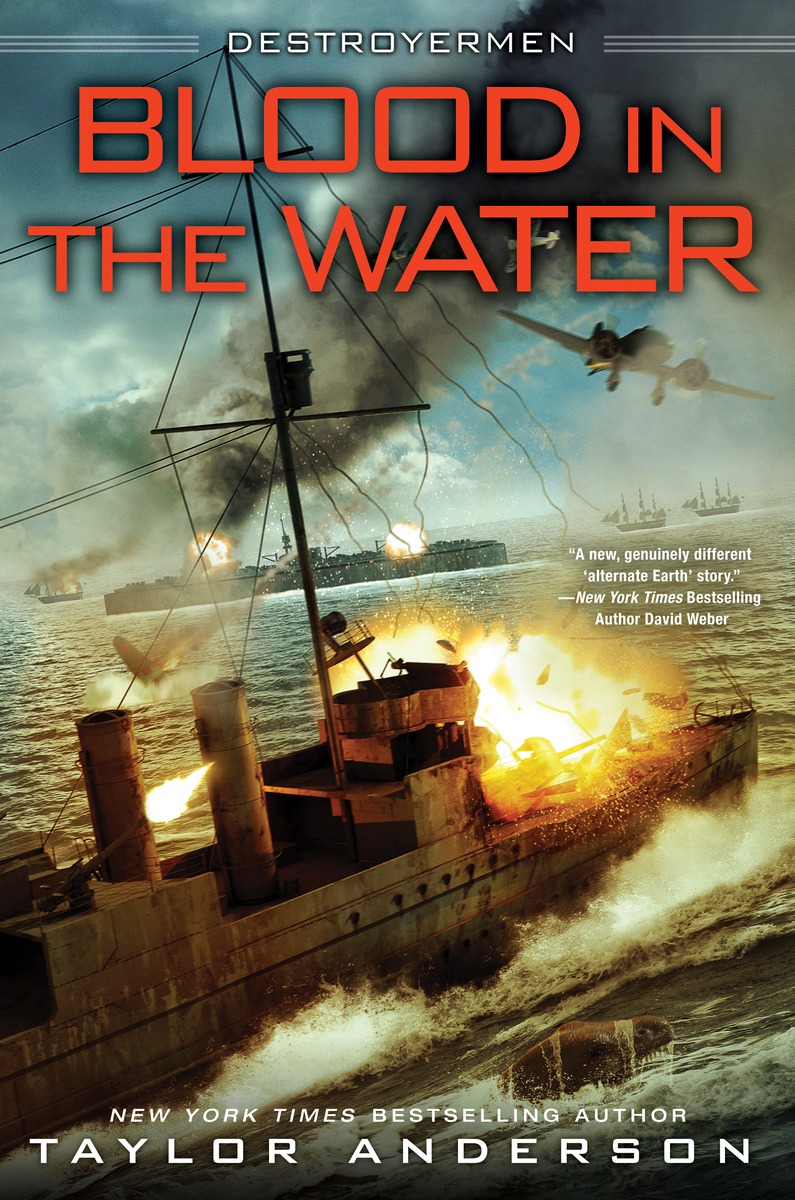 It’s going to be a game-changer. Our heroes are spread pretty thin, with greater and greater demands on their capabilities. This makes them terribly vulnerable . . . Historically, in situations like that, things can go either way—but usually badly, and you really find out what people are made of. The problem is, the D-Men and their allies have been showing “what they’re made of” over and over again. Too many times back to the well? We’ll see. As usual, there’s a LOT of action and some truly wicked battles (I think some of my best) between forces that readers may not expect, and from a few perspectives that haven’t been viewed for a while.
Destroyermen is going to be eleven books long. Did you know from the beginning that this series would have so many installments?
Yes. At least I always hoped so. When I mapped out the general “history” of the Destroyermen world, beginning with their involvement, I knew it was going to be a big story, and I can’t thank the fans of the tale enough for letting me keep “playing” in this world. As much as they enjoy reading it, their pleasure can’t compare to what I get from writing it.
That said, from a planning standpoint, little has been “cast in stone,” particularly regarding who lives and dies. Sometimes, believe it or not, that surprises me as much as anyone. And things change and evolve in the story, as in life, based on unforeseen circumstances. Still, The End has been on paper for a long time. (Yes, it WILL end. All good stories must), but I remain unsure exactly how many more books it will take us to get there. I do want to tell the WHOLE story, after all, and when it does end, it will be . . . unforgettable.
Are you working on any projects outside the Destroyermen series?
Yes I am, but I’d rather some remain a surprise, and I’m not at liberty to discuss a couple just yet rest assured, however, none will interfere with the Destroyermen series. I WON’T just drop it and leave people hanging for years while I monkey around with other stuff. That’s a promise.
Any advice for aspiring authors?
Turn 40. (Just kidding). But DO, by all means, rack up some life experience. I use the “turn 40” advice as a metaphor for that. To write anything, and particularly believable characters, you have to MEET a lot of “characters” to draw inspiration from. I’ve known 20 year olds who’ve “lived” more in their few years than many retirees– and could write a far better story–so the number 40 has little real meaning. But to the younger crowd in particular, who want to write stories that “grownups” with real life experiences will choke down without complaint, you need to get out and DO stuff. Meet people, listen to them, talk, laugh, live.
After that, write what you’re passionate about. It WILL come out on the page. And don’t get disheartened if you get rejected. Everybody does. Then, even if your story DESERVES rejection, for whatever reason, always remember it was the story, not YOU. Be objective (I know it’s hard) and seek the opinion of people you trust to tell you the truth. If they think it’s bad, don’t get mad at them or yourself, make it BETTER! Finally, (and some might—perhaps rightly–disagree with me here), decide from the start whether you want to tell a great story, or just string a bunch of beautiful words together. You CAN do BOTH, and some of the very best stories are built with artistic prose, but the story MUST be the focus. Even the most abstract poetry must have a point. Again, try to be objective and be prepared to be brutal. Read what you’ve written aloud. If it sounds awkward to you, it will certainly read that way to others. Don’t be afraid to get rid of that stuff, restructure it so it doesn’t distract from the story. Even save it, if you want, for “later.” But if it doesn’t advance the story, help set the mood or the scene, if it’s there just because it’s “pretty,” hit delete.
Interview by Matt Mitrovich – SFFWorld.com © 2016




thx for the advise I’ve been working on a science fiction story for a few years now and hit a block but if I dump some of the non essential I might get past it!
Great interview! Great advise. Life experience is the key to a super story. All the little details and color with the characters drive the story and makes it believable. You have a true fan here!
Thanks for the”Destroyermen”!