Jay Posey appeared on the speculative fiction scene in 2013 with the release of Three, the first book in his Legend of the Duskwalker series. Followed by Morningside Fall and Dawnbreaker over the next two years, the books distinguished themselves from the post-apocalyptic crowd by carrying various elements of enticingly very-high-tech into their collapsed future.
His current novel, Outriders, steps across into new sub-genre territory but deepens an apparent love affair with novel technologies, this time in a covert/special ops setting, and now we’ve an opportunity to hear more from Jay directly about his writing.
So, Jay, to begin with pitch us Outriders – what’s the story this time, and what makes it stand out from the genre crowd?
 JP: First off, hi Andrew, and thanks so much for taking the time to chat with me!
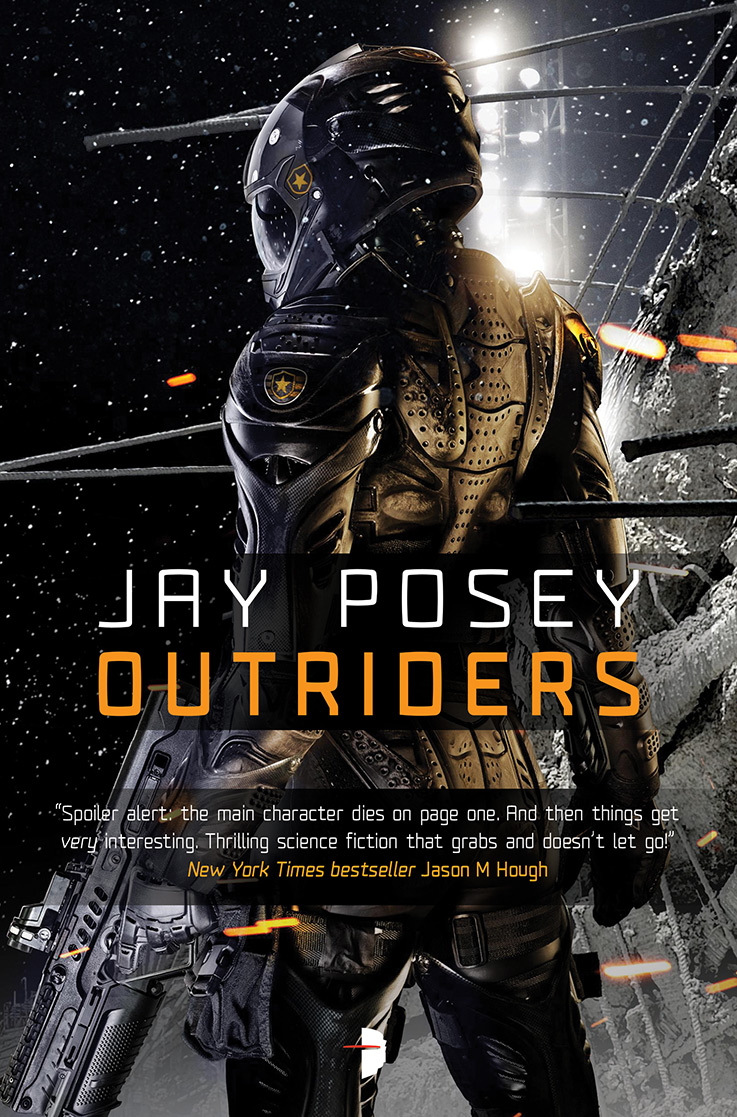
Outriders is about a small team of death-proofed special operations soldiers trying to prevent the outbreak of the first interplanetary war.
The story follows Captain Lincoln Suh as he assumes leadership of the secretive 519th Applied Intelligence Group (aka “the Outriders”) and takes on his first mission with the team. And it’s quite an introduction. A pair of events threatens to cripple the United American Federation’s Martian intelligence-gathering capabilities, but it isn’t clear whether they were a horrible coincidence, or an extremely well-disguised attack. It’s up to Lincoln and his team to uncover what’s really going on, and naturally, what they find has dire implications not just for their own nation, but for both Earth and Mars.
I wanted to take a slightly different approach from the usual elite-team-of-shooters and/or power-armor-makes-you-a-walking-tank experience. The Outriders have power armor and all kinds of nifty gear, but it’s all designed for stealth and infiltration. They’re really an intelligence unit first; they just happen to do all of their intelligence gathering in places they aren’t supposed to be. And they also just happen to be really good at shooting and blowing things up, in case it ever becomes necessary (which, of course, it usually does).
What provoked the switch from writing post-apocalyptic fiction to military sf?
 It took me about four years or so to write the Legends of the Duskwalker trilogy, and it was an emotionally difficult journey. It starts with a lone gunslinger who agrees to escort a dying woman and her son across the urban wasteland, to the boy’s father before she dies. Of course, things are much more complicated than they first seem.
At its heart, the Duskwalker trilogy is a long-arc story about imperfect people trying to do the right thing in a bleak, broken world. I love the Duskwalker world in all of its weird post-apocalyptic Western cyberpunk glory, but it’s a pretty grim place to work.
Once I completed that story, I was ready to take a creative break and do something a little lighter. A lot of what’s gone wrong in the Duskwalker world has to do with the misuse and abuse of technology, or technology out of control. With Outriders, I wanted to look at the more aspirational side of technology, and all the great things we can do with it if we put our minds to it.
I enjoyed Outriders a lot, and (for reasons I won’t go into here!) two points of reference sprang to mind while reading – the first, Old Man’s War by John Scalzi, and the second, Joe Haldeman’s The Forever War.
 I think there’s certainly overlap there, particularly with Old Man’s War. The idea of being able to shift consciousness from one body to another, for example, is a central part of both. And I think all three books are exploring different aspects of the impact of conflict and combat on humans. But both Old Man’s War and The Forever War focus more on the infantry-level experience in a large-scale conflict, and Outriders is a much smaller story by comparison. In Outriders, humans haven’t really made it much past Mars yet, and there’s no alien contact. We’ve still got plenty of issues to resolve between ourselves before we get too much farther out or into anyone else’s business.
I have to confess that I’m sort of delighted that anyone would consider Outriders as even remotely relevant next to those two titanic works.
At this point in my career, I’m not even sure how to count influences or inspirations on my writing. I’m sure that anything I’ve ever read has left its mark on me in one way or another. Tolkien is certainly one of the biggest; maybe not specifically in how I write, or in my subject matter, but definitely in the philosophy of why I write. William Gibson is another, primarily in his courage to write about what he wants, and in the trust he has in his audience to follow along and to put pieces together on their own. And Helen MacDonald’s work, especially her amazing H is for Hawk, shows such a breath-taking mastery of language that it helps keep me aware of just how much room I have to grow as a writer.
As the book’s blurb confirms, it’s not really a spoiler to mention that your protagonist notably dies three minutes into the story, only to dust himself off and get straight back on with his career. Did you have a particular thematic objective in mind when you devised this quirk of the story world, or was it just a case of thinking “that’s a cool idea” and you ran with it from there?
It’s absolutely critical to the heart of the story. Typically, in America, we have access to some of the best medical treatment in the world, and we’re pretty great at patching people up physically. But we have a long way to go in understanding the psychological and emotional toll that war can take on those who’ve served, and an even farther way to go in helping heal those wounds. I wanted to explore the idea that even if we get to a point where we can overcome death, it still doesn’t free us from the realities of what confronting violence and evil does to those who volunteer to do so.
That’s not to suggest that all of our veterans are walking around damaged or emotionally unstable, no matter what impression various media outlets may have given. The vast majority of veterans that I’ve had the pleasure of getting to know are perfectly well-adjusted to civilian life and some of the most productive and reliable members of society I’ve ever met. But I think it’s important to recognize the toll that war takes on all of those that it touches, not only those that serve but on their loved ones as well.
We tend to use the term “gave their life” to mean someone died in battle, but in reality, anyone who deploys is giving some portion of their life for their country. They’re putting the nation’s needs ahead of their own, giving up time with their families, often putting their own desires on hold while they go off to serve.
Even with all the information available to us today, it’s become very easy as a civilian to ignore the actual cost of war, and if my work can do anything to spark a little more awareness and gratitude for the men and women who serve in our armed forces, then I’ll feel like I’ve done something more useful than just telling a good story.
(To that end, if you don’t mind me giving a little plug, I support a non-profit organization called Hope for the Warriors that specializes in providing care for post-9/11 service members and their families. They’re a highly-rated charity and they do great work, and for anyone interested you can find out more about them at that link.)
Outriders features some convincing action sequences, sometimes from the perspective of hyper-competent planning-and-execution, sometimes the disorientation and chaos that epitomises the fog-of-war. Prior to making the move into published fiction you worked for over a decade as a writer and game designer, in particular on the Tom Clancy’s Ghost Recon and Rainbow Six franchises – how much of a resource has that been when it comes to writing military sf?
I couldn’t have written this book if not for all the years working on those franchises; Ghost Recon especially. I’ve always been interested in the military and have had a long appreciation for it, but working on Ghost Recon really challenged me to get much deeper into the subject matter than I ever would have on my own. The biggest gift I received from that work, though, was the access it gave me to people who actually do those jobs for a living.
Red Storm Entertainment (the development studio I work for) has given me access to a number of advisors, both retired and active duty vets. Having the opportunity to sit down and talk with them about their work (and in some cases observe their training) gave me an entirely different perspective and appreciation for them. It really matured my view and understanding of war and violence, and of the men and women who volunteer to confront those horrors. I wouldn’t have been able to write Outriders if it weren’t for those people who generously took time to share their experiences with me.
 It’s now almost twenty years since you began working in the gaming industry. Will you tell us a little about the path that brought you there, and your experiences in game writing?
I have a strange and tangled past, so I don’t recommend anyone else try to replicate it. I got my degree in computer science and then took my first job out of college doing tech support for a game company. I spent a little over a year there, hoping to transition to a programming role, but after it became clear that wasn’t going to work out I ended up leaving the industry to do web application development.
I did that for a few years until my soul shrivelled up nearly completely, and then I did the thing you SHOULD NEVER EVER DO (probably), which was quit my job and take up screenwriting. I was a freelance screenwriter for two years, and then (when my first child was on the way) decided I should probably get a stable job, at which time I reached back out to buddies of mine who were still in the game industry and, lo and behold, ended up at Red Storm Entertainment.
So what prompted the shift to writing novels rather than games?
I’m still making games for my day job, but I started the Duskwalker series specifically because I felt creatively stifled in the game development world. It might be hard to believe from outside the industry, but when it comes to making games the writer is rarely driving the decision-making process. In the worst cases, the writer isn’t even involved in the decision-making process. You end up having to make a lot of compromises, and sometimes you just have to make something work based on what pieces you get handed. Some of the situations I got put into as a designer and writer were incredibly frustrating. So for me, the novels really became my own playground, where I got to play with MY toys and I didn’t have to let anyone else touch them.
Is it a wrench or a relief to step away from such a highly collaborative creative activity as game production is to one where you have to go it alone?
It’s both. One of the great things about Red Storm is how many amazingly creative people work there. There have been many times that I’ve handed off a character description or a write up of a particular scene to a concept artist, only to have it come back about 10,000 times better than I had imagined it originally. When you work with such excellent people, it keeps you motivated to push yourself to get the most out of your own creativity. I also have people I can turn to for bouncing ideas off of, and typically solutions we come up with together are better and stronger than what I would have done on my own. So I definitely miss that aspect of working collaboratively.
At the same time, communication is always a challenge. There are inevitable compromises I have to make for a variety of reasons, sometimes because of creative differences or sometimes for more practical things like budget or schedule. So having a creative place that is entirely my own is liberating in a way. I don’t have to justify my decisions or try to convince anyone else to trust me if I want to try something narratively risky or outside the normal bounds.
Of course, I don’t have the luxury of blaming other people if my books are terrible, so there’s that side of it too.
There is an element of gamification to the idea of KIA troops brought back to life. You’re taking permadeath off the battlefield, but in gaming that’s often a given – so much so that offering players a taste of finality becomes a rare selling point. Don’t you risk diminishing the sense of threat that your characters face with this concept?
That’s a great question, and it’s definitely something I was very concerned about with this first book. But that’s also, in a way, the point: I really wanted to explore the idea that when you take that fear of death off the table there’s still an enormous psychological and emotional cost to losing one of your teammates, even if it’s temporary.
It was a tricky balancing act (that I hope I pulled off!) but there are moments where we see this play out in the book. There are characters who think that losing an Outrider shouldn’t be that big of a deal, because “you can always bring them back”. But then there’s the reality; from the Outriders’ perspectives, there’s the chance that you might not just watch a friend die once, you might have to suffer that horror many times.
My hope was that once readers got to know the characters and realized how they themselves felt about The Process and the experience, the sense of threat would remain.
I think you succeed in that. Outriders is clearly set up to be the beginning of a series – is writing the sequel your next project, or are other things competing for space on your plate?
I’ve actually got another novel to complete before I return to the Outriders world, but it’s not one I can officially talk about quite yet. But I assure all the fans of Outriders out there that I’m already working on the plan for Book 2, and I’ll get it to you as soon as I possibly can.
Many thanks to Jay for talking with us! And you can keep in the loop with him at his website, JayPosey.com, or on Twitter, where he goes by @HiJayPosey.
Thanks so much, Andrew!
Interview by Andrew Leon Hudson – SFFWorld.com © 2016