 “Fifteen year old Jackson is different from the other children at the foundling hospital. Scales sometimes cover his arms. Tentacles coil just below his skin. Despite this Jackson tries to fit in with the other children. He tries to be normal for Sister Jerome Grace and the priests. But when a woman asks for a boy like him, all that changes. His name is pinned to his jacket and an orphan train whisks him across the country to Macquarie’s.”
We have talked to E. Catherine Tobler about The Kraken Sea that is being released tomorrow.
Welcome to SFFWorld, many thanks for giving us some time here. In your own words, who is E. Catherine Tobler?
“Alice replied, rather shyly, ‘I — I hardly know, sir, just at present — at least I know who I was when I got up this morning, but I think I must have been changed several times since then.’ ”
I think that’s a good answer for someone who is both a writer and an editor in the science fiction field. Sometimes you wake up and put your writerly hat on. Sometimes you wake up and put your editorial hat on. It’s hard to wear just one hat at a time, but I try.
How would you describe The Kraken Sea in your own words?
The Kraken Sea is, at long last, the story of Jackson, who founded Jackson’s Unreal Circus and Mobile Marmalade. I’ve been writing stories in this universe since 2004, so it was probably past time to tell Jackson’s own story, which is that of him crossing the country on an orphan train, to discover who and what he really is.
The story is set in your traveling circus universe and tells the story of the circus’s founder, Jackson and we meet him as a fifteen year old. How was it to write Jackson as a fifteen year old?
Jackson has always been something of a mysterious figure in my circus short stories; there have been hints as to his past, but I’ve never taken the time to explore it in depth. Writing Jackson as a young man was great—we get to see him inside the orphanage where he grew up, and get to see him riding a train for the first time. Trains play an important part in his life, both past and present, so getting those first moments onto the page were delightful.
What new challenges did you set for yourself with this book?
Given that we have had only glimpses of Jackson throughout the short stories, it was a challenge to explore and reveal more of who he is. I don’t know that I set that as a challenge, though—it was built in. I’ve always enjoyed Jackson’s mystery—for example, in the short stories, we know he has trouble with his hands, but readers are never told exactly why. They get to find out why in The Kraken Sea. I suppose the challenge is revealing those tidbits and histories without losing the magic that surrounds a character.
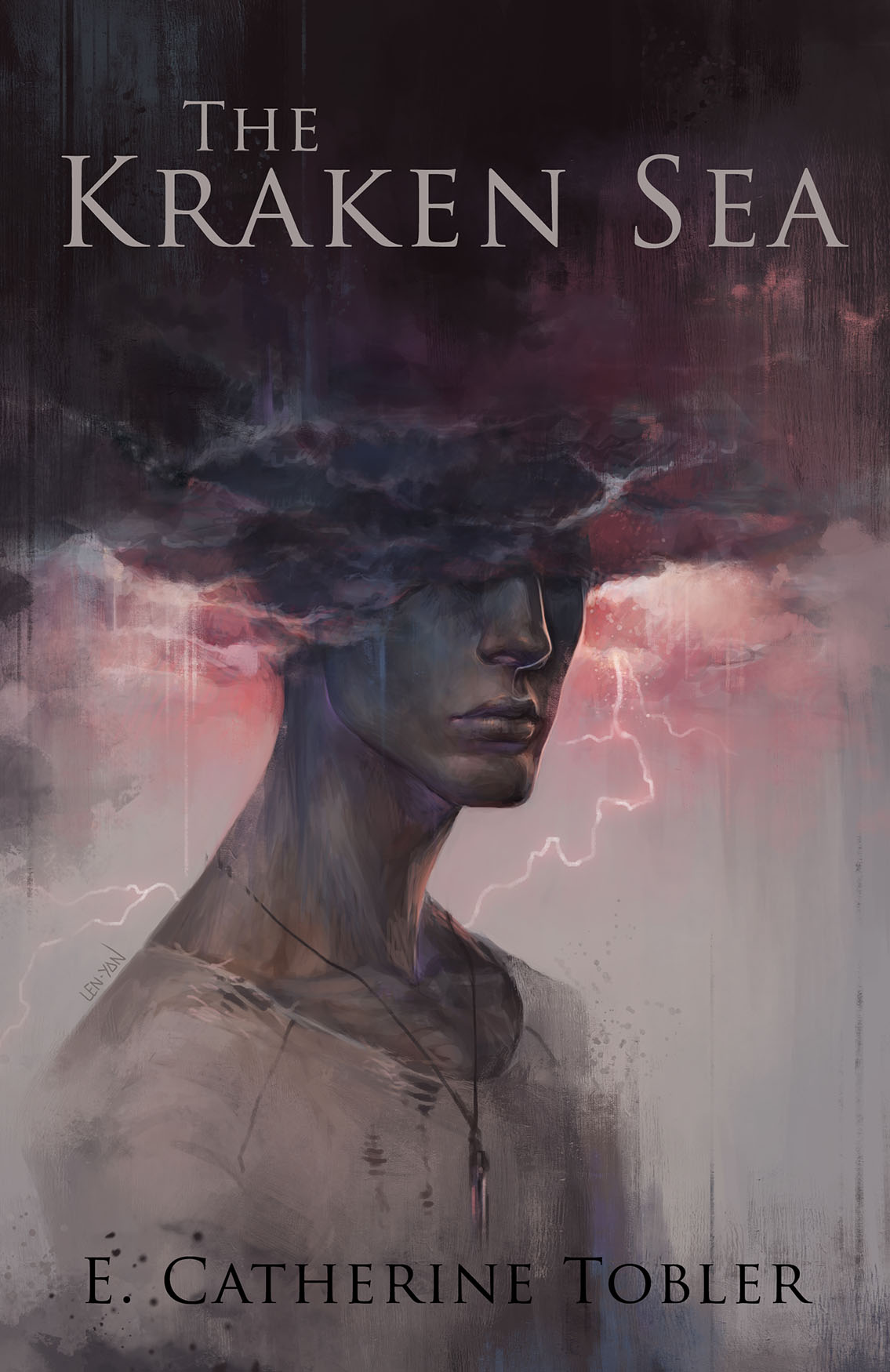 Book covers are always interesting to talk about, especially when they are good and the cover for The Kraken Sea is rather breathtaking. Can you tell us a bit about it? How involved were you in the process of choosing a cover?
A lot of times, authors have no input, so I was very happy when editor Lesley Conner approached me and asked me if I had anything in mind. We both wanted tentacles on the cover, but the more art we explored, the less that seemed feasible. I stumbled across the work of Magdalena Pągowska on Deviant Art, and both Lesley and I were blown away by the style of it. We didn’t end up with tentacles, but we ended up with a brilliant portrait that captures Jackson—both good and bad, light and dark, calm and storm. I’m so delighted by it.
Have you ever struggled between what you would like to happen to a character and what you considered more sensible to occur? Can you tell us when and what did you do at last?
I think that may have been in The Kraken Sea. The impulse is to make the main character a hero, isn’t it? We want to show them in the best light at all times, but that was never Jackson’s life. He’s not a character who is drawn in black and white. He is all kinds of gray, usually doing the thing that will benefit him most. Even if this is good for someone else, he’s chiefly it in for himself—because that’s how he was raised. He had to put himself first, because no one else ever did. (Until—well, that’s a spoiler.)
What is it with Steampunk and Fantasy you find fascinating?
What I like best about steampunk is that it often turns history on its head. In school, history was probably the subject I liked least, but now, seeing history get remixed as it were, it’s greatly exciting. I love the idea that there’s the history we know and then a myriad of secret histories, just under the surface. Fantasy does the same, especially portal fantasies. That wardrobe could be an entry point to another world! Let’s go!
What books inspired your career as an author, and what authors do you enjoy now?
The foundations of my writing are: Alice’s Adventures in Wonderland (Lewis Carroll), The Martian Chronicles (Ray Bradbury), Narnia (C.S. Lewis), and Lord of the Rings (Tolkien). I often look at this foundation and grumble a bit—where are the women authors! But as a young reader, these were the books I was given. This is where I started. From there, I discovered McCaffrey, Le Guin, Julian May, and Bradley. I still enjoy these writers, but today I also read Connie Willis, Jeff VanderMeer, Silvia Moreno Garcia, Molly Tanzer, Kage Baker, Colson Whitehead, Angela Carter, Orrin Grey, Jason Gurley, Elizabeth Hand. I could list authors until the sky goes dark.
What’s next? Do you have more new and exciting projects you’re working on?
By the time this goes to press, I will likely be knee-deep in working on the fifth book in my Folley & Mallory Adventures. It’s a series that combines history, steampunk, science fiction, and fantasy, chiefly set in turn of the 19th century Paris and Cairo. Book four, The Clockwork Tomb, will be released this October.
*****
Interview by Dag Rambraut – SFFWorld.com © 2016