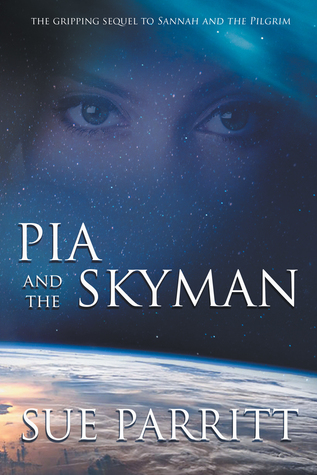
Pia and the Skyman is Sue Parritt’s follow up to Sannah and the Pilgrim. We’ve talked to her about the books and the road to publishing.
 Welcome to SFFWorld, many thanks for giving us some time here. In your own words, who is Sue Parritt?
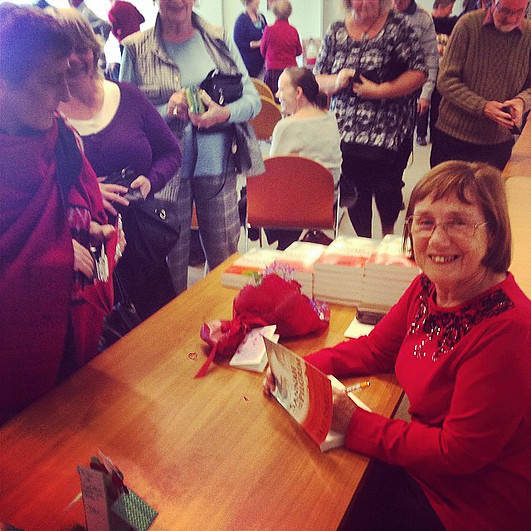
I am a fiction writer based in a bayside town near Melbourne, Australia. Originally from England, I worked after graduating (B.A. University of Queensland 1982, with majors in English Literature, Drama and French) in university libraries until taking early retirement in 2008 to concentrate on creative writing. My novel Sannah and the Pilgrim, published by Odyssey Press in 2014, was Commended in the 2014 Fellowship of Australian Writers Christina Stead Award. Pia and the Skyman, published in April 2016, is the sequel. My current project, The Sky Lines Alliance completes the trilogy and will be published in October 2016. My short stories, poetry and articles have appeared in national and international magazines and anthologies for over thirty years. I have also written the pilot for a TV series based on Sannah and the Pilgrim, and am now seeking a producer.
First of all can you tell us a bit about your series that started with Sannah and the Pilgrim?
Anger, abhorrence and disbelief inspired me to write the series. I was and remain, appalled by past and present Australian governments’ policies on refugees and asylum seekers and failure to act on climate change. I felt my option as a fiction writer was to draw on these policies to create a portrait of a future dystopian Australia.
Initially I envisaged only two books, Sannah and the Pilgrim’ plus a sequel based on Sannah’s daughter Pia and Kaire, the pilgrim of the first novel. But on completing Pia and the Skyman, I realised the need for a third book to complete the story of a future Australia scarred by the ravages of climate change and decades of totalitarian government.
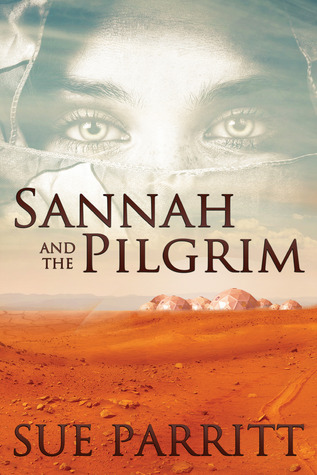 In the first book, I was inspired to create the role of Storyteller for my protagonist, Sannah, by the manner in which information is often distorted by both media and government in order to provoke certain reactions. For instance, in Australia, fears of being swamped by refugees are intensified by using terms such as ‘illegals.’ Sannah’s people are kept in ignorance through a steady diet of Tales (a weird blend of historical fact and fiction) delivered by government-trained storytellers. Set in late twenty-fourth century apartheid Australia, Sannah and the Pilgrim is a tale of courage defiance and deceit as a group of women risk their lives to undermine an oppressive regime. The women gain unexpected support for seditious exploits when Sannah finds a stranger (Kaire, who insists he’s a pilgrim) on her domestep. But when Sannah turns ‘Truth-teller’ even Kaire’s white privilege and advanced technology cannot save her from subsequent retribution.
The second book, Pia and the Skyman is a tale of loyalty, betrayal and duplicity as Pia and Kaire not only risk lengthy imprisonment by helping those suffering in apartheid Australia, but become involved in a conspiracy that if discovered, will see them wandering the universe forever stateless.
The Sky Lines Alliance completes the trilogy by implementing a proposal by former Sky Commander Breta (mentioned on the last page of “Pia”) to create an alliance comprising Sky pilots, the Kauri-Australia Line (KAL) and the Women’s Line to overthrow the oppressive Australian government and restore democracy.
In the second book, Pia and the Skyman we get to follow Sannah’s daughter Pia. Was this a natural choice to continue the story and how different do you find writing “Pia” compared to “Sannah”?
Focusing on Sannah’s daughter Pia felt the natural choice to continue the story. As the second book in the trilogy, I already knew the central characters and had a good idea of the plot, so “Pia” only took me a year to write. (“Sannah” took four years including research on climate change, particularly in the Pacific region). The surprise was discovering at the end of the first draft that I had so much more to say and would be writing a third book.
 What new goals did you set for yourself with the second book?
I wanted to challenge my readers by presenting choices that are intended to be disconcerting. Cold hard facts such as the UNHCR’s 2015 report that the number of displaced persons seeking asylum has topped 60 million worldwide, can be difficult to envisage, despite seeing frequent TV news footage of refugees fleeing war and brutality in the Middle East. So, in Pia and the Skyman I decided to focus on a tiny population forced to flee their home and the ramifications when a significant percentage, including hundreds of children, are refused asylum due to unacceptable difference. I believe fear of difference has caused or at least contributed to countless wars, killings and exile throughout the long history of humankind and even today colours many people’s response to those seeking asylum.
The backdrop for the story is environmental refugees and an apartheid regime. Are these topics you feel strongly about and wanted to lend a voice too through your writing?
I feel passionately about peace and social justice issues. Pia and the Skyman was inspired by the continuing mistreatment of asylum seekers and refugees seeking refuge in Australia and the government’s ongoing failure to adequately address climate change. By creating speculative fiction that I believe could easily become fact, I hope to inspire more ‘ordinary’ people to take a stand and work for a more equitable and sustainable future.
If you should put a label on the series. Would Climate Fiction be a good one?
Climate fiction is certainly the genre, as the failure to slow damaging climate change creates the situation where millions are forced to flee their homes and seek asylum elsewhere.
What can you reveal about The Sky Lines Alliance, the third and final book?
The Sky Lines Alliance is a tale of bloody revolution tempered with acts of compassion as three groups join forces to overthrow the brutal Australian government. Pia and Kaire play key roles that challenge their principles and commitment, forcing them to accept that radical change cannot be achieved without recourse to the dark side.
Can you tell us a bit about the process that led up to the series being published?
Some years ago I approached several mainstream Australian publishers with the first book, but all rejected Sannah and the Pilgrim as ‘too pessimistic and showing Australia in a poor light.’ Believing they had missed the point, I turned to indie publishers and was delighted when Michelle Lovi of Odyssey Books shared my faith in the story and agreed to publish it.
How did you start writing? Was there a particular book or moment in your life that spurred you on?
Writing has been a passion since my teenage years when I wrote poetry, usually reflecting my feelings about social issues or newly discovered love. During my teens and early twenties, I also entered public speaking competitions, often including snippets of my poetry in speeches on particular subjects, eg. The threat of nuclear war, mental illness, pacifism. University studies (1978-1982) saw me concentrating on assignments and afterwards full-time work and parenting didn’t allow much time for writing. Only when I reduced my working hours some years ago, in order to have a ‘writing’ day, and took early retirement in 2008, have I been able to devote extensive time to creativity.
What books inspired your career as an author, and what authors do you enjoy now?
I don’t have a favourite author or genre. I have always read widely, however some of my preferred authors are: Helen Garner, Margaret Drabble, Mary Wesley, Sebastian Faulks, Ian McEwan, Kate Grenville, Anita Shreve, Joyce Carol Oates and Elizabeth Jolley.
What’s next? Do you have more new and exciting projects you’re working on besides the third book in the series?
My next project is a novel based on my father’s unusual experiences as an RAF airman based in Naples in 1944 and as a tourist in 1974. A few years ago I wrote this story as a feature film screenplay entitled Feed thy Enemy but so far have been unable to find a producer. Rewriting the script as a novel seemed an appropriate next step.
*****
Interview by Dag Rambraut – SFFWorld.com © 2016