
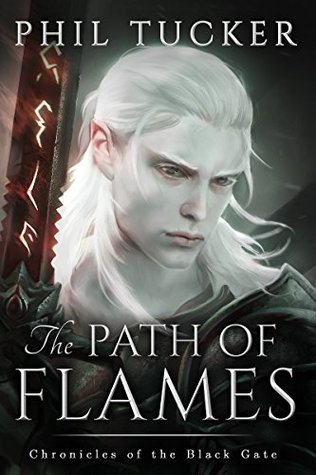
 Phil Tucker, the author of Path of Flames and the sequel, The Black Shriving, was kind enough to submit himself to one of my torturous interviews. (I kid. I don’t torture.) But Phil did agree to an interview. I first learned of Phil through a review of Path of Flames on Pornokitsch. Phil’s first novel is entered in the second Mark Lawrence SPFBO (Self-Publishing Fantasy Blog Off), and the review the book received was sensational. The reviewer felt Phil’s book was so strong that it should actually be entered for the Gemmell Award, not the SPFBO. I rushed out and purchased both of Phil’s books, and I have to say that I largely agree with Pornokitsch. Path of Flames was one of the best novels—self-published or otherwise—I’ve read in awhile. It’s as good in its own way as Dawn of Wonder.
Moving on to the interview. A question all writers get, Phil—or should get—is the simple ‘what inspired you to become a writer?’
I’ve always enjoyed stories. I wasn’t one of those kids that was writing little novels at the age of four, but I always had my nose in a book. I think it was in 6th grade that I discovered Fighting Fantasy novels, which were sword & sorcery choose-your-own-adventure books, and they lit my imagination on fire. From there, it was a natural step to join my 8th grade Middle Earth Roleplaying after school group, where I quickly became the Story Teller.
I moved to the US in 9th grade and joined a local D&D group, and around that time I realized that I just wanted to tell stories forever. I loved that feeling around the table when the party was totally immersed in the game, when the distance between them and their characters disappeared and I could look around and think: this is it, I’ve got them, they’re living in the world I’ve created.
So nerdiness drove you to write. Hmm. That sounds about right.
Even though I did a little writing in high school, I only got serious in college, but even then I was too busy just reading and goofing around to anything more than what my creative writing classes required. The very fact that I ‘knew’ I was going to be a writer made it easy to put off actually writing; I kept waiting for the lightning strike of inspiration, and it was only by the time I was around 26 that I started to notice that it struck very rarely if ever at all.
At that time I was in Australia and spending my nights playing online text based rpg games. The penny dropped one night and I realized that either I was going to get serious about writing novels or I was just going to while away the years writing online with friends. Which was fine, but not something you could live off of. So I jumped into a NaNoWriMo, wrote a ghastly 56,000 word novel, and suddenly saw that as long as you wrote something every day, you could actually produce a book without too much effort.
And I’ve been writing ever since, having shelved the whole ‘divine inspiration’ schtick in favor of approaching the business like a craftsman, striving with each new book to improve my craft. There’s been no looking back since.
 Now that we’ve gotten your nerd history out of the way—and for me, nerd is a compliment—tell us about your story.
Sure thing:
A war fueled by the dark powers of forbidden sorcery is about to engulf the Ascendant Empire. Agerastian heretics, armed with black fire and fueled by bitter hatred, seek to sever the ancient portals that unite the empire – and in so doing destroy it.
Asho–a squire with a reviled past–sees his liege, the Lady Kyferin, and her meager forces banished to an infamous ruin. Beset by tragedy and betrayal, demons and an approaching army, the fate of the Kyferins hangs by the slenderest of threads. Asho realizes that their sole hope of survival may lie hidden within the depths of his scarred soul–a secret that could reverse their fortunes and reveal the truth behind the war that wracks their empire.
Blurbs are meant to intrigue, and your blurb certainly does so. But the book itself is actually more intriguing still. You really overthrow some conventions in the first book. There’s a boy who seems like the overlooked hero, but he hates many of the people who inhabit the world. Nevertheless, he devoutly follows a religion based on reincarnation in a higher station in life. How does Asho meld those dichotomies of hating these people to whom he is enslaved and wanting to be one of them in his next life?
Asho’s conflict as he seeks to reconcile the scorn his world feels for him due to his heritage with his own desire to rise within that world and do good was one of the primary engines that drove my story forward. I think that the best tales are powered by characters and their emotional arcs, and if you can invest a character’s personal issues into their goals and adventures then you naturally raise the stakes for both them and the reader.
Your book has obvious parallels with Hinduism. Was that an intentional inspiration or that just a concept you needed for the story?
The reincarnation theme came about as a result of some of the earliest world building decisions I made. The original nugget from which everything flowed was the decision to create an empire that wasn’t geographically cohesive; I wanted to explore what having a far flung empire connected by teleportation gates would be like. That idea in turn came from a conversation I had years ago when being interviewed to work at Google: the last question was to think out loud about how the invention of teleportation gates would affect our world. I babbled for about five minutes, and many of the ideas I had in that moment stuck with me and came together in the form of this book.
Once I had a series of gates that were connected together, I had to decide where they began and ended. Or were they perfectly circular? I decided on each end would be a gate from which nobody ever returned – which became my Black Gate and White Gate – and that a religion would arise that sought to explain their existence. Reincarnation through the gates seemed right on target, with one end leading to hell and the other heaven, and the rest flowed naturally from there.
 One of my favorite characters was Audsley the librarian. He’s plump, brave, and smarter than others realize. Please tell me he doesn’t die.
Thanks! I had blast writing Audsley. He’s a great palette cleanser and it’s nice to write someone who isn’t as intense and grim as the rest of the cast. And no worries there – he doesn’t die in Book 3.
You do a good job interweaving the various stories and characters except for one: Tharok. His story is separate from the others, and that circlet he finds is quite mysterious, almost like an AI. And if it is an AI, it would mean that your world could be one of many things. Pretty cool. Beyond that, I’d love to know a) when will Tharok’s story intersect with Asho’s and b) what the hell is the circlet?
The revelation as to the circlet’s true nature is coming up in the later books and will play a big role in the development of the plot, so I’m going to have to stay quiet on that front, but I can assure you it’s not AI-based. Tharok’s story will intersect in a big way at the end of Book 3, and from then on remains completely intertwined with everyone else’s throughout the rest of the series.
Your battle scenes are also quite vivid, and you really throw everything into them. Reading the battles is like reading the description of a video game fight. In addition, both of your books end with the death of a big boss. Should I even ask who the big boss is for book 3?
Thanks! I have a lot of fun with combat scenes. I put on great music, crank the volume up real loud, and then write as fast as I can, transcribing the action as I see it in my mind’s eye. And no worries: the Big Bosses get bigger and badder (while remaining true to the setting), so I think you’re in for even higher octane action.
Badder bosses and more lethal fights in a world of floating cities, teleportation, enslaved demons, and religious dogmas that may prove a lie. That’s a lot of coolness right there. How many books will there be? I know the third one comes out in September.
Unless the story surprises me, I’m expecting there to be five installments all told.
I hope you can manage that five book limit. It’s been a very fun ride so far. Moving on then. Who are your favorite writers?
Oh man. I’ll skip the classic complaints about how hard this is and cut to the chase. Jack Vance. He’s infinitely rereadable, endlessly amusing, brilliant and scintillating and wry. Nicola Griffith’s Hild knocked me out of my chair, and then kept knocking be back out each time I turned the page. Sophia Samatar’s language is delightfully rich and vivid, and you can’t go wrong with China Mieville, though the sheer intensity of his genius makes reading him in large doses a challenge. Gene Wolfe, Samuel Delany, Ursula LeGuin, Octavia Butler, and then you get to my old school favorites that are written into my DNA: David Gemmell, Terry Pratchett, early Raymond E Feist, Guy Gavriel Kay and Robert Howard.
Good gracious! That’s a much better list than one I could come up with. However, I will say that, for me, of those on your list, you resemble Gemmell the most in terms of theme. Finally, who would win in a battle between Superman and Batman? And don’t look to that atrocious movie from this summer as an answer.
I’d like to think that Batman would win given his lethal combination of paranoia, genius, wealth and propensity for preparation. But in the end I think all that would crumble before Superman’s sheer power. I find Batman to be much more interesting in his conflicts and complexities when compared to Superman’s wrestling with how best to do good, but I think Supe’s main characteristic is that he simply wins, and that one’s hard to beat.
Supes is the best.
* * * * * * *
Interview by Davis Ashura – SFFWorld.com © 2016





Phil looks pretty relaxed in that canoe. He looks like he’s easing along the French Broad River near the Biltmore.