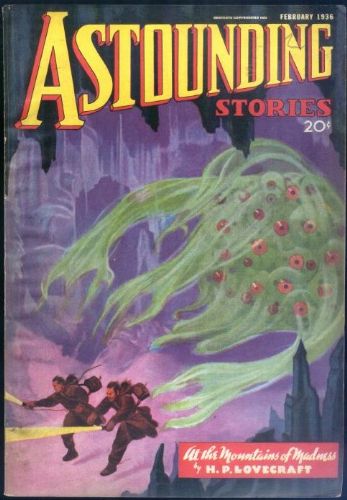
 As part of our Countdown to Hallowe’en, our SFFWorld Horror expert, Randy M., gives us his take on the Lovecraft classic:
I am forced into speech because men of science have refused to follow my advice without knowing why. It is altogether against my will that I tell my reasons for opposing this contemplated invasion of the antarctic –with its vast fossil-hunt and its wholesale boring and melting of the ancient ice-cap – and I am the more reluctant because my warning may be in vain.
— first paragraph
It was young Danforth who drew our notice to the curious regularities of the higher mountain skyline – regularities like clinging fragments of perfect cubes, which Lake had mentioned in his messages, and which indeed justified his comparison with the dream-like suggestions of primordial temple ruins, on cloudy Asian mountain-tops so subtly and strangely painted by [Nicholas]Roerich.
— from chapter 3
In September of 1930, in the footsteps of Shackleton, Amundson, Scott and Byrd, Professor William Dyer (full name only later revealed in “The Shadow Out of Time”) of Miskatonic University lead an expedition to the antarctic (Lovecraft did not capitalize this), fully supplied with shortwave radio, five Dornier aeroplanes, sledges, dogs, 20 men of various skills and expertise, and the newest apparatus for drilling and melting ice. The voyage provides Lovecraft room for foreshadowing as Dyer contemplates Poe’s The Narrative of Arthur Gordon Pym and, on sight of the mountains beyond McMurdo Sound, the paintings of Nicholas Roerich, and finally the fabled plateau of Leng as told of in the “dreaded Necronomicon of the mad Arab Abdul Ahazred,” a volume which resides in Miskatonic’s library and which Dyer perhaps too assiduously studied. In short, and without meaning to be, Professor Dyer is supremely qualified to understand and convey the terror of his experiences beyond McMurdo Sound and, more dreadfully, beyond the mountains that rise in the distance with sharp pinnacles and strange outcroppings perhaps too symmetrical to be produced by nature.
Prodded by discoveries not far from McMurdo Sound, Lake and Gedney break from the main expedition to fly northwest, discovering a plateau near the base of the mountains and on which they land. Upon drilling they discover a cave and in exploring it uncover bones and strange objects, including barrel shaped fossils that might be the remains of an unknown species. They share their enthusiasm and information over the shortwave until bad weather strikes their encampment and they stop responding to repeated calls.
When Dyer and Danforth arrive to rescue Lake and Gedney, they find the encampment destroyed, Lake and the dogs dead, and Gedney missing; they also find signs of a sledge moving toward the mountains beyond. Flying through a dangerous pass in the mountains, they discover another plateau even more forbidding than the one they just left, and what looks to be the remains of a Cyclopean (a favorite Lovecraft adjective) city. The rest of the novel details their exploration of the city and the tunnels beneath it, and their finding of Gedney, among other … things.
After rereading “The Shadow Out of Time” a few years ago I approached this reread with misgivings. The imagination behind “Shadow…” is still powerful, but at times Lovecraft lost narrative momentum by, I thought, straining to sell his premise. There is no straining for effect here: At the Mountains of Madness is Lovecraft at his most imaginative and confident, telling his story as briskly as he knew how, his prose suited to the academic background of his narrator as he merged his enthusiasms for the Antarctic, architecture and science into a great short adventure novel not quite like anything before and rarely equaled since.
Other s.f./horror invasions:
“The Autopsy” by Michael Shea (http://www.isfdb.org/cgi-bin/title.cgi?49726;http://www.sffworld.com/forum/threads/countdown-to-halloween-2011.32378/page-3#post-663908)
“Passengers” by Robert Silverberg (http://www.isfdb.org/cgi-bin/title.cgi?41078;http://www.freesfonline.de/authors/Robert_Silverberg.html)
The Body Snatchers by Jack Finney (1955; a.k.a.: The Invasion of the Body Snatchers) (SFFWorld Review HERE, Guest Post about the book HERE.)
S.F. in a similar vein:
The Puppet Masters by Robert Heinlein (1951)
Camouflage by Joe Haldeman (a well-written novel taking on some of the themes found in Campbell’s story)
(Neither of these are horror, exactly, but enjoyable all the same)
Chilling:
“White” by Tim Lebbon (http://www.isfdb.org/cgi-bin/title.cgi?92351)
The Invisible Man by H. G. Wells
Frankenstein by Mary Shelley
The Terror & A Winter’s Haunting by Dan Simmons (haven’t read these, but their reputations are solid)
At the Mountains of Madness by H. P. Lovecraft (first published in two parts in Astounding Science Fiction, February & March 1936; The New Annotated H. P. Lovecraft, 2014; for further publishing information,http://www.isfdb.org/cgi-bin/title.cgi?21818; on-line: http://www.freesfonline.de/authors/John W._Campbell.html)