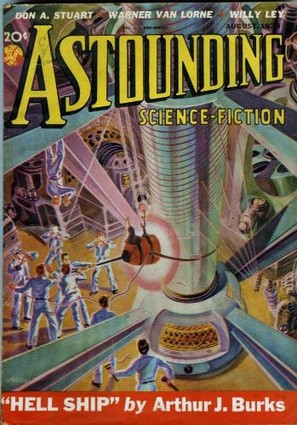
 As part of our Countdown to Hallowe’en, our SFFWorld Horror expert, Randy M., gives us his take on the John W. Campbell Jr. SF/Horror classic:
“Twenty million years ago Antarctica was beginning to freeze. We’ve investigated, thought and built speculations. What we believe happened was about like this.
“Something came down out of space, a ship. We saw it there in the blue ice, a thing like a submarine without a conning tower or directive vanes, 280 feet long and 45 feet in diameter at its thickest.”
— McReady to the rest of the crew
A great shadow deep in the ice pack of the Antarctic and a group of scientists are certain they’ve finally found one. But the thermite bombs used to melt the ice ignite the metal of the embedded ship and the resulting explosive heat nearly kills them as it sinks what little of the ship survived. Not far away, though, lies another shadow, much smaller, promising something else: The pilot.
They carve out and transport a block of ice containing the alien to their base. Some scientists are eager to test it; others are wary of alien contamination, bacteria that might be inimical to man; and a few wonder if the alien isn’t still alive, aware of them, watching them, maybe affecting them – there have been dreams among those who found it …
And then the ice melts.
A group isolated and in peril has been a recurring basis for plot time and again in various genres, examples range from Clemence Housman’s “The Werewolf” (1896) to Agatha Christie’s And Then there Were None (1939) to James Blish’s “There Shall be No Darkness” (1950) to Dawn of the Dead (1978) to The Walking Dead and, I’m sure, beyond. Here, the evolving understanding of the nature of their enemy and its powers isolates each man from the others, wary of an enemy that infiltrates the very cells of their bodies and so could be anyone.
“Who Goes There?” was the basis for the 1951 movie, The Thing (from Another World) directed by Christian Nyby, one of the great Halloween evening movies (note its use in the background of John Carpenter’s Halloween [1978], another great Halloween movie) and the 1982 movie, The Thing directed by John Carpenter, with various sequels and off-shoots since. The original story by Campbell is written in what I’d identify as pulp style, journalistic prose given a heroic edge when dealing with tough, clear-eyed men used to hard work and problem solving, for instance his description of the main character, McReady:
Moving from the smoke-blued background, McReady was a figure from some forgotten myth, a looming, bronze statue that held life and walked. Six-feet-four inches he stood as he halted beside the table, and, with a characteristic glance upward to assure himself of room under the low ceiling beams, straightened. His rough, clashingly orange windproof jacket he still had on, yet on his huge frame it did not seem misplaced. Even here, four feet beneath the drift-wind that droned across the Antarctic waste above the ceiling, the cold of the frozen continent leaked in, and gave meaning to the harshness of the man. And he was bronze—his great red-bronze beard, the heavy hair that matched it. The gnarled, corded hands gripping, relaxing, gripping and relaxing on the table planks were bronze. Even the deep-sunken eyes beneath the heavy brows were bronzed.
The first movie incorporates a post-World War II sensibility, and also the sensibility of its producer, Howard Hawks, who is thought to have had a hand in the direction of the film, by high-lighting the trust and camaraderie between the military men, who had survived the war together, and some of the scientists, the sense of team work against a shared threat, but also respect for higher authority, whether the airmen’s Captain or orders from headquarters. Carpenter’s version is closer to Campbell’s story regarding the nature of the alien, maybe closer to the relationships between characters who seem to know each other only from this project, and very much, I think, a post-Vietnam War movie in its somewhat jaundiced view of a military outpost and military discipline. Carpenter’s film is fine, and the special effects still startlingly effective, but the Nyby/Hawks version is the one I’m more likely to watch again and again in spite of changes to the story necessitated by the special effects of the time.
Among those who care about such things there is a continuing controversy as to whether Campbell was influenced by At the Mountains of Madness. (See review HERE.) Perhaps the answer is somewhere in Campbell’s writings but the best answer I’ve seen on-line is, maybe. On rec.arts.cthulhu several years ago a poster had me convinced that the time needed for writing, editing, submitting and being added to the publication schedule would exceed the two and a half years between the initial publication dates of the stories. I’m less sure now, if only because as a professional writer for the pulps Campbell may well have been able to write his story in a few weeks; according to Leslie Klinger, Lovecraft wrote his novel during February and March, 1931, and I doubt Campbell would have needed much more. But whether or not there was a conscious influence, the story shaves the parallels of location and of scientists seeking to understand something alien and threatening, though perhaps the strongest parallel is that each has now excited and entertained succeeding generations of readers.
Other s.f./horror invasions:
“The Autopsy” by Michael Shea (http://www.isfdb.org/cgi-bin/title.cgi?49726;http://www.sffworld.com/forum/threads/countdown-to-halloween-2011.32378/page-3#post-663908)
“Passengers” by Robert Silverberg (http://www.isfdb.org/cgi-bin/title.cgi?41078;http://www.freesfonline.de/authors/Robert_Silverberg.html)
The Body Snatchers by Jack Finney (1955; a.k.a.: The Invasion of the Body Snatchers) (SFFWorld Review HERE, Guest Post about the book HERE.)
S.F. in a similar vein:
The Puppet Masters by Robert Heinlein (1951)
Camouflage by Joe Haldeman (a well-written novel taking on some of the themes found in Campbell’s story)
(Neither of these are horror, exactly, but enjoyable all the same)
Chilling:
“White” by Tim Lebbon (http://www.isfdb.org/cgi-bin/title.cgi?92351)
The Invisible Man by H. G. Wells
Frankenstein by Mary Shelley
The Terror & A Winter’s Haunting by Dan Simmons (haven’t read these, but their reputations are solid.)
“WHO GOES THERE? by John W. Campbell Jr (first published in Astounding Science Fiction, August 1938; Adventures in Time and Space, 1946; The Science Fiction Hall of Fame, vol. 2A, 1973; Foundations of Fear, 1992; for further publishing information, http://www.isfdb.org/cgi-bin/title.cgi?48111)
Older SFFWorld review is HERE.