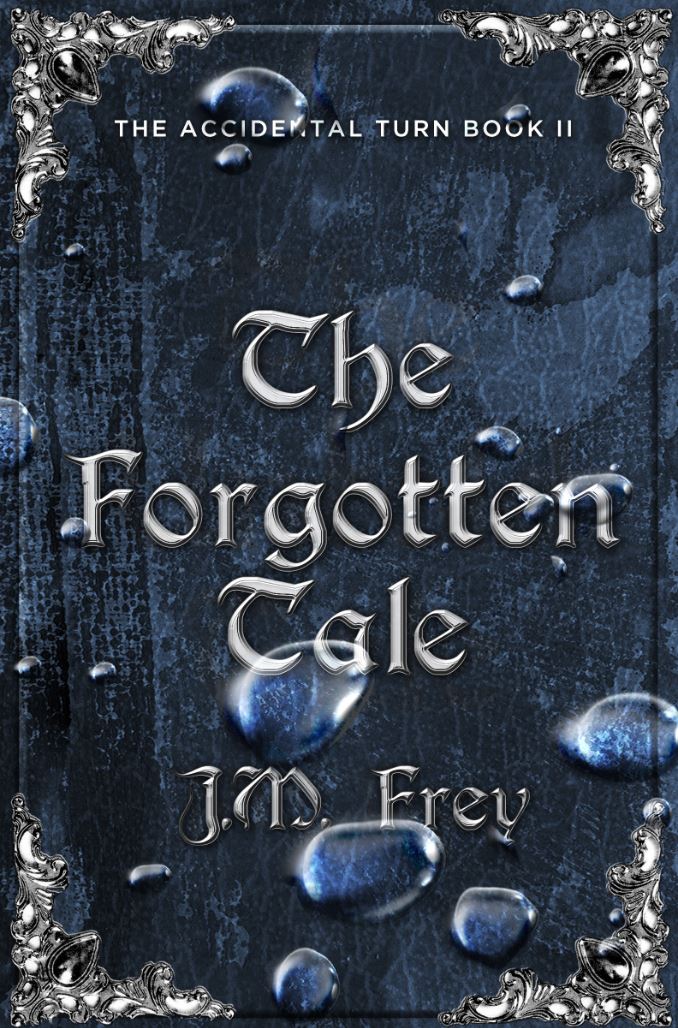
 Welcome to The Untold Tale read-along! The Untold Tale by J.M. Frey is the first book in the Accidental Turn series, the second book of which, The Forgotten Tale, will be released on December 6th. To prep for book two, we’re sharing a ten-part series that will be part recap, part review, and part discussion of the book that has been called the “most important work of fantasy written in 2015.”
If you want to read along with us and avoid the SPOILERS that will follow, you can pick up your copy of The Untold Tale from major online retailers.
About the book
Forsyth Turn is not a hero. Lordling of Turn Hall and Lysse Chipping, yes. Spymaster for the king, certainly. But hero? That’s his older brother’s job, and Kintyre Turn is nothing if not legendary. However, when a raid on the kingdom’s worst criminal results in the rescue of a bafflingly blunt woman, oddly named and even more oddly mannered, Forsyth finds his quaint, sedentary life is turned on its head.
Dragged reluctantly into a quest he never expected, and fighting villains that even his brother has never managed to best, Forsyth is forced to confront his own self-shame and the demons that come with always being second-best. And, more than that, when he finally realizes where Lucy came from and why she’s here, he’ll be forced to question not only his place in the world, but the very meaning of his own existence.
Smartly crafted, The Untold Tale gives agency to the unlikeliest of heroes: the silenced, the marginalized, and the overlooked. It asks what it really means to be a fan when the worlds you love don’t resemble the world you live in, celebrates the power of the written word, challenges tropes, and shows us what happens when someone stands up and refuses to remain a secondary character in their own life.
Part One: “I assume the body is a corpse.” Chapters 1 and 2
Part Two: “Information, at last!” Chapters 3, 4, and 5
Part Three: “Your brother is a slimeball.” Chapters 6 and 7
Part Four: “It’s not cheating to know your enemy.” Chapters 8, 9, and 10
Part Five: “I’m allowed to want it.” Chapters 11 and 12
Part Six: “I wasn’t any help.” Chapters 13 and 14
 Part 7: Chapters 15 and 16
Pip’s discomfort and oddness become more pronounced as she and Forsyth approach the next item, the Knife that Never Dulls, in the depressing and cold graveyard. After discovering the knife missing, they despair, which isn’t helped by the appearance of Bootknife, Pip’s torturer, who reveals the truth–
WARNING: You cannot go back from these spoilers!
–that Pip has been under the mind control of the evil Viceroy the whole time. Yes, the whole time. They defeat Bootknife with some help from the unexpected arrival of Kintyre and Bevel, but the relationship between Pip and Forsyth is utterly destroyed; it never really existed.
Pip withdraws, speaking and eating little. Forsyth suffers the loss of Pip and the proximity of his brother, who is now openly partnered with Bevel and who seems at least a little bit to want to repair their relationship.
—
This is a difficult section of the read-along to write, for…oh so many reasons. This is the twist, the moment we learn exactly what has been up with Pip clutching at her throat mysteriously, and our first interaction with one of the villains, Bootknife, who is exactly as gross as you’ve been imagining. I mean, how do you cover spoilers like that?
But just learning that Pip has been mind-controlled literally the whole time she’s been on the page isn’t the worst. The worst is that J.M. Frey calls out what that actually means. That whole wonderful ship of Pip and Forsyth we’ve been enjoying?
Yeah.
And that’s not the only consequence. Last week we talked about Pip’s struggles to fit into this world she grew up loving from a distance, about her bitterness at being a sidekick. But this plot twist cuts so much deeper than just not fitting, and it’s perfectly encapsulated by two scenes, two lines of dialogue from Pip, one before the reveal and one after:
Page 381: “It means being part of a tribe, having a place and a people to belong to. Being a fan means being obsessed, but in a good way. It means learning to love–wholeheartedly, honestly, proudly, crazily love.”
Page 424-5: “Don’t you try to comfort me, Forsyth Turn! I have been proved wrong! Do you know what that means? I have been proved an idiot by the world I love most. […] I have been betrayed in the harshest, cruelest way possible.”
In putting together this read-along and the other interviews in the Forgotten Tale blog tour, I’ve been able to get deep with Frey about the fantasy genre as a writer and as a reader. I’m a literary analysis person at heart, and that’s what I love so, so much about the Accidental Turn series. And Pip’s–let’s call it disillusionment–with her childhood fave is something that a lot of us go through, certainly something that I’ve gone through; but everything Frey does with this series pulls that relationship between reader and story out of the abstract and into a visceral narrative that actually hurts.
Truth is, though, that this is not unusual, which is in fact Frey’s whole point. There’s tragic fiction, there’s hard stories, and then there’s tropes and stereotypes and characters who seem to be limited because of traits they share with you. Women. People of color. People with mental illnesses or disabled people. This horrible twist happens to Pip because in the world of Hain, a world deliberately evocative of our classic fantasies, women exist only in terms of their relationships to men. She’s the Viceroy’s tool; she’s Forsyth’s bait. While she strove against it with everything she had, it wasn’t enough to overcome the parameters of the world–partially because she got no help from Forsyth, because as he says, “It was…written. Everything you are calls to everything I am.” (pg 423)
This is a very dark section, and the darkness lasts until the climax of the book. But as painful as this part is, it also gives us the key to seeing the light. Frey didn’t write this book because she hates the fantasy genre–exactly the opposite.
Stories are part of a long tradition and are always, always informed by the people, cultures, and histories that surround us. They’re integral to the human experience, which is why they have the power to inspire us and hurt us, why we seek them and create them…and critique them. Stories are powerful, but they’re not omnipotent. They’re not infallible, and they’re not inviolable.
More importantly, they speak to each of us individually. This is one of the things people love about books and TV shows and movies. Fandom moves beyond that individual relationship you have with the book to other fans. Maybe you both had the same conversation with the book; maybe that person talked with the text about something wildly different. Fandom is that sharing. That discussion. Learning more about the story you love through experiencing it over and over again, through the eyes of others, and through your own eyes with new lenses as your knowledge of the world changes.
Sometimes that means realizing, as Pip did back in chapter eleven, that “there’s no place for me because I’m not a white face, because I’m a woman, because of the kind of world that Elgar Reed wrote.”
It also means realizing that that’s not an end. That realization may inspire you to write fanfiction, or your own original worlds, worlds that give you what you needed and didn’t get from the old stories. That realization may inspire you to critique stories, even new ones, that fall short, all in the hope that the future will acknowledge and include you. Because you love these stories.
Because that’s the magic of being a fan.
Coming up
The next section follows our heroes as they get ever closer to the end of their quest, and begin to confront the hidden burrs in their paws. Part eight, covering chapters 17 and 18, will go live next Tuesday on Books, Vertigo and Tea.