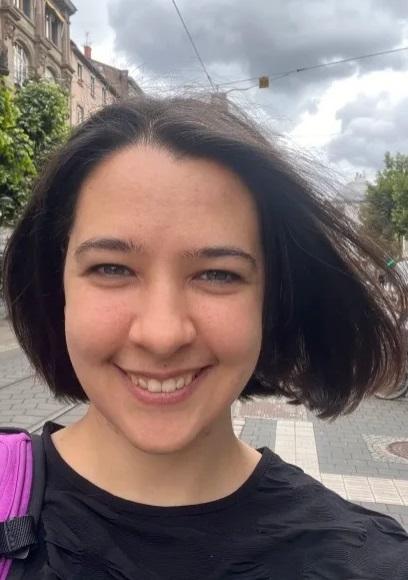
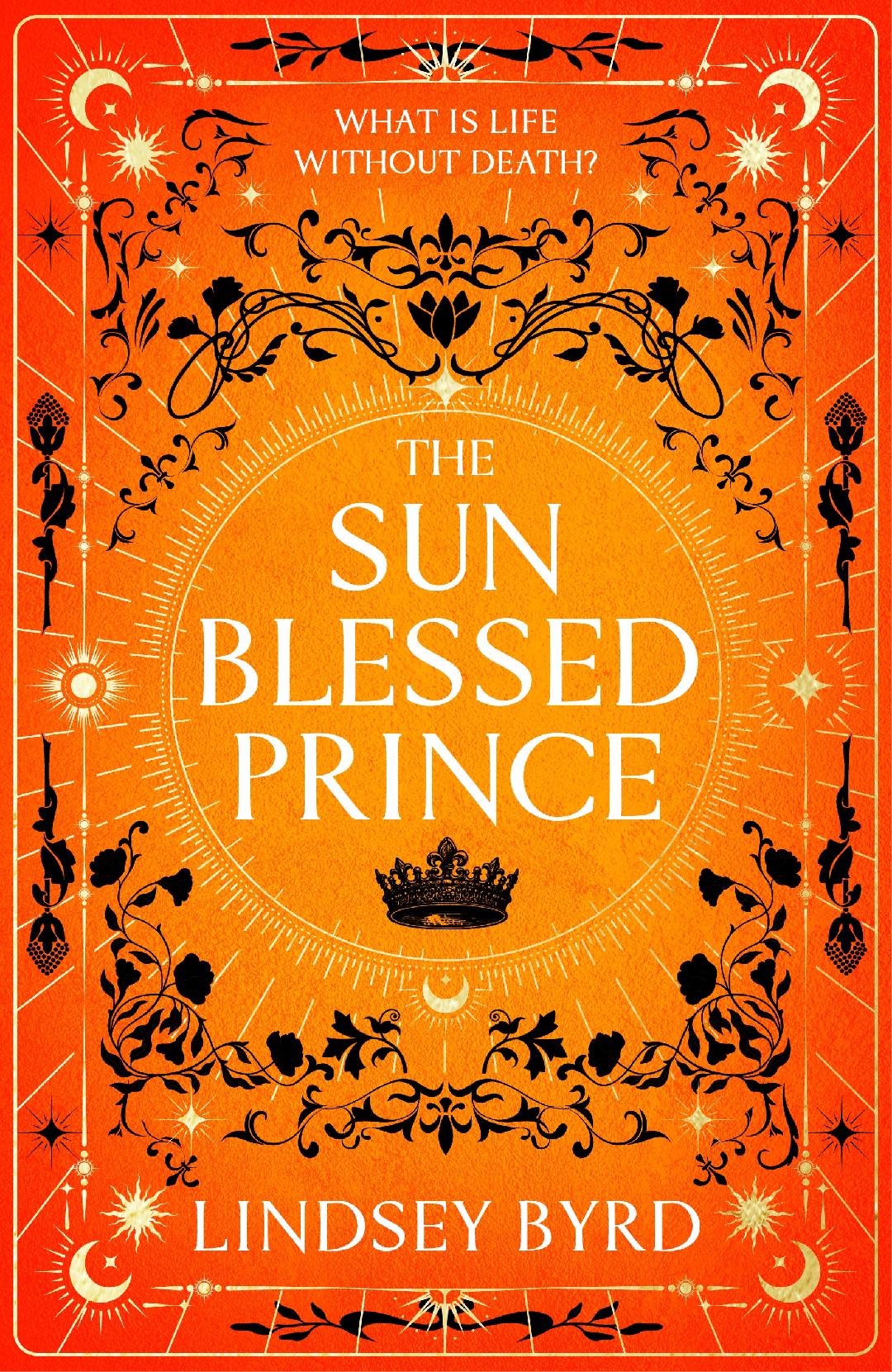
 In this post SFFWorld is very pleased to introduce you to Lindsey Byrd. Lindsey is a fan of all forms of speculative fiction, and is an avid researcher of history. She grew up in New York before moving abroad to France for graduate research studies. Her new book, The Sun Blessed Prince is her adult fiction debut.
With this in mind, we asked her “When writing fantasy, how important are real places to you?” This was her response:
There’s a very common bit of writing advice that says you should always “write what you know.” This, on its face, can seem a bit like a bizarre suggestion when you write speculative fiction. I have never had magic powers, nor have I lived in a fantastical world – so how can I write what I know?
The trick, here, is not to only write about your personal lived experience in the real world, but to be able to extrapolate your experiences and put them into context in a fantasy setting. I know that the sun rises in the east and sets in the west, that the moon affects tides, and the stars can be used for navigation. I know that for thousands of years, people used these astronomic bodies to help navigate their way in the world. Even if the sun, moon, and stars behave differently in my fantastic world: I know people want to be able to navigate. So how do they navigate, and what would make the most sense for them to do?
I love designing new worlds, but mainly: I love imagining how those worlds actually function. For me, there is a distinct relationship between the culture and geography. Architecture is spawned from the mix of these two areas, with the physical materials coming from the geographic (and geological) resources available, and its presentation is a result of cultural influence. So when I create a new world, I have to know the setting, its resources, and from there – I can imagine the culture that evolved.
In The Sun Blessed Prince (TSBP), I drew inspiration from the Rhine Valley and Alsace in particular. First: the river. In reality, the Rhine River was of huge commercial, territorial, and cultural importance to the people living in the valley region. Fighting over the river and the fertile lands on either side of it has existed for well over a thousand years. In TSBP the Bask River takes a similar position to the Rhine. It divides two great countries (Soleb and Alelune), and managing or maintaining the river is essential to both sides.
Architecturally, though, things diverge ever so slightly. The main city that rests along the Bask is called Altas (named prior to my decision to use so much of Alsatian geography in this design). Because it has changed hands so many times, between Soleben rule and Alelunen, its architecture varies as well. If you ever have a chance to visit Strasbourg, France, I’d strongly recommend just strolling through the streets. Buildings frequently shift and change designs, emphasizing the tastes of the revolving dominant culture.
I show this by highlighting how arches and curves clash against straight geometric latticework. How color preference and door frames are indications of when a building was constructed and by whom.
In Soleb, the primary stone that is mined and used to construct their buildings is sandstone. This matches the Germanic sandstone used in the Rhine Valley. The Château du Haut Koeningsbourg (below) are one such example of how this architecture might look.
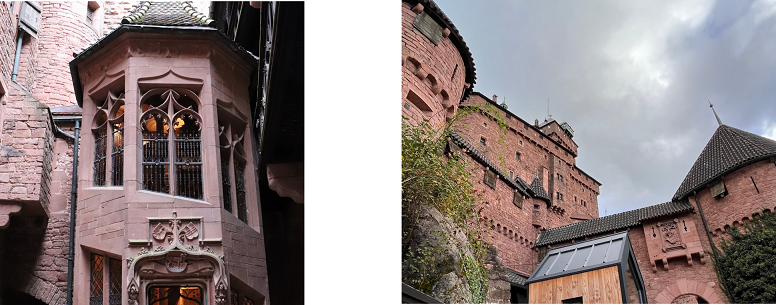
(You can visit by instagram at: https://www.instagram.com/thelindseybyrd/ to see more pictures of the château!)
This contrasts mightily with Alelune which primarily mines white stones such as limestone, marble, alabaster. While not Alsatian inspired, the choice to use marble as a contrast was particularly influenced by Paris and the Lutetian limestone quarry beneath it.
Consider here, the difference between Sacré-Cœur and Château du Haut Koeningsbourg:
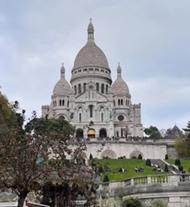
Arches, domes, and actual material differences make it stand in stark contrast to the Château. These locations were built in vastly different centuries, and in vastly different circumstances, but their ability to be built at all comes from the amalgamation of both cultural influence and geographic/geologic potential.
I describe Alelune, then, as a country that is based more heavily in a French tradition. I reference their style preferences, and then add to it. There’s no proper electricity in Alelune, but they do have the fantasy equivalent: a bluestone capable of providing both light and heat. Street lamps, therefore, are a blue and cast that color on the white walls which create a particular kind of effect or atmosphere.
I don’t need to know what a bluestone is in reality, I know what blue light looks like, and can thus describe it in a way that helps the reader imagine the world within the pages.
Beyond architecture though, is also plant life. Animals. What, besides humans, lives in these worlds? What kind of birds fly about? What kind of insects? Each of these tiny details are all things that humans in reality are familiar with. When fantastic or un-real plants are described, there is still a feeling of connection because : we know what an actual plant is. The rest is suspension of disbelief.
For me, I think a huge part of creating believable fantasy worlds is knowing how the real world works. What technologies can be invented based on the resources available, and how do those tools help make life easier for the people living there? When designing a world, the best advice I can give is to take apart each element of the world you currently live in and understand why such things are important.
What is necessary for survival? What is necessary for entertainment? And how can the two be mixed?
A lot of time doesn’t need to be spent on the description, but just enough so that the reader can both see it in their mind and accept that it is a logical way to go about life in the world you have made. And even if the world is entirely make believe – you still in the end will have written what you know.
Thank you, Lindsey! Lindsey’s novel mentioned in the post, The Sun Blessed Prince, published by Pan Macmillan, is due out on the 1st May. We wish her well!
Thanks also to Lucy for helping us organise this one!