The Art of (Space) War
Sun Tzu says there are Nine Grounds in war. These are different situations an army might find itself in, and he goes on to suggest the mindset flag officers must use to overcome them.
His teaching are as relevant now as they were in 512 BC when he developed them and they are still taught in military academies around the world.
Recently, I was introduced to Isaac Hooke’s novels. I started with the Captain’s Crucible series and have developed a minor addiction to one of the best Military Science Fiction authors out there.
So what makes them so good? There is the usual stuff – great characters and and top writing. But that is only to be expected. What really sets this series apart is the exciting technology, the portrayel of space combat and the innovative tactics the protagonists adopt, often using the geography (or spaceography) to great advatnage.
Today, I have the honour of being joined by Isaac as we talk about some of the themes and technology which underpin his work.
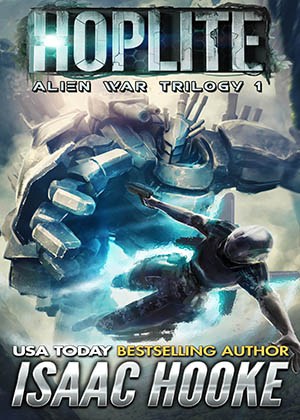 Hi, Isaac. First can I say a huge congratulations on the release of your latest series, The Alien War trilogy. To say it is being received well is an understatement.
I must say, I don’t think I’ve encountered such a well thought through military SF world since the Honour Harrington series. One of the things which facinates me, and I want to focus on, in this interview is the use of tactics and technology in the Captain’s Crucible series. Now this may be a bit of a Chicken and Egg question, but did you develop one or the other first.
Isaac: The tactics came out of the technology that I created as part of the world building process. Basically I looked at the constraints of the tech I had designed for the Captain’s Crucible and ATLAS universes, and developed the tactics out of that. How would we trick a whole fleet of pursuing aliens into splitting up near the surface of a volatile red subgiant? How would we escape a pursuing starship near the Kármán line in the lower thermosphere of a gas giant? The answers relied on the tech.
In the Captain’s Crucible series, one of the things which struck me as being different was how your protagonists and antagonists use the geography of space to seek the upper hand over one another. Traditionally, we seek an advantage. Whether that be fighting from the high ground, attacking out of the sun, stealth or a multitude of other things we have developed over the centuries. In space combat, what do you perceive would constitute an advantageous position?
Isaac: In the Captain’s Crucible universe, no ship has developed the tech necessary to hide the massive amounts of thermal radiation a starship ejects into the cold void of space. So that provides a few ways of outwitting an enemy.
You can hide from an enemy by orbiting on the far side of a planet or moon, and hope that they don’t have any telemetry drones in play throughout the system already that could see you, or that they don’t launch any. To guard against that, ideally you’d want a gas giant whose radiation fields interfere with the EM-based communications technology (yes, it’s a plot device I use often, and it could probably be called a SF trope).
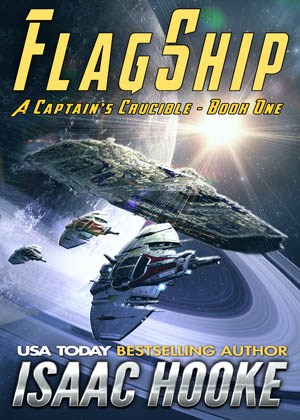 The best place for an ambush, if your radiation and heat armor can take it, and your ship has a delta-v budget great enough to escape the gravitational well, would be to hide in the thermal bloom of a star.
Since most ships also obey Newtonian physics in my universe, including the enemy vessels, and you know your enemy has a relatively high delta-v cost for each maneuver, draw the enemy into orbit around a gas giant or gravitational well of similar mass, and use your superior delta-v budget to your advantage.
You can also use the time delays involved at the distances of space battles to your advantage. It takes light (and thermal radiation) about eight minutes to travel 1 AU. Your enemy is always operating on out-dated information. If you’re part of the reinforcements arriving in a system under attack, and you‘ve Gated into the territory, the attacking enemy won’t see you for between eight minutes to an hour, depending on their positions. Whereas their light and radiation signatures will be reaching you already. Arrange your fleet in the desired battle formation, and accelerate toward them before they have a scramble into a countering formation.
There is often the trope of the humans being smart, and the aliens throwing themselves into the meat grinder of our guns, and only the sheer weight of numbers being the issue. In the Captain’s Crucible series, I really get the impression that the enemy is trying to outthink our protagonists as well as the vice versa. I suspect it was quite fun to imagine what a highly competant commander would do… and then imagine how an equally competant commander on the opposing side would deal with it.
Isaac: Depends on the series… in the Alien War Trilogy, there is a lot of the aliens throwing themselves into the meat grinder of our guns, using their sheer numbers to overwhelm us. But in Captain’s Crucible, you’re right, the enemy doesn’t have the luxury of numbers: starships are incredible expensive to create and maintain, and they have only a very limited supply. As such, the enemy commanders are forced to employ strategic thinking, developing tactics that work within the confines and limits of their own technology as they attempt to outthink the human commanders. What makes it worse is that the thinking of either party is relatively alien to both parties. How can you outthink an alien, when you don’t even know how that alien thinks?
Another feature of your stories is the exceptionally well-thought out technology. Like I suspect you are, I am facinated by the potential of augmented reality. Our readers may be quite up on what virtual reality is, but can you tell us a little about AR.
Isaac: Of course. That’s a great question. I’m sure you can tell from my books that I’m a big fan of Virtual and Augmented Reality, drones and FPV flying, and all these fun futuristic toys I never had as a kid. I see keeping up on the latest technological trends as part of my job as a science fiction writer.
First, the difference between Virtual Reality and Augmented Reality. In VR, you‘re completely immersed in a digital world. Everything around you, people, objects, landscapes, is simulated. It’s typically achieved by placing two screens inside of a headset, and basically cuts you off from your environment, so you can’t see anything in the real world. You have to be careful not to hit any real world objects when you’re wearing a virtual reality headset and interacting with the virtual universe. Chaperone technology built into some VR headsets, like HTC Vive, overlays a grid onto the virtual display so that when you’re operating in room-scale mode—meaning you can walk around your whole room while still being embedded in VR—and reach something like a wall or desk in the real world, a digital grid representing that wall or desk will be overlaid onto your vision, holodeck style, so you don’t hit it.
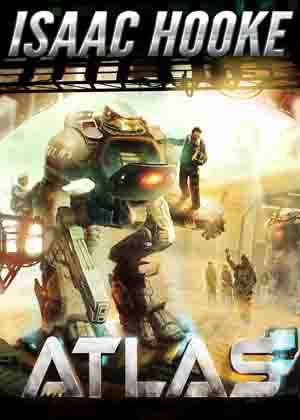 Augmented reality, meanwhile, adds digital, three-dimensional content directly to your existing environment, overlaying that content seamlessly with your surroundings. You typically wear translucent glasses, so that you‘re still grounded in the real world. Imagine playing a video game in the real world underneath a bridge with your friends. You’re holding haptic feedback sticks that appears as pulse rifles in your hands, and enemies straight out of Gears of War or Halo are attacking from behind the bridge pillars. Or imagine turning your house into the site of an alien invasion. Or into a haunted house. Or witnessing an earthquake or tornado taking place outside your living room. Or decorating your home with virtual furniture, visible to anyone who visits your house (as long as they’re equipped with AR glasses). Or changing the cold, smog-filled winter you see outside your windows into a beautiful beach or mountain scene. With AR, all of these exciting scenarios are possible.
The fun thing about AR is that it’s almost here. Meta, SULON, and Magic Leap all have working prototypes. Microsoft has already released the Hololens to developers (though it’s expensive: $1500 a pop, and its field of view is quite limited)
If you’re interested, Meta has a good article describing the science behind AR.
And SULON has a fairly good video demo of AR in their Beanstalk demo (the operator is sitting in an office at work, and throws some virtual seeds on the ground; a beanstalk grows through the roof of the building, and a giant grabs him and pulls him outside)
And lastly, Keiichi Matsuda has put together a short film of what living in an AR future could look like (though he does overdo it a bit… having that much AR overlaid onto one’s reality could lead to severe overstimulation, not to mention mental exhaustion; then again, we could probably get accustomed to that much stimulation, much like the younger generation is doing these days with their smartphones, for good or for bad).

It seems, that it will have repurcussions in every theatre of life, from the operating table, to business to, well, playing Pokemon Go! Rather pessemistically, and talking about its application in combat here – How do you think it will effect things in that sphere, from the level of boots on the ground to the highest admiral?
Isaac: I imagine we’ll eventually get to a point where we’ll be controlling automated “boots on the ground“ remotely, in addition to overseeing the AIs of other mechanized war machines fighting our battles. With drones and satellites providing battle space coverage from the air, I can imagine combat would evoke the feeling of a surreal real time strategy game for the players involved.
Which would you rather be, a starship commander… or a MOTH (A Mech pilot)
Isaac: I‘d be a starship commander who speaks with the potty mouth of a mech pilot.
One of the things I like to do on these interviews is Pay it Forwards. On the last interview, Robert M. Campbell had this question for you.
What overused scifi trope really irks you off the most?
Isaac: These two are not really tropes, but things like sound in space and lasers whose beams we can see can really crack me up in a movie theater.
Another thing that bothers me is too-human aliens, and too easily understanding alien language and motivations. Of course it’s going to be very difficult to communicate with an alien species. They probably won’t have writing, at least not in the form that we know it, and they might communicate with scents and other chemicals, rather than sounds.
It also bugs me when humans easily hack into alien technology. How do we even know how to interface with their tech? In Captain’s Crucible for example, so far I’ve made it basically impossible for the humans to make any sense of the tech they’ve captured.
Finally, next time I will be talking to best-selling fantasy author, Jacob Cooper. Do you have any questions for him?
Isaac: Mark Zuckerberg covers his laptop camera and microphone with tape. With the ever-advancing rate of technology, and the growing adoption of Internet enabled devices (re: Internet of Things) potentially facilitating the ease of governmental spying via zero day hacks or manufacturer approved backdoors, will there ever be such a thing as privacy in the future? Or will we have to choose, as a society, between privacy or security?
Isaac, thank you very much for your time. It’s been great to talk to you on some topics which I find personally facinating.
Once again, congratulations on your success.
Buy from Amazon.com Hoplite – Flagship – ATLAS – Clandestine
Isaac Hooke
USA Today bestselling author Isaac Hooke holds a degree in engineering physics, though his more unusual inventions remain fictive at this time. He is an avid hiker, cyclist, and photographer who sometimes resides in Edmonton, Alberta.
Visit his website at IsaacHooke.com or sign-up to his top-secret Readers’ Group here: http://bit.ly/isaacrel