
 One of the great things about being a book reviewer is that we do sometimes get a glimpse into things early that we hope are going to be great. Our job then is to let people know, which is also usually great fun.
An alternative view is that we get told of things by publishers that are going to be ‘the next big thing’.
The difficulty sometimes is that the two opinions do not always combine. I’ve lost count of the number of times I’ve been told that a book will be by ‘the next Stephen King, George RR Martin, Peter F Hamilton, Iain M Banks’, etc. to find that it really, really isn’t.
And the reason for this preamble is that this debut novel has been spoken of in such a manner. Interestingly released early as an e-book, no doubt to build up that much-needed ‘word of mouth’, this one has been described to me as ‘the next Brent Weeks’, ‘the next Brandon Sanderson’ and ‘for fans of Robert Jordan’s The Wheel of Time.’
Having read it, I think I can see why. But I’m not sure that it’s an unqualified success.
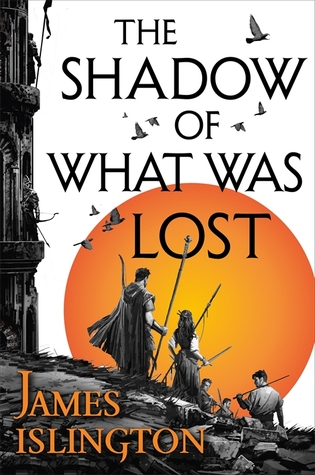
From the publisher: “AS DESTINY CALLS, A JOURNEY BEGINS. It has been twenty years since the god-like Augurs were overthrown and killed. Now, those who once served them – the Gifted – are spared only because they have accepted the rebellion’s Four Tenets, vastly limiting their own powers. As a young Gifted, Davian suffers the consequences of a war lost before he was even born. He and others like him are despised. But when Davian discovers he wields the forbidden powers of the Augurs, he sets in motion a chain of events that will change everything. To the west, a young man whose fate is intertwined with Davian’s wakes up in the forest, covered in blood and with no memory of who he is …And in the far north, an ancient enemy long thought defeated, begins to stir.”
If you’ve been reading this type of thing for a while now, you will know that that description is nothing new. It sounds like a book from the 1980’s or 90’s, and ticks off all the expected, oft-used tropes.
Don’t get me wrong – to riff off old favourites and much loved tropes can be great fun. It is usually accepted that anything written in homage, as I understand this was, has got to be able to create that sense of contentment, that feeling that “it’s great to be back”, so that a reader is happy knowing what’s going to happen, even if it’s not precisely shown how.
And at first this seems to be a book determined to follow a well-trodden path from before. There is the usual initial setting up. The book is set in a world years after a war between those with magic powers (the Augurs) and those without. The ones without powers won – which means that the Augurs are gone and those Gifted who helped them are kept in gated communities known as Tols and usually only let out amongst the general populace (for supplies and such) wearing a limiter – an arm bracelet named a Shield.
In this world we meet Davian, a young hero with a destiny about to begin a bildungsroman journey, Asha, his girl friend, Wirr his faithful sidekick friend with a secret past and Ilseth is an elderly mentor also with a secret past. There’s magic/forbidden powers and evil afoot – in many cases it’s almost Star Wars (without all the SF trappings, admittedly.) I must admit I found this first part wasn’t inspiring to begin with. It’s an attempt to be filmic that doesn’t entirely work for me, has dialogue that screams “cliché!” and a lot of information-dumping to set up the plot. However if you can accept that this is a debut novel and a big novel, it is worth sticking with.
As in many of these tales, the book soon gets Davian and some of his friends separated. Asha ends up working in the library of the Tol Athian with Ilseth, believing her friends killed. Davian and Wirr have actually set off on a secret quest North, Davian being told by an Elder to do so. They rescue a Gifted prisoner named Caeden and meet Taeris Sarr, a man who has been important in Davian’s past. The group soon becomes larger with a priest named Nihim and a young swordsman Aelric and his sister Dezia sent to help Davian and Wirr, all helping the group get to The Council at Ilin Illan so that they can discover Caeden’s mysterious past. Here the book has space to breathe, a world to build on and characters to develop.
There are parts that I liked, especially once past the beginning. Once it settles down and the main plot gets going, there’s lots of running and being hunted, which was quite exciting, and there’s even a couple of nearly-unexpected twists along the way (as well as a couple that were blindingly obvious.) If you can cope with the fact that you may have read something very similar to this before (and I do realise that there may be many who have not!), it is undoubtedly entertaining.
It is clearly a character driven tale. The dialogue between the characters is generally good, though there’s the occasional clunk of dialogue info-dumping. It is perhaps to be expected with a debut novel of this size, though, and not too jarring for the reader. What keeps you reading are the characters – their wishes, worries, beliefs, loves and back-stories, all of which flesh out the plot and the world as we go.
So far, so expected. And as much as I was enjoying it, I was beginning to feel that there was nothing particularly original here. I was recognising touches of Brandon Sanderson, of Robert Jordan and even good ol’ Tolkien. As my SFFWorld colleague Rob Bedford often says (and I often agree with him), there’s no problem if that is the case, as long as the author brings in his/her own little twists, their own stylistic traits that add to the classic and traditional.
For a book to remain noticeable above the rest of the mass, the thousands of books using the same ideas and principles, it has to have something in there that’s new, that readers will latch on to and remember. A character trait, a key idea, a place that is comforting or scary – the things that make a reader want to read it again. I was beginning to think that Shadow was not that sort of book.
But then, about half way into Shadow, and just when things are settling down to be this pleasantly comfortable Fantasy epic, there’s a rather abrupt slap in the face, when in the bigger scheme of things, Davian encounters time travel and quantum universes and goes a little SF.
This doesn’t last too long before things return back to classic Fantasy style, though. As the book moves towards the end, there’s a lot of mysteries being resolved and things discovered. Lots of secrets are shown and revealed, although as the characters keep telling us this is clearly only the start of something bigger. Davian discovers his destiny (and other things besides) and moves to defend his world against the inhuman soldiers known as the Blind who are doing Davaed’s work for him. Surprisingly, Darth Vader (sorry, Aarkein Davaed) appears very little, letting his evil minions pave the way for his malevolent plans to bear fruit. Nevertheless the book moves towards a logical conclusion, albeit partly a set up for the inevitable Book Two.
Of the parts I disliked, the already-mentioned beginning is a key one – almost to the point where I stopped reading – but I’m pleased that it did seem to get better. Perhaps my biggest concern is that despite Shadow being such a big book there’s a lot happening without a great deal of explanation. Characters do things without being given a real need or understanding of why they must do these things. Though, as readers, we are told that things are important, there’s little said about why they must do things, and so our engagement with things, our concern for the characters, is less. The mysterious and enigmatic enemy has a presence but it never seems as if our heroes are in genuine peril. The deaths of characters mean surprisingly little as there has been little given to make us care about them. In the end it feels like a book with epic width but little depth.
Nevertheless, The Shadow of What Was Lost is a big, fat immersive novel that many readers will love. With characters you may recognise and situations you may recall as similar to what you have read before, as well as by dealing with traditional values such as loyalty, honour and love, it brings back to Fantasy many classic things that in the recent days of Grimdark have been less noticeable. As a new version of what has been loved before, I can see why it may be popular.
I do think the author has potential, although I don’t think The Shadow of What Was Lost is quite there as a definitive classic, for playing make-believe in an area well-known already, even in homage, does not an immediate classic make. It was a typical debut novel in that whilst there were parts that show the author can write well, there were sometimes other elements that were uneven and at times even annoying. It’s good but not that good.
Despite my quibbles, there’s enough here to entertain and enough curiosity created to keep the reader reading and the pages turning. I did enjoy it (and unlike The Wheel of Time series and The Stormlight Archives I did finish it!), but it may be more a case of The Opportunity What Was Lost rather than The Shadow of What Was Lost.
The Shadow of What Was Lost by James Islington
Book One of the Licanius Trilogy
Published by Orbit Books, November 2016. (Ebook: July 2016)
704 pages
ISBN: 978-0356507750

The title of this article is wrong. You have the book title as The Shadow That Was Lost by James Islington but it’s The Shadow of What Was Lost by James Islington like the picture of the book cover clearly points out.
Thanks for pointing out the typo. We’ve corrected it now 🙂
Thanks for the review. The two books you state that you did not finish reading are two of my all time favorite series. And the faults that you point out in this book are the same faults that made me unable to read the Sword of Truth series. Probably not reading this one, unless the reviews on book two tell me that the author has fixed the faults. This is the first review of yours that I’ve read, and your insight actually coincides with the most important parts of a book to me.
I find it fascinating how different small things will make a book readable or not readable to different people. My friend and I have similar “Epic Fantasy” tastes. But the books we love are totally different. I love “Wheel of Time”, “Stormlight Archives”, “Game of Thrones”, and “The Kingkiller Chronicles”. He hates them, but he loves stuff like “Shannara” and “The Sword of Truth”, which I could not get thru.
My point is, despite what seems to be different tastes, you seem to touch on all the things that are the most important to me. Thus, this is the first review I have read of yours, but will not be the last.
Many thanks for your comments, Lee. I am determined (one day!) to get past Book 5 of The Wheel of Time. Have tried at least three times now.
Reviews are always a subjective thing, which is why I always think context is important. Hopefully that came across in the review. For the record, I love Tad Williams’ work and Patrick Rothfuss’s, Game of Thrones and even enjoyed the first few Goodkind books. I can see why people like Brandon’s and Terry’s work. But that may muddy the waters a little!
Pleased though that whatever I was trying to say there (and apologies for the title typo!) had some resonance for you. Hope you enjoy the rest of the reviews in the future.
“Unlike The Wheel of Time series and The Stormlight Archives I did finish it!”
How. I’m reading The Way of Kings again at the moment in anticipation of Oathbringer and I can’t imagine how anyone can start Kaladin’s journey and not feel like they have to see what happens next.
The lack of character depth or maybe the lack or sex and predominance of religion stopped me 1/2 way through with book 2. I felt like I was being led around by a Junior High school guide. The story has great potential, but not with shallow unchanging innocent characters. Oh sure, they witness people dying, heads being swapped on bodies, but sex? how about even true male/female interaction? I think any story that gets into death and killing has stepped out of the PG-13 arena.