

Having taken a break from the Old Man’s War universe, John Scalzi launches an Epic Space Opera with The Collapsing Empire, a title that sets the tone for what to expect and the grand canvas on which he tells his story. Where the novels in the Old Man’s War universe were on a wide universal canvas, the tone for most of the novels were more military fantasy than space opera. Here in The Collapsing Empire, humanity has spread across the stars because of the discovery of “the Flow” and Earth is something between a memory and a myth. A fairly standard starting trope for epic-scale Space Opera, but Scalzi is a clever writer, so if you’ve read his previous novels, you’ll know something very interesting is in store. Here’s the publisher summary:
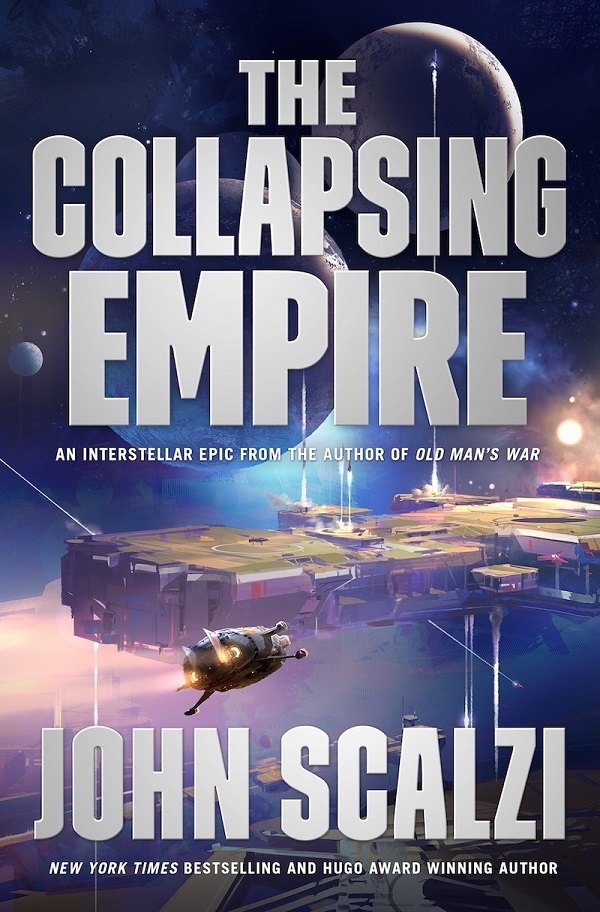
The first novel of a new space-opera sequence set in an all-new universe by the Hugo Award-winning, New York Times-bestselling author of Redshirts and Old Man’s War.
Our universe is ruled by physics and faster than light travel is not possible — until the discovery of The Flow, an extra-dimensional field we can access at certain points in space-time that transport us to other worlds, around other stars.
Humanity flows away from Earth, into space, and in time forgets our home world and creates a new empire, the Interdependency, whose ethos requires that no one human outpost can survive without the others. It’s a hedge against interstellar war — and a system of control for the rulers of the empire.
The Flow is eternal — but it is not static. Just as a river changes course, The Flow changes as well, cutting off worlds from the rest of humanity. When it’s discovered that The Flow is moving, possibly cutting off all human worlds from faster than light travel forever, three individuals — a scientist, a starship captain and the Empress of the Interdependency — are in a race against time to discover what, if anything, can be salvaged from an interstellar empire on the brink of collapse.
Like many great, epic tales, The Collapsing Empire begins with a prologue, introducing the empire-wide problem of the novel, the evolution or shifting of the Flow – the almost magical means by which humanity has been able to populate the galaxy. We see how the grand-scale systematic change affects individuals aboard a space vessel in this prologue.
The Interdependancy, the Empire in question, is set up as powerful, mysterious, far ranging, and quite old. The novel opens on the deathbed of the current Emperox, with his estranged daughter Cardenia, the heir to the empire, keeping him company. The two try to reconcile their lost time, but the emperor does leave his daughter with some ominous words about what he leaves her: in addition to the infighting across the empire of humanity and the Flow is breaking down.
Meanwhile, Scalzi introduces Kiva Lagos, representative of her family’s trading house, in one of the more visceral introduction scenes even by Scalzi’s. Remember, this is the same writer who began a book on a fart joke (The Android’s Dream). Kiva is in the midst of an action that is far more mutually enjoyable to those involved than those exposed to a fart. Be that as it may, the introduction of Kiva serves to illustrate how in-your-face, bombastic, and take-no-crap the character is. She’s a character who breathes snark and seems to thrive on making people feel uncomfortable. I loved her.
Kiva is set to meet the Duke of End, who oversees the planet furthest away from the Hub of the Empire, the planet from which the Emperox rules. The End, is in some ways, like a slightly tidier, planet-sized version of Mos Eisley Spaceport. The Duke is in a protracted conflict with many of the people of End and wishes to strengthen his hold on the planet. Also on the End is Jamies Claremont a scientist and former friend of the late Emperox, a scientist (as well as his children – daughter and soldier Vrenna and son and fellow scientist Marce) who has been studying the Flow for years and has concrete proof of the coming changes to the power that allows far flung interplanetary travel.
These three primary storylines come together seamlessly and through it all, the characters stand out as people whose introduction here in The Collapsing Empire portend what is hopefully a long journey over several novels and stories. At the forefront are these amazingly well-rounded, believable women – Cardenia and Kiva leading two of the storylines, with Vrenna supporting her brother Marce in the third storyline.
As we follow these character’s journeys, Scalzi reveals a large canvas of a human universe, but effectively shows the potential effects of the all-important Flow on a distinct few, while extrapolating its effect on the vastness of humanity. If Earth, the cradle of humanity, can be cut off from the Flow, is any human-inhabited planet safe? Put simply, no, as theorized in the novel.
One of the more logical conceits in the novel is how the current Emporex is able to communicate with previous occupants of the throne. Prior to the death of each Emporex, their personality is uploaded or copied to a sophisticated program that allows personal interaction so the current throne sitter can gain insight and advice from their predecessors. Additionally, some scientific codification is applied to the Flow, enough to make it a plausible enough conceit for interplanetary travel.
A nice nod throughout is Scalzi’s Tuckerization of some of his writerly peers in the Science Fiction and Fantasy genre.
Elements of the story resonate with Firefly/Serenity, Star Wars, and James S.A. Corey’s The Expanse (both the books and TV show), but all told in the inimitable voice of John Scalzi, The Collapsing Empire is a must read and will likely find itself on many Science Fiction & Fantasy best of lists for 2017.
Highly Recommended
© 2017 Rob H. Bedford
March 2017 | Tor Books
Hardcover | 336 Pages
http://www.tor.com/2016/12/26/excerpts-the-collapsing-empire-john-scalzi/
http://whatever.scalzi.com/
Review copy courtesy of the publisher, Tor




My concern after reading the back cover and this review is that it sounds like a thought piece or set-up novel in which nothing much actually happens.
There is set up, it is the first of a series after all, but “stuff happens.”
Sounds awesome.