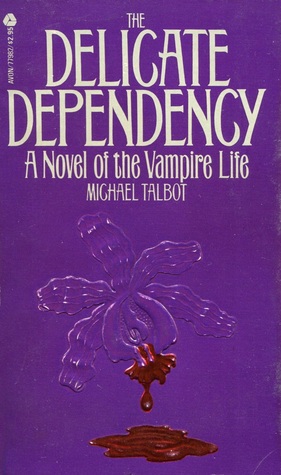
 I read my first vampire novel as a college student for an assignment. Forced to take a liberal arts class, I chose The Formation of Myth and it turned out to be wonderful. That first vampire novel was Dracula, of course, and it started a long love affair with vampire novels. However a few years ago, looking back at all the vampire genre books I’ve read, something became clear to me. I may love vampire novels but they sure didn’t love me back. It seemed that I had been wading through a large sea of mediocrity and I quit reading the genre altogether. Recently, by accident, I came upon The Delicate Dependency by Michael Talbot and I once again realized why I love this genre so much.
Leaving behind the two most common themes, excessive gore and barely tolerable clichés of erotic immortals, Talbot takes the vampire in a different direction. In his novel set in Victorian England vampires act almost as guardians of knowledge. Their immortality leaves them beholden to no one and they can focus on learning and their passions. The vampires are almost like another species and the most important secret they hold is immortality. Into this background Talbot introduces four main characters. Dr. John Gladstone, a virologist whose experiments may drastically change the hidden world of the vampires and his two daughters, one a young woman who is caught up in the dreams of immortality and the other an “idiot savant”. The final character is the Lady Hespeth whose motivations remain initially unknown. The characters are drawn into the vampire’s world literally by accident. Gladstone runs someone over with his carriage. At the hospital, the staff begin to notice his rapid healing and the doctor takes him into his own home to finish convalescing. There he remarks on the stranger’s resemblance to a person he once saw in a painting. Niccolo, with his friendly manner, is at ease in the doctor’s home until one day he disappears along with one of his daughters. As he searches for her, Gladstone slowly starts to unravel this previously hidden world. His is not the only child abducted but he cannot understand why.
For myself the novel is interesting in a number of ways. While the vampires are bloodsuckers this aspect is almost unimportant. The novel contains very little bloodshed or gore. Talbot also jettisons the common myths of vampires, such as fear of crosses, sleeping in coffins, the wooden stake etc. and the result is much better for it. He focuses almost on the “culture” of being a vampire and how that has affected and possibly guided the rest of humanity. I see it almost as horror fiction set in a specific historic time somewhat similar to stories by Tim Powers like Anubis Gates. But at its core it is a novel of dense characterizations. The players are fully fleshed out and Talbot’s vivid command of the English language makes it a pleasure to get to know them. There are times when the pace is slow but rather than detract from the story I see it as an important ploy to further enmesh the reader in the world of the vampires. I can honestly say that the plot is truly original and the novel ends with a particularly satisfying conclusion
The only other issue that I have is that the novels can be difficult to find. My own copy came out of the depths of my favorite used bookstore but luckily in 2014 Valancourt Books republished it and it can be found on Amazon. If you do pick up the Valancourt edition you may want to avoid the forward as it lays out most of the plot. Unfortunately Talbot would go on to write only two other horror novels, The Bog and Night Things before dying of lymphocytic leukemia at only 38. Both of those novels are excellent as well. Finally for readers with a special interest in the more unusual, Talbot would publish a few non-fiction novels as well, the best and most interesting being The Holographic Universe, in which he championed the theory that our universe is basically a hologram. As usual, life is stranger than fiction.
© 2017 George Anadiotis