

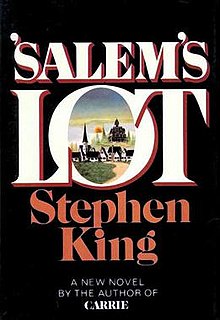
My dad has a copy of this.
I have a long association with Stephen King’s fiction, as I may have mentioned in the past. I would say I’ve read about 80% of his novels and many of short stories, but before a couple of years ago, one of the major oversights of his bibliography for me was his classic vampire novel ’Salem’s Lot. Well, that oversight was been “corrected,” to borrow a term from another of King’s work. In short, I enjoyed the hell out of the novel.
As has likely been recounted about this novel, ’Salem’s Lot is King’s mash-up of Peyton Place and Dracula. Both novels are referenced in the text of ’Salem’s Lot: one character (Matt Burke) is remarked to remind the others of Van Helsing and Peyton Place is even called out by another character. After a brief prologue featuring Ben Mears and a young boy after the events of the novel transpire, King introduces the populace of Jerusalem’s Lot in a leisurely fashion. ‘Salem’s Lot (or The Lot), as the inhabitants call it, seem to know each other and each other’s business; the quintessential New England small town. Their everyday life is shaken up when visitors arrive: writer Ben Mears arrives looking to exorcise some past demons (in large part, the death of his wife) through writing a book. Ben grew up in Jerusalem’s Lot so, in a sense, Ben sees his visit to the Lot as something of a homecoming.
The other “new arrivals” are Straker & Barlow, two antique salesmen who arrive looking to set up a new shop selling their old wares. Ben and Straker & Barlow are both interested in the old Marsten house which overlooks the Lot to the point that Ben was going to rent it out until he discovered Straker & Barlow have taken up residence in what many feel is a haunted mansion.
While some of the characters can be considered to lean towards cardboard cut-out territory, King gives a lived in, familiar, and quaint feel to the Lot. This is one of the novel’s strengths, its sense of place and initial comfort. The other strength is the subtlety and slow reveal of the terror hiding in the shadows, aside from the dog’s head on the pike early in the novel, of course. The subtlety is when the human characters interact with the vampire; there are more hints than description, allowing the reader to finish the scene with their own imagination. Though King can imagine terrifying things, it is this cooperative horror that proves to be so effective in ’Salem’s Lot and would prove to be one of his most effective storytelling tools for years to come.
Where the novel stumbles is two-fold and both of these I’ll generously attribute to the time the novel was published and the fact that it was King’s second published novel. The relative lack of female characters stood out to me. We have one primary female character – Susan Norton – and while it is through her eyes we initially see the novel, she’s little more than a romantic entanglement used to drive Ben Mears through the plot and provide him tension and action. The only other truly (and fully) positive female character in the novel is Eva Miller, owner of the boarding house where Ben takes up residence during his time in the Lot. Most of the other women are portrayed in varying degrees from middling to quite negative.
The other stumble is some of the flowery early interaction, between Susan, her family, and Ben. I’ll chalk this up to being a novel of its time in how the characters talk. Susan and Ben fall for each other quite quickly and the language King uses to show them falling for each other reads as a bit put upon by today’s standards. There’s also a bit of an age barrier between the two that may not sit well with today’s readers, almost a teacher student age gap.
Some other points to note about ’Salem’s Lot:
- It is the first (of many) Stephen King novels to feature a writer as the protagonist
- King would return to similar themes, specifically a small town with a dark cloud of monster(s) lurking in the shadows: It, Needful Things, The Tommyknockers and to a lesser extent The Dark Half
- Tangentially, like Needful Things, ’Salem’s Lot features a small town disrupted by the arrival of a strange visitor
- Like IT, ’Salem’s Lot features a small town with some historically recurring darkness
- As the King constant reader knows, Father Callahan later shows up in the fifth Dark Tower novel, Wolves of the Calla
- I think part of the reason Needful Things has a lesser reputation in King’s bibliography might be because of how it echoes ’Salem’s Lot (I personally liked Needful Things but it has a special spot for me as I point out in that link at the top of this post).
My colleague (though we’ve never met, and I mean colleague in the sense that some of our writing appears at the same place) Grady Hendrix over at Tor.com wrote about ’Salem’s Lot as part of his Great Stephen King Reread. While he does make some points I can grok even if I don’t agree with them, there is one interpretive point I can’t agree. He suggests there’s no real reason for Barlow and Straker to go to the Marsten House. The answer, for me, is right there in the novel. Throughout the novel, characters remark that The Marsten House is a magnet for evil, ever since old Hubie Marsten lived there and committed horrific acts, supposedly demonic sacrifices, killing children, and killing his wife.
The other point / character is Mark Petrie; Grady makes Mark out to be something like Harold Emery Lauter (from The Stand) when in fact, Mark is fairly well-adjusted and manages to take out the school bully early in the novel. This sort of informs us that Mark, coupled with his love and knowledge of horror/monster movies, is as well-equipped as any character in the novel to take out Barlow. Mark may be an early example of a character with Genre Savvy. Mark’s calculative methods prove very useful to the plot and if he were nerdy and off-putting, the two other kids we see in the novel (the Glick Brothers) would have been more hesitant to visit him. (Admittedly, Grady recants some of his thoughts on Mark).
I’ll split the hairs regarding Grady’s take on the one-dimensional hillbilly characterization of the ‘Lot’s inhabitants. Most of them don’t really stretch beyond that of a cheating spouse or an abusive mother, but those folks don’t need much more attention than their archetypes in this particular story for me. Again, I see Grady’s point here and can agree with it to an extent.
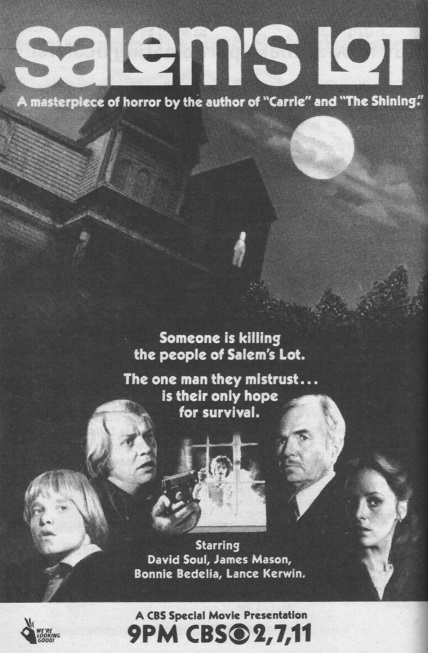
As for the adaptations of the novel, I watched the old TV miniseries once years and years ago. I hadn’t been aware of who James Mason was at the time, but now I want to re-watch it just for James Mason. I did not see the 2004 remake featuring Rob Lowe, but that interests me now, too. Since reading the book a few years ago, the mini-series starring James Mason aired last year (2016). Mason chewing up scenery alone is worth watching, but the mini-series like the book is definitely “of its time.” The staid pacing (one could almost say snail-like) came through even more in the 1979 mini-series. The vampire, Barlow, in the 1979 version is more monstrous and doesn’t even speak, he’s more akin to a caged beast. The filmmakers went with a look that is VERY similar to the iconic Noserfatu from the silent film. Some of the characters from the book are melded together in the telefilm, a couple of names changed, but it is still watchable so long as you have patience. David Soul was okay, if a little emotionless as Ben Mears, but as I said, the standout was James Mason largely because he is James Mason.
Now I really want to watch the Rob Lowe version with a cast that includes Donald Sutherland as Straker, Rutger Hauer as Barlow, James Cromwell, and Andre Braugher who I’ve come to adore on Brooklyn 99,
’Salem’s Lot was an incredibly addictive read and I can understand why this helped to set King on the path of superstardom. I’m not sure exactly where it ranks against the other King novels I’ve read only because the later books I read were after he became a more polished writer and storyteller. All told, I really enjoyed the novel despite some of its flaws. I wonder how high it would rank in my personal canon for Stephen King novels if I had read it earlier when I was first making my way thought King’s oeuvre. The quality is so high that I suspect it may rank even higher. Consequently, I don’t know that I would have ranked Needful Things quite as high, despite what I say earlier in this review/overview.
A final recommendation for King fans and Constant Readers: check out Grady’s Stephen King reread project, there’s some good insight to the books in his articles and I’ve reexamined my own thoughts on some of King’s work.
An earlier version of this review appeared on my blog, Rob’s Blog o’Stuff on October 10, 2014.
http://robbedford.blogspot.com/2014/10/halloween-reading-2014-salems-lot-by.html



Rob, I keep thinking I should reread this one. As I recall, I read THE SHINING first and came back to this earlier work. Those two made me a King fan.
The 1979 mini-series was, at the time, anyway, a terrific horror story for a TV production. With a few exceptions like the Kolchak movies, DUEL and TRILOGY OF TERROR network TV at the time had to pull its punches too much to be truly scary. But this one worked well and had a great cast. Besides James Mason and the ever-bland David Soul, who I actually thought was pretty good in SALEM’S LOT, there Lew Ayres (who’d been acting since the silent movies), Bonnie Bedelia (HEART LIKE A WHEEL and a couple of DIE HARD movies), Elisha Cook Jr. (THE MALTESE FALCON, THE BIG SLEEP, an episode of the original STAR TREK), Marie Windsor (like Cook, really too many credits to list), Reggie Nalder (who had a look that stereotyped him as the rat-faced stoolie), Kenneth McMillan, Ed Flanders, George Dzundza (the last three cover roles in dozens if not hundreds of TV shows and movies from the ’70s into the early 2000s), and Fred Willard (who has been in, roughly speaking, everything I’ve seen since 1979 or so, and I will swear even things filmed before he was born).
Randy M.