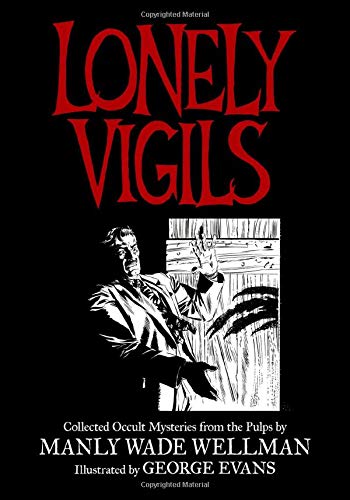
And on the last day of October we finish our usual Halloween Countdown with not just one but two reviews today! First up, Randy’s review of a pulp classic:
[Thunstone’s] fingers touched the brass knob, and it was icy cold.
He paused a moment, even then, to ponder the connection between thoughts of evil and of the Arctic. Lovecraft, who wrote and thought as no other man about supernatural horror, was forever commenting on the chill, physical and spiritual, of wickedness and baleful mystery. The ancients had believed in whole nations of Warlocks to the far north – Thule and Hyperborea. Iceland and Lapland had been synonyms for magic. Where did one find the baleful lycanthrope most plentiful? In frozen Siberia. Why do natives dare not scale the snowy crests of the Himalayas? For fear of the abominable ice-demons. Death’s hand is icy. The Norseman’s inferno is a place of utter dark and sleet.
From “Sorcery from Thule”
Occult detectives have been a feature in popular fiction at least since Joseph Sheridan Le Fanu’s Dr. Martin Hessalius in the mid-19th century and their numbers expanded around the turn of the 20th century in the wake of Sherlock Holmes’ popularity. Later pulp writers carried on the tradition, for instance, Seabury Quinn with his popular occult sleuth, Jules de Grandin, hero of dozens of tales, who is name checked in several of the stories in this volume (Quinn and Wellman were friends). Lonely Vigils features the exploits of not just one, but three occult detectives Wellman created before arriving at Silver John the balladeer, the character who brought Wellman his greatest renown (see, Who Fears the Devil?)
The collection opens with four stories about Judge Keith Hilary Pursuivant and one about Professor Enderby. In these Wellman seems to be searching for the ideal character to carry a series. Enderby only had one try; while he could overcome a supernatural threat, he couldn’t survive the end of the magazine in which he was featured. “Vigil” is negligible, not bad, but rather like a one-note joke, and a somewhat misogynistic joke at that.
Judge Pursuivant is a tall, heavy man known for wearing a cloak and broad brimmed hat and carrying a cane. As Quinn’s de Grandin echoes Agatha Christie’s Hercule Poirot, Pursuivant echoes John Dickson Carr’s Dr. Gideon Fell; or, to be fair, since Fell was based on G. K. Chesterton, and Chesterton is named in one of the Pursuivant stories, maybe both characters share a source. Two Pursuivant stories are the longest in the book: “The Hairy Ones Shall Dance” a werewolf story with an interesting psychic twist; and “The Black Drama,” one of the collection’s best stories, dealing with the appearance of an unearthed play by Lord Byron and the company gathered by its producer to enact it. Pursuivant also gets two of the most intriguing titles in the book, “The Dreadful Rabbits,” and “Half-Haunted,” the former enjoyable, the latter a neat twist on the ghost story.
In some ways, Wellman really hits his stride with the fifteen stories featuring John Thunstone. These stories are compact, befitting a hero who combines the knowledge of a Dr. Hesselius with the physicality of a Black Mask private detective. That sounds like there’s a lot of action, and there is some, and it’s well-described, but Wellman frequently refers to the scholarship backing Thunstone’s actions, much of it from real books (there’s also a mention of H. P. Lovecraft’s Necronomicon; Wellman was a fan). I enjoyed all of the Thunstone stories, but the ones that stick with me are, “The Third Cry of Legba,” which introduces the Countess Monteseco and Rowley Thorne, both recurring characters, the latter Thunstone’s frequent adversary; “The Dead Man’s Hand” which introduces another frequent adversary, the Shonokins – a fascinating group who claim to have inhabited the U.S. since before the Native Americans; and “The Last Grave of Lill Warren,” with its sympathetic depiction of a man who loved the title character.
I’d planned on reading a few of these stories and setting the book aside so I didn’t grow tired of it. I ended up reading all of them partly because Wellman was adept at ringing changes on his themes and approaches, but more than that because Wellman invested his stories with imagination and ingenuity, describing his settings authentically, making each story fresher than I expected and consistently entertaining. Note though that anyone looking for depth of characterization is going to be disappointed: These are pulp adventures concerned mainly with establishing a premise, posing a problem, and resolving that problem satisfactorily.
Lonely Vigils was originally issued by Carcosa Publishing Company, founded by David Drake, Karl Edward Wagner and Jim Groce after August Derleth’s death, thinking his passing would end Arkham House. As with the founding of Arkham House, they wanted to preserve in book form the best of the pulp magazine writers of weird fiction, and since they weren’t just admirers of Manly Wade Wellman, but his friends, and he was, indeed, a good writer, they started with his work. That this collection has been reissued in an affordable paperback volume is a gift to readers who enjoy vintage weird.
LONELY VIGILS by Manly Wade Wellman
Published in 2020, Shadowridge Press; (reissue of Carcosa Publishing Company edition, 1981)
504 pages
ISBN: 978 194 6808 172
Review by Randy Money