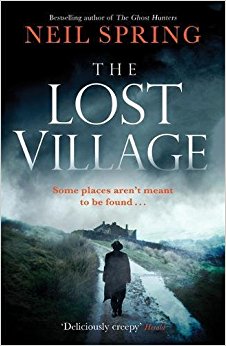
 As Autumn arrives at Hobbit Towers, and we continue to Countdown to Hallowe’en, here’s a creepy tale from the author of The Ghost Hunters.
From the publisher: Many years ago, soldiers entered a remote English village called Imber and forced every inhabitant out. It remains abandoned . . . Each winter, on one night only, Imber’s former residents return to visit loved ones buried in the overgrown churchyard. But this year, something has gone wrong. Secrets are surfacing, putting all who come near Imber in danger. And only one man can help.
Notorious ghost hunter Harry Price has reluctantly reunited with his former assistant Sarah Grey. Once, she worshipped Harry, but their relationship has recently soured. Harry knows that Sarah could be the key to unlocking the mystery of Imber, but will her involvement in the case be the undoing of them both?
I last came across Neil with his debut novel, The Ghost Hunters, in 2013 (reviewed HERE.) I enjoyed it a lot, as it told of a real person, Harry Price, Britain’s most famous ghost-hunter in the 1920’s and 30’s, and created a fictional story about him. Though it was mainly fictional, it had a semblance of reality around it which I liked. I wasn’t the only one. Since then a UK television series (Harry Price: Ghost Hunter, starring Rafe Spall) and another unrelated novel has surfaced. But The Lost Village brings us back to Harry Price, ghost-hunter and his complex relationship with his young assistant (now redundant) Sarah Grey.
Set a year or so after the events of The Ghost Hunters, we find Sarah Grey leading a relatively mundane life after leaving Harry (and after giving birth, unbeknown to Harry, of their illegitimate child.)
When Sarah is asked about a village that she knew her father worked at in her youth, the village of Imber, she finds herself very reluctantly having to work with Harry to solve a mystery. The village is now deserted, its residents forced to leave whilst the Army use the village for training. Imber has never been returned to the people who lived there, although once a year the original owners and their descendants are allowed to return for a remembrance service in the village church.
Except for this year. As the deadline to the next service approaches, the Army are troubled by a number of weird goings-on – soldiers disappear in the village woods for long stretches of time, and return claiming to have heard strange voices. One soldier has been locked up, seemingly insane after dousing himself in petrol after the voices told him to do it. The Army are beginning to get worried and so call Harry and Sarah in to look at it for them.
Harry and Sarah have a week to resolve the issue and debunk the events or else the annual church service will be cancelled, causing major embarrassment for the military involved.
But with their own strained background and strange things happening more frequently as the day of the deadline nears, it looks increasingly more difficult…
Like in The Ghost Hunters and with Borley Rectory, Neil has again taken a real place (Imber village, on Salisbury Plain, Wiltshire) but twisted it to fit his story. Unlike Borley Rectory, Imber is still there today, and still has ‘Open Days’, but in reality was only taken over in 1943 as a practice area for American soldiers in WW2, a decade or so after the setting of this story. Some will find it a little annoying that the author plays with facts to present them as fiction, but I think most readers, and certainly those used to such things often in genre reading, will accept such matters quite readily.
It reads like a cross between an ancient X-Files and Phil Rickman’s Merrily Watkins series of novels, mixing fiction with genuine places and some real people. There’s a strong sense of English folklore too, turning the plot into something akin to The Wicker Man in places.
The book very much hinges on the tempestuous and difficult relationship between the charismatic Harry and the less confident Sarah. There’s enough backstory to be able to read this without having read The Ghost Hunters, though I would still do so if you can. As with The Ghost Hunters, there’s a big twist about two-thirds through – it didn’t quite work for me, but I must admit though the signs were there, I didn’t see it coming. The ending ties things together nicely and yet also leaves the door open for more books should the author wish to take it further.
As the nights get darker here at Hobbit Towers and the cold draws in, this is a great read for this time of year. Images of creepy, deserted places that feel uncomfortable work well when sat at home in a comfy chair with a reviving hot beverage. The Lost Village does well to evoke such an atmosphere and there’s the odd moment that may make you look at the curtains or listen more carefully whilst around the stairs. Whilst not quite perfect, there’s a lot to like here.
In short, The Lost Village is a welcome return to the world of The Ghost Hunters. It’s accessible and entertaining, with enough to keep the reader interested and the pages turning until the end. Whilst it’s not a total success for me, there’s enough I liked to want to read more.
The Lost Village by Neil Spring
Published by Quercus Books, October 2017
464 pages
ISBN: 978-1784298616
Review by Mark Yon