 Ah: Christmas.
By the time you read this, Christmas will have just gone for another year, although as I type this it is actually October and we are rapidly moving in time towards that seasonal time of year that seems to be more than a religious celebration, that is celebrated by many who do not even have a religious belief*. The idea of giving gifts and receiving presents at a time of seasonal adversity seems to be universally regarded as a good thing. Connie Willis has said, in her book Miracle and Other Christmas Stories that “I love Christmas. All of it—decorating the tree and singing in the choir and baking cookies and wrapping presents.”
Much of our values of Christmas were created when we were at our most impressionable, when as a youngster we would stay awake waiting for Santa to visit. This was reinforced by the Dickensian celebrations of Christmas as a time of redemption, of cold snowy winters but also good food, good company and shiny gifts. Fairy tales of elves and snow, magical creatures and enchanting choirs have been written to rival such as those written by The Brothers Grimm or Hans Christian Andersen and make entertainment in such times that emphasise the goodness of Christmas.
The Toymakers taps into these feelings and creates a feel-good story, heavy on the Dickensian tone but one with less “mawkish sappiness” (as Connie calls it) than you might expect. There’s a darker side too, with a frisson of creepy thrills that make the story more than a story meant just to delight and entertain you. It will remind you of good times, of the particular joy of a childhood Christmas and yet also remind you that the festive season may also be a difficult one for some. I am sure will become a regular read at this time of year.
From the publisher: “The Emporium opens with the first frost of winter. It is the same every year. Across the city, when children wake to see ferns of white stretched across their windows, or walk to school to hear ice crackling underfoot, the whispers begin: the Emporium is open!
It is 1917, and London has spent years in the shadow of the First World War. In the heart of Mayfair, though, there is a place of hope. A place where children’s dreams can come true, where the impossible becomes possible – that place is Papa Jack’s Toy Emporium.
For years Papa Jack has created and sold his famous magical toys: hobby horses, patchwork dogs and bears that seem alive, toy boxes bigger on the inside than out, ‘instant trees’ that sprout from boxes, tin soldiers that can fight battles on their own. Now his sons, Kaspar and Emil, are just old enough to join the family trade. Into this family comes a young Cathy Wray – homeless and vulnerable. The Emporium takes her in, makes her one of its own. But Cathy is about to discover that while all toy shops are places of wonder, only one is truly magical…”
This is a magical novel in all senses of the word. Through the rich, nuanced characterisation, we discover a wonderfully imaginative world, as much Harry Potter as it is Hans Christian Andersen. Each year, through Papa Jack and his two sons, the shy Emil & the boisterous Kaspar, the Emporium tries to outdo the last year, spending the time from the appearance of the first snowdrops of Spring to the first fall of snow in Winter designing more and more outlandish toys for the next Christmas, to make each more memorable than the last. There are unicorns, loyal wind-up patchwork dogs, exploding paper trees and cloud castles, all within the vast caverns of the Emporium’s shelves.
To this we have touches of Dickensian sentimentality through the arrival of unmarried mother Cathy Wray. In typical Dickensian fashion Cathy, a pregnant runaway, takes on a job at the Emporium in 1907 and never leaves. She becomes the object of both Kaspar and Emil’s affections, which has consequences for all concerned.
The story is mainly centred around the two boys and their father, although the plot expands as other characters are added. Set initially before the First World War, we see a world in transition. In 1907 the world pictured is mainly one of simple pleasures and joy, where the world within the Emporium especially is bright and shiny, a place away from the harsh realities of the real world. With the arrival of Cathy Wray we see this world of wonder lose its innocence. This continues as the characters grow up, with the boys still rivals but yet at the same time, ones that love each other. World War 1 has consequences for them all, as it did many of the relatively innocent men who marched jollily off to war to be ‘home by Christmas’ and came back changed.
As time goes on and the tale reaches London in the 1920’s and beyond, things change and the Emporium and the people grow as well. There are good times and bad, with the ongoing rivalry between Emil and Kaspar partly to blame. The ending is bitter-sweet, rather like much of Dickens’ work.
In summary, The Toymakers is an assured magic-realism novel that will create a feel-good aura around even the most cynical of readers. It captures the excitement and the sheer joy of the Christmas season, with characters you will grow to love and situations where you will be kept up reading because you want to know what happens next.
For anyone who enjoys the change in the seasons, the preparation for and the celebration of Christmas, who wants to live in a story that has imagination, whimsy and characters that you care about in an alluring world of miracles and wonder, The Toymakers is a sheer, sparkly, shiny triumph. I loved it. I suspect that next Christmas this will be the story to read.
*I pointed this out in 2016 in THIS article.
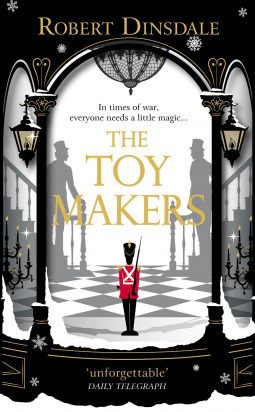
The Toymakers by Robert Dinsdale
Published by Penguin Books/Del Rey, February 2018. Review copy received.
320 pages
ISBN: 978-1785036347
Review by Mark Yon